Tuesday, November 22, 2011

A Plump and Perky Turkey

A Plump and Perky Turkey
by Teresa Bateman
illustrated by Jeff Shelly

Ages 4-8

Publisher: Marshall Cavendish Corporation

Stories told in rhyme have a charm and allure that is hard to miss. A Plump and Perky Turkey is one such which, despite its simple story line, managed to put us in a Read->Laugh-along->Repeat cycle.

The people in Squawk Valley
were downhearted and depressed.
Thanksgiving was approaching,
but without its special guest.


Special guest? Why, the turkey, of course!

Far and wide and long and hard they search but not one single turkey was to be found.

But then, Ebenezer Beezer has an idea: why not let the turkey find them instead? And that is what they set out to do. A Squawk Valley Art Show with a turkey theme.

An ad is circulated: Model Wanted for the Art Show.

Why, even turkeys understand
(as everybody knows)
you can't make turkey art
without a turkey there to pose.


None respond, except for silly old Pete, the Plump and Perky, Clever and Cocky.

With a proud and jaunty gobble,
he gave out a hearty cry—
"A plump and perky turkey?
Well, I'm sure I qualify."


He is hired without delay and put to work right away posing for the artsy-craftsy folk to make their turkey art.

They make turkeys out of spuds,
and out of clay and out of rope.
They made turkeys out of oatmeal,
and out of paper, out of soap.


When it is time for Pete to judge the Pete-inspired art, the salivating people exult at having trapped the hapless bird. He studies each work of art as the crowd close in and cheer; he stops for a closer look and then he... disappears!

How? you ask. Well, since I believe it is cruel to leave the reader hanging (esp., if they cannot get their hands on the book easily), here's what Pete did:
The room was full of turkeys,
in a wall-to-wall collage.
For a clever bird like Pete
it was a perfect camouflage.


And manages to escape.

Needless to say, the people of Squawk Valley are certainly disappointed. Crashed are their hopes to relish a roast turkey. But, being pragmatic folk, they agree when Beezer says breezily:
Right now, at least I'm thankful
that we still have shredded wheat."


Turkeys are notorious for lack of smartness, sometimes even to their own detriment. The story puts an interesting twist on this fact. And why cannot they be found around Thanksgiving in Squawk Valley? Well, being clever flightless birds, they gather in groups, hop on hot air balloons and head to warmer shores come autumn.

The illustrations by Jeff Shelly are silly, comical, expressive and busy. The beautiful oranges and browns capture the autumn in the air.

The catchy lilt and rhythm, the double-trickery, the illustrations, and the autumn cheeriness of the setting all have added up to a merry read-aloud favorite.

Labels: , , , , , ,

Thursday, November 17, 2011

Six from the 6 yo (that vaulted into our Wish List)

Of all the books that came our way in October, selecting just six of the books the six year old and I liked best sure was tough. Only restriction was that the six short-listed ones must be picture books (we will do a separate chapter books list) and something Ana enjoyed reading more than once and would love to share with her friends.

Why six and only six books? Well, for no reason other than that I like the sound of "Six from the Six Year Old" to go with "Three from the Three Year Old" posted earlier.

And, we did find more than six books we liked that I want to share here. At another time. In a separate post. Mostly non-fiction, plus a few delightful chapter books.

It wasn't a surprise to note that four of the six books showcased poetry - Cat Poems, Poetrees, Mirror, Mirror, and Around the World on Eighty Legs.

However, Hooray for Inventors! was a surprise for me. Something about the format and the presentation of tidbits of facts about famous inventors and their inventions seems to have impressed the six yo.

A Horse in the House is one of those books that makes one wonder about the animals and question our assumption that they are just dumb beasts (or that we humans are intellectually well-endowed).

Sometimes we hit a dry patch for weeks and none of the books we randomly bring home from the library stirs us even remotely. Sometimes even the books I placed on hold having read rave reviews about fail to resonate with us. And of course, sometimes there are those books that I love absolutely and want the kids to like them but they were totally unimpressed.

I think we got lucky that many of these wonderful books landed in our house at the same time, somehow cosmically arranged, to help us share it here.

I would've loved to dedicate individual posts to each of these. Maybe I will at Saffron Tree.

Here they are, in no particular order, the six books that not only caught the six year old's attention over the last month's reads, but impressed me tremendously!


Poetrees
by Douglas Florian

This book is ripe with poetrees,
They're grown to educate and please.
You'll see a cedar,
Oak tree too.
Birch and banyan,
Pine and yew,
Palm and gum
And willow tree,
Plus more you'll love tree-mendously!


And true to its promise, Poetrees offers seed-sized lessons about the mighty trees. The font spacing and arrangement of text on some of the poems like The Seed, Tree Rings and Roots - reminded me of the concrete poems we've read (Janeczko's A Poke in the I comes to mind).

Some of the words have been spelled creatively to rhyme and I had fun discovering it with Ana. For example in Tree Rings, "his-tree" at first baffled her but as we replaced it with "history" it made sense. Plus, we learnt about Heartwood and Sapwood. Two things we didn't know before we read this particular poem.

Imagine a background zoomed in on the tree rings, with the text going around in a circle along one of the rings depicted.

Tree Rings:
Tree rings show how trees grow. Wide rings: fast growth. Narrow rings: slow. Heartwood: dead wood. Sapwood: living. A tree's true his-tree free for the giving.

The large format book has huge double-page illustrations for each poem, in portrait orientation (rather than the usual landscape) so that we open the page and hold it up vertically to read and appreciate it in full.

And when I read, "Each poem is printed on a vertical double-page spread illustrated with mixed-media artwork in gouache, watercolor, colored pencil, rubber stamps, oil pastels, and collage on brown paper bags", I was doubly awed by what an interesting canvas the brown paper bag made.

Glossatree (Glossary) at the back of the book provides more information on each tree.


Around the World on Eighty Legs: Animal Poems
by Amy Gibson
illustrated by Daniel Salmieri

From Far Far North to Down Under and Out Back, we travel the world and discover the various animals, some thriving, some extinct. All in charming lilting rhyming verse.

Some are short little verses, some are multi-stanza poems, but they all bring out a distinguishing feature about the animal in an unforgettable way.

Anaconda:
Although Anaconda is fond of a hug,
to my liking, his hug is a little too snug —
And a little too strong, and a little too long,
and that's why when I see him, I hurry along.


The illustration for this poem shows a fairly devious-looking anaconda wrapped tightly around a sign that reads "Free Hugs".

We learn about Auk (extinct), Skua, Guillemot (and its wedge-shaped eggs), Proboscis Monkey, Pangolin, Slow Loris, Takin (something she had learnt about thanks to D's Bhutan trip a few years ago), Goanna (thanks to Steve Lattanzi's Goanna Joanna), and even tiny Krill, among other regulars, of course.

Auk:
When moved to talk,
the awkward auk
lets out an awful,
raucous squawk—

No dainty squeak,
no piercing shriek,
no chilling screech
slips past his beak...

(and a couple more verses that reiterate the squawk of the auk)

The illustrations by Daniel Salmieri, combining watercolor, gouache and colored-pencil, complement the text well and are laced with humor and lightness.

The "Menagerie of Facts" located at the back of the book lists the animals alphabetically with brief notes about them. [Amy Gibson's site has resources for teachers]

Much like Polar Bear, Arctic Hare by Eileen Spinelli, this is a book I'd love to have on my bookshelf. It is delightful and informative, with simple colorful illustrations that lean on the funny side. There's something in the book each for the budding writer, the curious young zoologist, the quirky goofball, and the seasoned adult.


Mirror, Mirror: A Book of Reversible Verses
by Marilyn Singer
illustrated by Josée Masse

Fairy Tales. There is always something new to discover - a new perspective, an interesting what-if, a hidden agenda... We never tire of them.

Mirror, Mirror takes some of the classic fairy tales and turns them upside down. Literally. In breathtakingly refreshing, clever, and unique reversible verses.

Isn't
this
a fairy tale?
A fairy tale
this
isn't...

Write a short verse. Read it in reverse, line-by-line, with perhaps change in punctuation. Does it make sense? If so, does it convey the same idea from a different perspective, an opposite perspective? Then you have a reverso poem.

Sleeping Beauty, Red Riding Hood, Goldilocks and the Three Bears, Cinderella, Princess and the Frog, Hansel and Gretel, Rapunzel... there are two sides to every story.

Picture a larger than life wolf camouflaged among the trees in the woods in the background. Now imagine him wearing a snazzy suit coat and a hat, lumbering on all fours. Slavering jaw. Front paw raised in motion. Glaring... glaring at the little girl in the foreground. A little girl wearing a red hooded cape. Popping berries into her mouth. One leg kicked high behind her suggesting skipping motion while the basket in her hand swings jauntily. All in bright colors of teal and green and brown and red and yellow, a brilliant blend of warm and cool colors.

In the Hood

In my hood,
skipping through the wood,
carrying a basket,
picking berries to eat —
juicy and sweet
what a treat!
But a girl
musn't dawdle.
After all, Grandma's waiting.

After all, Grandma's waiting,
mustn't dawdle...
but a girl!
What a treat —
juicy and sweet,
picking berries to eat,
carrying a basket,
skipping through the wood
in my 'hood.

Illustrations by Josée Masse are bold, bright and gorgeous, cleverly bringing out the two perspectives of the reverso poems.

The six year old read it over and over. To hear the "yeah, I get it, mama!" after every poem that clicked was divine music to my ears. We read it together, discovering the perspectives. I loved reading this aloud to her as I could make dramatic pauses to bring out the differences that the same lines in reverse order presents.

This has become one of my all-time favorite books! (Nana, if you are reading this, we would like to add this to the Wish List)!

[Here's an interview with author Marilyn Singer about her creative process for this book].


Cat Poems
by Dave Crawley
illustrated by Tamara Petrosino

The two cats we adopted as tiny kittens nearly a decade ago are quite a source of entertainment and education for the kids at home.

Plus, of course, an assorted bunch of neighborhood cats stop by as often as they can as I am a soft-touch - I end up feeding them. Not just leftovers or cold milk that the kids didn't finish, but toasty warm milk - warmed up just for them now that it is winter - as soon as I spot them pawing the back door.

Which is all to say that we love cats. Cats are right up there with Horses, Ana's first favorite in the mammalia. So, this book of cat poems easily amused her.

The illustrations are funny and charming, complementing the poems well. Front and back inside covers have illustrations of the various popular variety of cats from Persian to Manx, Ragdoll to Siamese, Himalayan to American Shorthair (which is what our two kitties are, I think).

However, when she got past poring over the inside front cover, she still took her time over every poem, presented one per page - some short, some long, some in cartoon style panels and some as a sweet little story. The book seems like fitting kid-size tribute to these much misunderstood creatures.

Don't ever try to wash a cat.
It simply doesn't work.
If you should put her in the tub,
the cat will go berserk.


So true. And yet, until Ana actually tried to get one of our kitties in her bath, she did not know this. And since she has done it, she laughed out loud at this poem and and accompanying illustration.

Non-cat-lovers might be inclined to give this book a miss, but, the poems beautifully showcase the idiosyncrasies of cats, the fiercely proud and selfish yet cuddly and affectionate nature they choose to exhibit, and yet always manage to bring warmth into the people they live with.


Hooray for Inventors!
by Marcia Williams

From Gutenberg's Movable Type to Marconi's Radio, from Wright Borthers' Flying Machine to Thomas Edison's Light Bulb, the book is packed with information presented in a child-friendly cartoon format with colorful panels. The illustrations with conversations lean towards the comical, but each panel has the facts progressing along like a story.

Thanks to My Brother's Flying Machine we had read nearly a year ago, Ana enjoyed Wilbur and Orville Wright and their Fabulous Flying Machine section very much.

I found the Owl conversations around the edges on the borders of each page to be quite distracting, but Ana found them silly and entertaining. [Author's website is laid out much like the pages of her book - busy border, lots of color, conversational asides]

Back of the book has a page dedicated to Women Inventors, many of whom I am ashamed to admit, I had not heard of before. And finally in My Favorite Inventors Take A Bow section we learn about the author's favorite inventors.

This is not a book that can be read in a hurry. And not just once. It has to be consumed in small doses, maybe focusing on one invention/inventor at a time. A nice book to have handy for the curious mind.


A Horse in the House
and Other Strange But True Animal Stories
by Gail Ablow
illustrated by Kathy Osborn

Gail Ablow, an award-winning broadcast journalist shifted gears to present this collection of news stories about Animals (and Humans) Behaving Atypically. Facts from the news are spun into short one-page stories that are both amusing and outlandish.

The Donkey Wedding apparently took place in Magadi, a village near Bangalore, India, to invite the Water God Varuna to shower down rains to their drought-stricken place.

Eye-glasses for the near-sighted greyhound, an antenna implanted in a Secret Agent Acoustic Kitty's tail to transmit sounds as soft whispers, the now-famous relationship between Owen the baby hippo and Mzee ("old man" in Swahili) an old tortoise...

Each story is crisply told, peppered with just enough humor and drama to fascinate a six year old.

The illustrations by Kathy Osborn are vivid yet rather surreal, bold yet humorous.

Author's note at the back also lists the references to the news stories in the various publications that inspired this book.

A quirky book for the young reader who loves the bizarre as much as sugar and spice and everything nice.

[image source: amazon.com, and where possible from author/illustrator websites]
Labels: , , , , , , , , ,

Friday, September 16, 2011

Assorted Half Dozen Books The 3 Year Old Enjoyed

Every once in a while I write a cluster post of books that the kids enjoyed. Sometimes they are a collection of books on a particular topic, sometimes just a random set of recent reads, typically grouping Ana's separately from Og's favorites, considering their age/development and interests.

As always, some books are spectacular and take my breath away, inspiring me and leaving me in awe of the author/illustrator - even as a jaded adult. Some books are just fine, I can see why kids like it. Some books of course, I'd rather not worry about too much.

The six books listed here are Og's recent favorites, not particularly because they are special to him, but just that he liked reading them over and over at bedtime for the last few weeks. I liked a few of them (the animal ones) very much for the illustrations, simple text, and the way it lead into deeper conversations.

Three of the six collected here are animal books and three are about machines/construction/train/bridge and such things that I am yet to start feeling excited about :)

  1. Loon Baby
    Molly Beth Griffin
    illustrated by Anne Hunter

    Thanks to Lang Elliott's Songs of the Wild Birds, the Common Loon is a household name even if none of us has seen one face to face. Perhaps that's a reason why Oggie liked the Loon Baby book.

    A baby loon wades around with his mother who usually dives down to bring him back some food. Once, she dives and doesn't resurface for an unusually long time, which gets the baby loon very worried.

    He wanders here and there looking for her, getting lost in the process. When he must've felt completely abandoned and helpless, of course, the mother Loon finds him and takes him under her wing, safe and sound as always.

    The illustrations are gorgeous (sample at Anne Hunter's studio). The calm blueness of the watery dwelling is idyllic. The panic and rush of emotion when the baby fears he is lost is brought out beautifully well.

    The text, crisp and simple, flows easily for read-aloud sessions. There is plenty of opportunity to talk about what the loon could have done differently when he didn't see his mother come back when he expected her to.


  2. Puffling
    by Margaret Wild
    illustrated by Julie Vivas

    Atlantic Puffin became a favorite, again, thanks to Lang Elliott's Songs of the Wild Birds - it had the most surprising bird call which sounds like the whirring of a chainsaw (audio available here).

    A baby puffin is eager to go out on his own. His loving parents, Big Stripy Beak and Long Black Feather, tell him, "When you are strong enough and tall enough and brave enough, you'll leave the burrow all by yourself". Meanwhile, they feed him, care for him and teach him what to expect when the day comes.

    Am I brave enough? Am I strong enough? the puffling wonders as he grows impatient waiting for the day when he can venture forth independently.

    The illustrations are beautiful. Puffin is certainly an interesting-looking bird with bright beak and black/white body coloring ("like a toucan and penguin, mama"). The illustrations bring out not just these striking features of the mature birds, but also the fluffy softness of the baby puffin.

    Not surprisingly, very rarely has a picture book captured us minus the gorgeous pictures. Sort of antithetic to have a picture book with humdrum pictures, isn't it?

    Another wonderful book that opens up plenty of things to talk about. When Oggie wonders whether he is ready to drive a backhoe or climb a ladder to the attic by himself, it is nice to quote the puffling's anxiety and how it all works out for him when he is just ready to do all the things he has learned to do.


  3. Chameleon, Chameleon
    Joy Cowley (Author)
    Nic Bishop (Illustrator)

    Madagascar Panther Chameleon.

    Can't say it without feeling a certain something. They are colorful and strange-looking.

    Colour Colour Kamini was perhaps Og's first introduction to chameleons as we had it handy in our bookshelf after a recent trip to India back in 2009. Since then he has liked chameleons and we've read a few fiction and non-fiction about these creatures, including well-beloved Eric Carle's The Mixed-up Chameleon.

    This is a simple non-fiction photo book with a real-life story unfolding through the pictures. A male Madagascar Panther Chameleon wanders around looking for food and enters the territory of a defensive female. Through his friendly body language he convinces her that he is not a threat and she lets him in.

    Therein ends the story. Nothing is mentioned of mating or procreation or life cycle. Just a simple episodic a-day-in-the-life-of style narration. The photographs are awesome. There are some notes at the back about how the photos were taken.


  4. The Bridge Is Up!
    Babs Bell Hajdusiewicz
    illustrated by Rob Hefferan

    A very simple book that excited the resident 3 yo. It is about a draw bridge that is up so one by one as vehicles/animals come in they have to wait to go across. Then, of course, the bridge comes down, and nobody has to wait anymore.

    The cumulative and repetitive aspect is always fun - a bus waits; a car comes, so the car and the bus wait; then a bike comes, now the bus, the car and the bike wait... and so on. The illustrations have a certain kid-appeal, simplistic and funny.

    Our city is blessed with many bridges and Og loves going over them when we go about town. We even have draw bridges and I've waited at times when it was up during the rush hour morning commute. So, it was not surprising that Oggie chose to bring this book home from the library, after I read it to him once when we were there.

    (Link to an author interview)


  5. My Truck is Stuck!
    by Kevin Lewis
    illustrated by Daniel Kirk

    What's not to love about dogs and dump trucks? Better yet dogs driving dump trucks!

    As they truck along, two dogs find their truck's wheel stuck in a pothole. One by one other vehicles come in to help pull it out but without success until who should arrive? The Tow-Truck!

    All's well that ends well and everybody is on their way, happy and moving along. There is a sub-story as well for the observant reader where the gophers who dig the hole make off with the dump truck's load of bones. Perhaps that was their intention in digging the hole?

    The rhyming text and child-friendly illustrations made this a favorite bedtime read.


  6. I am a Backhoe
    Anna Grossnickle Hines

    Bold color illustrations, with a little boy as the protagonist, digging, dumping, rolling and scraping, pretending to be the machines he so loves to play with and read about, this book was much-enjoyed at bedtime, and otherwise.

    I liked that it inspired imitation and movement rather than passive listening - it was nice to see the little arms make the scoop and dig motions, his whole body rolling on the floor like a roller and so on... the rhyming text was easy to read along.

    I dig my hand into the sand, my scooper hand.
    Dig. Dig. Dig. Lift, turn, tip. I am . . . a backhoe.


[image sources: us.macmillan.com, Molly Beth Griffin's website, wiseowlfactory.com, goodreads.com, barnesandnoble.com]

Labels: , , ,

Thursday, September 15, 2011

What is God?

What is God?
by Etan Boritzer
illustrted by Robbie Marantz

Published by Firefly books

Ages 6-12 yrs

I had earmarked this book about year ago from CROCUS 2010, at Saffron Tree, a Children's Book Reviews Repository that I steadfastly support and of course contribute reviews to.

I wanted to wait till Ana was ready to read it. And, from the explosion in her curiosity and thirst for understanding her world that happened over summer, she seemed ready to me. So, we read it recently.

What is God? is not an easy question to answer.

Philosophers and theologians through the ages have tried to answer this question.

Maybe we can only feel God
Like we can feel love
Or like we can feel happy or sad.


It is an amazing book. No matter what faith, belief, religion one is affiliated with, this book addresses the general curiosity children have about God.

Maybe God is an eternal mystery.
Eternal means forever and ever.
And a mystery is like a big puzzle,
with lots of pieces you have to fit together.


And whether one believes in God or not, at some point children do ask, "What is God?" And, so did Ana. Especially after the mythological tales we've read on and off be it Indian, Norse or Greek.

The book flows gently and purposefully from general to specifics, exploring what religion is and what some great teachers have passed along to us over the years, what the holy books of various religions can offer.

There are many ways to talk about God.
Does that mean that everything
That everybody ever says about God is right?
Does that mean that God is everything?


Questions like these in the book made Ana think. And before we read further, she tried to answer some of them herself.

If everything is God,
Then I am God,
You are God,
All of us are God!


This made her wonder even more about the concept. How can I be God? I am not God, am I? Are you God, mama? which led to What do you believe, mama?, which opened up a doorway for me to offer something from my cultural upbringing, something my parents taught me, something that states a similar idea in Sanskrit, Aham Brahmasmi, about the Cosmic Connection.

So if you really want to feel God,
You can close your eyes now,
And listen to your breath go slowly in and out,
And think how you are connected to everything,
Even if you are not touching everything.


The book is written in an easy style that did not overwhelm the resident 6 year old, that made me comfortable reading it with her and even quite grateful that such a profound topic was tackled with care and thoughtfulness, with universalist views towards peaceful co-existence without being dismissive about the major religions of the world. This a wonderful book to have in the home library so kids can reach for it anytime.

Labels: , , , ,

Friday, September 02, 2011

The Absent-minded Toad


The Absent-minded Toad
by Javier Rondón
illustrated by Marcela Cabrera
translated by Kathryn Corbett

Ages 2 and up

This book has been a firm favorite in our bookshelf (Thanks, Nana!) for the past three years or so and I realized I haven't shared it here.

Originally published in Spanish as El Sapo distraído, this English translation The Absent-minded Toad is pretty charming and simple with lilting text just under 200 words.

A toad, dressed for the market, armed with his list, sets out jauntily. He gets so caught up in the happenings around him that when he finally reaches back home he realizes he has not bought a single thing from his list.

What makes the book impressive for me are the gorgeous colorful illustrations. The sort of illustrations that kids at home pored over by themselves even if nobody was reading the book to them. The sort of deceptively simple and subtle yet humorous paintings that make me dream about picking up my brush and imitating the style even if I have no clue where to start.

There is a lot of action what with vendors at the busy market peddling their wares and the book manages to capture and present it all via soft but bright watercolors and mildly humorous lyrical text.

After many repeat reads over the years, with Ana and with Og, I am glad I didn't emulate the toad and completely forget to share this book here forever. This book is a keeper in our shelves.


Labels: , , , ,

Friday, August 26, 2011

Monkey Business, Ballroom Bonanza, Jungle Drums


Monkey Business
by Wallace Edwards


Jungle Drums
by Graeme base


Ballroom Bonanza
A Hidden Pictures ABC Book
by Nina Rycroft


What do these books have in common?

According to my 6 year old daughter, they are the best kind of books I like to read sometimes...

Why?

Because they have hidden pictures that we have to discover, and they are so fun!

Wallace Edwards is not a stranger in our house. Thanks to Nana, who added Edwards' books to our bookshelf over the years, Alphabeasts is much-loved and rather popular in our house, and not just with the kids.

Painted Circus by Edwards is another big hit with Ana as it is full of optical illusions. I remember reading about how Edwards plays with language and art to inspire kids to think differently.

Monkey Business was Ana's top-favorite for about a week, reaching for it every night at bedtime, where finding the monkey hidden in each page was as much fun as poring over the illustrations and figuring out the meaning of the text, not just literally.

IDIOM: a group of words whose meaning cannot be understood from the meaning of the individual words; an expression, peculiar to specific language, that cannot be translated literally.

Thus starts this gorgeously illustrated book full of visual pun and action. Each page presents an idiom in a simple sentence, but with rich yet comical illustrations that easily amused and entertained the resident 6-yo.

"Not again", sighed Owen. "It isn't easy being a bull in a china shop." shows a well-dressed gentleman of a bull with a ring at the end of his nose, one shoe untied, his cane and horns hooked into assorted urns and vases on the shelves, his hand stuck in a rather ornate jug, all entangled without intention.

Phil had no formal musical training, so he learned to play by ear. shows a droopy-eared long-faced dog, Phil, sitting on the sidewalk with two bones in his tip jar, playing a violin with his two long ears while two little mice sit in rapt attention cheering him, presumably.

I better leave the rest for the readers to experience first-hand. The book gave me the opportunity to introduce these idioms and phrases to Ana, explain the meaning easily, and let her connect the dots.

Incidentally, her first encounter with metaphors and phrases which don't mean much if we add up the meaning of the individual words themselves but have become part of our speech by what they convey in toto, was through the book Butterflies in my Stomach and Other School Hazards by Serge Bloch. "I have butterflies in my stomach", "I don't want to open that can of worms" and such might not mean much initially, but, with the stark yet comical pen-and-ink drawings Bloch has brought out the literal meaning of the words along with the emotions they convey.

Moving on, Jungle Drums by Graeme Base came into our lives after our fascination with Water Hole. By now, children around the world are probably familiar with the Swahili words for the animals of the savanna - Simba (Lion), Punda Milia (Striped Donkey aka Zebra), Kifuru (Rhino), Chui (Leopard) and Tembo (Elephant).

Jungle Drums is about a tiny warthog (Ngiri) who gets teased all the time and wants it to stop. Nyumbu (Wildebeest) gives him a set of magical bongos telling him that it will make his wishes come true. "Just remember, wishes can come true, but not always as you expect.", she says with a twinkle in her eye.

The unexpected happenings make up the rest of the book, until things get back to normal and Ngiri is not teased anymore.

Each page has Nyumbu hidden in the picture. Spotting her is the extra challenge in this book. I admit, I failed miserably. A wisp of a ghost-like projection somewhere in the far horizon, a suggestion of a face hidden among the bushes... it takes a keen eye to spot the wildebeest in each page. Ana found them all, rather rubbing it in my face, inviting me to spot them with her and saying helpful things like, "Oh this one jumps out at you, it is too easy Mama, come on don't take so long!"

The illustrations certainly have the Graeme Base touch, colorful, lush, imaginative. Ana's favorite (and mine) was the page where the Other Animals lose their stunning spots and striking stripes, impressive horns and curly trunks but the warthogs acquire them.

Ballroom Bonanaza by Nina Rycroft is a random pick from the library, after noticing how much Ana liked books with hidden visual images. And it turned out to be an instant hit.

In the famous town of Blackpool,
Each October, you will find
Gathered in the Tower Ballroom
Animals of every kind.

It's a dancing competition.
Who will win the prize this year?
Let us watch as keen contenders
Alphabetically appear.


Thus starts this book that runs from A to Z showcasing affluent alpacas, bears in boleros all the way to zebras who can dance the zapateado. Of course, as with all abecedary books, I am curious about what represents u, w, x and the book had a clever solution.

U is an ungainly letter,
lacking possibilities:
Hence the jitterbugging ugwumps.
(We have just invented these.)


The front and back inside covers show pictures of 26 instruments like kettledrum, guiro, castanets along with bassoon, cello, violin, saxophone and such, each of which is hidden in the pictures on the pages of the book. The challenge is to spot the instrument that completely blends with the action and props in the picture.

In addition, most letters introduce a dance form: camels doing the conga, donkeys demonstrating the disco, elephants belly-dancing, flamingos dancing the flamenco and so on with swans doing the samba, turkeys doing the twist. I learnt about few new dances through this book: Zapateado, Watusi, Nutbush and promptly looked them up to share with Ana.

Oggie was certainly fascinated with Jungle Drums, choosing it often for bedtime read, but was not quite ready to delve into the joys that Monkey Business and Ballroom Bonanza had to offer. After over a year in our bookshelf, Ana just now seemed ready for these books with her explosion in language skills over summer.

And, thanks to these books, Ana took her bland-old coloring activity to a new level. Be it Alice or Cheshire Cat, Asterix or Unicorn, rather than just coloring them in, she started adding a smiley face/flower/star with a dark marker somewhere in the picture, and colored over it with crayons, then challenged me to find the hidden picture. As a natural progression, she started adding these touches to drawings she does as well.

I am sure there are many more such treasures. I remember Look-Alikes Around the World by Joan Steiner and similar books a while back that we liked, which presented creative images with hidden objects to find. Books like these seem to have a universal appeal, regardless of age.

[image source: amazon.com]

Cross-posted at Saffron Tree

Labels: , , , , , , ,

Monday, July 11, 2011

Hooray for Amanda and Her Alligator

Hooray for Amanda and Her Alligator
by Mo Willems

Much like Elephant and Piggie books the kids liked, it seems like Amanda and Her Alligator collection has tickled them enough to urge me to share it here.

Little girl Amanda has a toy alligator, as the title suggests. And the conversations and interactions between them make up the 6½ stories. It is an early reader chapter book presented like a picture book, making the reading transition easier and fun.

But, as with Willem's other books, it is the pared down simplicity of words and images as well as the active imagination that made this book one of my recent favorite reads for the children.

The continual message of reading is subtly yet notably brought out by the first statement in each story.

Amanda was at her library getting her books for the week.
Amanda was reading her new library book How to Raise a Tiger when her alligator snuck into the room
Amanda was reading her new library book You Can Make It Yourself: jet Packs! when she noticed her alligator chewing on her head.

Boos, surprises, and tickles, how can kids not respond to these universal themes. The heart-warming part for all of us is when Amanda says the sweetest thing when alligator finds out that he was in the Sale bucket at the store because nobody wanted to buy him:
No one wanted to buy you because they knew you were meant to be my best friend.

[image source: Mo Willems Stuff]

Labels: , , , , ,

Thursday, June 23, 2011

Measuring Penny

Measuring Penny
by Loreen Leedy

Ana has seen me use my "Inch-Tape", aka measuring tape, a lot when I am sewing; especially when I am sewing something for her. D uses his around the house for the various home improvement projects. So, Ana had a fairly rough/vague idea of "measuring" things, for whatever purposes.

So, when I came across Measuring Penny by Loreen Leedy, whose informational books are widely used in many mainstream classrooms, I decided to borrow it for Ana, even if she doesn't get every concept therein.

My name is Lisa, and my teacher says our next big homework project is to measure something.

Thus starts the book which lays out the basics of measurement - how to measure, what to measure, how to record the measurements - i.e., units, standard and non-standard, comparison.

Lisa decided to measure her pet Boston terrier, Penny. And compare Penny's measurements with other dogs in the neighborhood. She uses the standard ruler, as well as one of Penny's dog biscuits as the non-standard unit for recording. Lisa measures the length of the noses of the dogs, their height when they sit, how high they can jump for which she uses herself as the unit - Penny jumps waist-high...

She also measures the amount of time she spends taking care of Penny, times for Penny's walking trips. Lisa even makes up a "Penny Thermometer" scale of measurement with drawings showing the outside temperature based on Penny's looks and demeanor.

Lisa also measures the Cost of having Penny, in dollar amount. And ends by stating "...she's worth a lot." by showing the Value of having Penny.

While many of the concepts in the book eluded her at this time, being just a kindergartner, the book did inspire Ana to measure things around the house, making up her own non-standard units like the length of her pencil: our pet kitty is 3 pencils long, his tail is more than 1 pencil long but less then 2 pencils long... and so on.

The author's website has resources and project ideas, some downloadable material.

I made a note to revisit this book after first grade to see where we are. Meanwhile, Ana enjoyed Penny and now wants a Boston terrier for a pet. This from a girl who is mortally afraid of dogs of any kind - even itty-bitty chihuahuas.

[image source: Open wide, Look inside ]

Labels: , , , , ,

Monday, June 20, 2011

The Crows of Pearblossom

The Crows of Pearblossom
by Aldous Huxley
illustrated by Sophie Blackall

Ages 4-8

I am glad my dad brought this wonderful book to my attention recently. Aldous Huxley whose novel Brave New World probably was a must-read for my generation, is easily a well-known figure in the literary world. The Crows of Pearblossom is a children's story he wrote, in 1944, for his niece, Olivia, as a Christmas present. Olivia's family at that time lived in Pearblossom, a town near where Huxleys lived circa 1937.

The original manuscript unfortunately was destroyed in a fire. By happy chance, the Huxleys neighbors, Mr. and Mrs. Yost (the tall poplar in which Old Man Owl lived belonged to them), had a copy of the story, which remained unpublished for nearly two decades. In 1967, it was released with Barbara Cooney's (whose Mrs. Rumphius is well-loved in our bookshelf) black and white drawings, which edition, as far as I searched, is out of print.

Olivia revived the story in full-color splendor with Sophie Blackall's detailed and brilliant illustrations. Abrams Books for Young Readers republished The Crows of Pearblossom in 2011 in picture book format.

Mr. and Mrs. Crow lived in a cottonwood tree at Pearblossom. A very proper couple, they went about their business with righteous dignity.

Every day Mrs. Crow laid an egg. When she returned from her afternoon shopping trip she always found the egg gone. This worried and annoyed her so, naturally.

A rattlesnake lived in a hole in a cottonwood tree at Pearblossom. Every day, he woke up punctually at half past three, slithered up the tree and breakfasted on a fresh egg in a crow's nest. Then, he crawled back to his hole and went back to sleep.

By now if you have quickly surmised that the big old rattlesnake and The Crows shared the same tree, you are correct.

And, as is inevitable, one day Mrs. Crow comes back early and catches the snake swallowing her egg whole, shell and all, and gets rightfully indignant. She worries Mr. Crow into teaching the rattlesnake proper manners or better yet, just kill him.

Mr. Crow being a gentleman states that her idea is not very good, and tells Mrs. Crow that he will consult with Old Man Owl who is a thinker.

Together with Old Man Owl, how Mr. Crow teaches the rattlesnake a lesson makes up the rest of the story, which is best enjoyed directly from the book.

The illustrations are delightful and charming. The inside back-flap notes that the illustrator's father once arrived at a party as Aldous Huxley was leaving. They may or may not have crossed paths in the vestibule.

I first encountered Sophie Blackall in Ivy+Bean books we read last summer. Then, in Wombat Walkabout (Carol Diggory Shields) and then in The Big Red Lollipop (Rukhsana Khan). I found her distinctive style appealing, and for some odd reason reminded me of Alison Jay's, (whose picture books are simply breath-taking with their signature crackle-finish), even though there is nothing much similar.

All's well that ends well in Pearblossom. Of course, as it was written over half a century ago, it is possible that today's conscientious parents might find some aspects of it objectionable. I found nothing terribly unappealing about it and loved reading it to Ana, reserving any sermonizing, opting to open some thoughtful discussions later on.

At the post-reading chat, I casually mentioned, "Poor rattlesnake, he was just hungry and that is what snakes do - find food, eat a bunch, sleep, wake up, eat again. If not Mrs. Crow's egg, he might just find a nearby Mrs. Northern Flicker's eggs."

To which, Ana countered, "I hope the snake learnt his lesson about not eating all of poor Mrs. Crow's eggs. She will never have babies if all her eggs are eaten. The rattlesnake should leave her a few eggs so she can have her babies."

We did agree that the rattlesnake was untangled and released from its agony afterwards, which is not mentioned in the story book, but happened anyway, and that he went about his life in a fair and courteous manner.

[image source: blommi.com]

Labels: , , ,

Thursday, June 09, 2011

Getting to Know Georgia O'Keeffe


The name Georgia O'Keeffe is probably not unfamiliar to many today. Her large arresting flowers in bold colors and immaculate detail is what my mind has come to associate with the name, along with a few now-famous bones.

For the kindergartner in residence, I thought it would be educational and fun to gather a few related books on a chosen topic and read them one after another (interspersed with other books, over a couple of weeks) to make it a sort of study without any pressure or expectation.

And to keep things interesting, I don't tell her the topic in advance. I borrow the books from the library, wait till the short-listed few on a topic are handy, then release them one at a time for Ana to read.

It is a joy to see her connect the related books and point out similarities among them and extract a few essential things from each to form a comprehensive picture.

There are no doubt many wonderful books on any given topic and knowing which ones to choose for the study is not easy. But I don't sweat over it. This is not an end-of-term research paper. This is more to introduce the fact that many books can present the same person/place/thing/animal and yet have an array of information to offer. And, also to reinforce the fact that different books on the same subject do in fact have some common core information.

One such recent study was artist Georgia O'Keeffe.


My Name Is Georgia: A Portrait by Jeanette Winter
by Jeanette Winter

We started with My Name is Georgia. The title was arresting enough and caught Ana's attention.

The book has bold illustrations and simple text. It presents Georgia's life in a condensed and compact way, highlighting her birth, childhood and later years.

But, unlike typical biographies, by selectively quoting Georgia's words directly, the book turns into a first person narration letting us see how the artist saw things. There is an indication of time passing and Georgia growing.

She painted small things large so people would notice them
. This stuck in our head. The book might not be quite engaging in and of its own for the typical picture book audience but it certainly started us off on a good path.


Georgia's Bones
by Jen Bryant
illustrated by Bethanne Anderson

Then, a few days later, she noticed Georgia's Bones strategically placed on her car seat on the ride from school. As she read it, she pointed out, "These are the same bones from that other book, Mama! Is she the same Georgia? She looks different in this book..." Sure enough, this opened up a new door for us to talk about.

The illustrations are beautiful in this book. The double-page with the huge Ram's Head caught Ana's attention.

Text is simple enough for elementary level, combining quotations and third person narration, but is packed with poetry. Talking about Georgia's fascination for bones that she collects from the desert
She didn't know why they pleased her so.
Perhaps it was the quiet way they did their work - the years of being invisible, and then, when everything fell away, they appeared, pure and beautiful.

The book again reinforced a handful of facts about the artist's life. It also brings out the artist's attraction to natural and everyday objects in which she found shapes, and she viewed them in unusual ways.
In the woods around her father's Wisconsin farm, she collected shapes: flowers, leaves, sticks and stones. She put them in her pocket and took them home.
"Such common objects," said her brother.
"Why do you bother?" asked her sister.
"Because they please me," Georgia replied.

However, it also showed how Georgia looked at things differently.
The holes in the bones pleased Georgia, too.
They made frames and windows through which she glimpsed a piece of the sky,
or a tiny corner of a mountain.

The book ends with Georgia painting the bones in her New York City studio.


Through Georgia's Eyes
by Rachel Victoria Rodriguez
illustrated by Julie Paschkis
Then came Through Georgia's Eyes, which sneaked into the stack of few books Ana had chosen to read at bedtime one night.

Again, she wondered why Georgia looked different in the pictures in this book, compared to the other two. She noticed that the book talks about the same yearning Georgia has for the wide open spaces, the same night sky she sees over open desert, the same determination at 12 when she declares 'I want to be an artist', and the attraction for common objects around her.
Season melts into season on her family farm. Georgia struggles to show on paper what she sees. At twelve she takes painting lessons. She tells her friend, "I am going to be an artist."

This book is in third person narration. The illustrations are beautiful. Ana particularly liked the double-page spread that shows people flitting like butterflies over gigantic flowers that Georgia paints.
Flowers delight her. She paints them as giants. People stop to stare. Georgia's flowers make them feel like tiny butterflies, flitting through the universe of her garden.

The book closes with an invitation to the readers.
Open your eyes...
...and walk along.
See the colors? Hear the shapes singing?
No need to hurry.
Lean in... look closer.


Presenting a biography, knowing which aspects of the illustrious life to showcase, and to do it in a short picture book format sounds like a Herculean task. But the three biographies above (regardless of how accurate they are historically) gave us a good picture of the artist, the person.


Georgia O'Keeffe Museum
Highlights From The Collection
by Barbara Buhler Lynes

To seal it, we looked at the reprints in Georgia O'Keeffe Museum, Highlights From The Collection at the Santa Fe Museum.


Finally, inspired by all that we've read, we did an art project.

Bones, or Landscape, or Flowers? Which one shall we choose?

We settled on flowers.

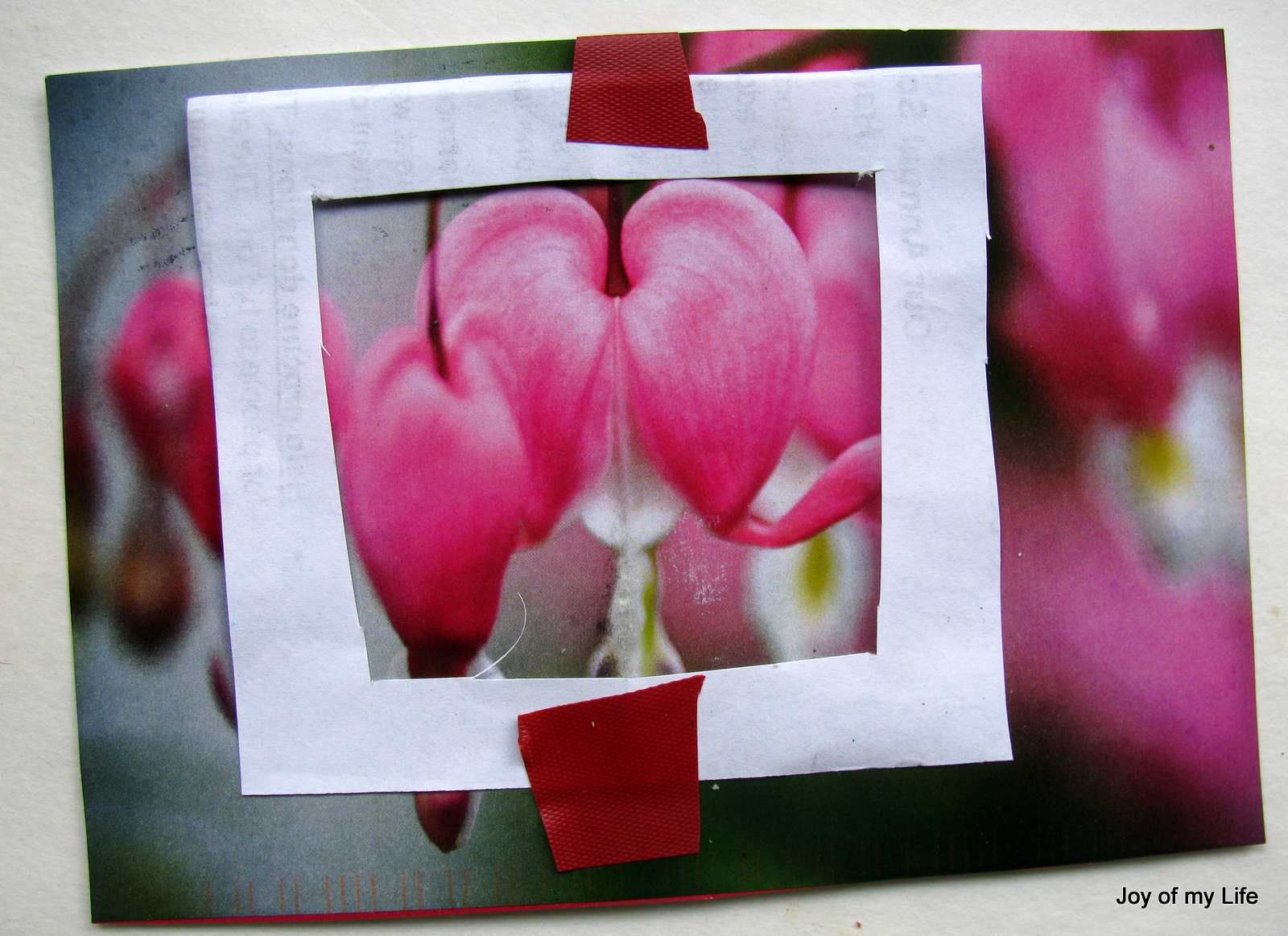
I found an old photograph of the Bleeding Hearts in our garden. I created a small frame to focus on just the details of one flower.


And we sat down side by side. Studied the shapes, light, colors within the small frame. Then, Ana tried her hand at representing what she saw using shapes and color pencils.


[Disclaimer: I am not an artist. I don't even pretend to be one. I am fascinated by artists and creative souls in general. And, I do a lot of art exploration projects with my kids in the hope of educating not just my kids, but myself as well.]

[image sources: goodreads.com, author Jen Bryant's website, author Rachel Rodriguez website, amazon.com, wikipedia]

Labels: , , , , , , , ,

Monday, May 30, 2011

The Cazuela That the Farm Maiden Stirred

The Cazuela That the Farm Maiden Stirred
by Samantha R. Vamos,
illustrated by Rafael Lopez

Ages 4-8

Published by Charlesbridge (Feb 2011)


Sometimes, there is an inexplicable cosmic coincidence that brings things together in our lives, be it as profound as meeting our spouses, or as simple as finding a beautifully illustrated children's book.

I was at the post office a while back and noticed the new set of stamps released recently. Now, going to the P.O. has become a rarity in today's life. And, while there, browsing and finding stamps I want to buy is a luxury. I used to collect stamps and appropriated my dad's ancient collection when I was young, but, between college and moving across continents, all that is lost. I must admit I have a weakness for stamps still, and manage to get most of the commemorative ones for hoarding collecting...

So, it does seem like a mysterious concatenation of circumstances that made me notice the Latin Music Legends set of stamps. While all the names of the legends there were familiar, I was struck by the fact that we had just read about Celia Cruz - book + CD from the library, called Celia Cruz, Queen of Salsa by Veronica Chambers.

But, most of all, Rafael Lopez, the designer of the stamps entered our little world and made it beautiful and bright.

And, that is how we came upon The Cazuela that the Farm Maiden Stirred, and got introduced to Samantha Vamos.

The bilingual book presents a cumulative story, much like This is the House that Jack Built, where we not only follow the progressive unfolding of events, but also learn a bit of Spanish. Each page introduces a new item in English, but on successive pages that item is referred to by the Spanish word, and it gets quite challenging (and fun) to keep up.

We start with the innocuous,
This is the pot that the farm maiden stirred.

Next, we read,
This is the butter that went into the cazuela that the farm maiden stirred..

Then,
This is the goat that churned the cream to make the mantequilla that went into the cazuela that the farm maiden stirred.

There is an underlying reason for everything that happens in this lively sequence: the making of Arroz con Leche, Rice Pudding.

The text flows easily, blending the two languages. The author shares, "As I incorporated Spanish words, the text flowed differently – the words sounded more intimate and tender. The English text with Spanish words woven in resonated because the bilingual manner of speaking reminded me of the way I had heard languages (in addition to English, my father fluently speaks four languages) expressed as a child."

Growing up with 3 different languages, besides English, and studying in English-medium school, I could identify with the author's note about having "bilingual on the brain" as shared in this article. To this day, I constantly "mix" Tamil, Hindi, Malayalam words into my thoughts and internal conversations as I primarily think in English.

The illustrations are breath-taking, vibrant and rather funny. From stark white background on the first 2 or 3 pages as we focus on the cazuela, mantaquilla and cabra, the images get rusty orange and colorful as the day progresses. The cabra with his toque, the gallina with her apron, the burro with his boots all add to the charm.

As artist Rafael Lopez shares in the post Stirring the Pot of Color, "For me color is an expression of my identity, my heritage and I believe it is the most direct route to the emotions of children and families who will turn the pages of my books". It is his bold colors, arresting images and textures that catch the eye, holding us ransom.

Little touches like the smiling sol looking in through the doorway, the gallina laying the eggs while grating the limon as the campesino tends to her... well, just about every single page is incredibly gorgeous, and complements the text well.

Back of the book has Arroz con Leche recipe and Glossary of Spanish Words.

[image source: author Samantha Vamos website]

Labels: , , , , ,

Saturday, May 21, 2011

3-D ABC: A Sculptural Alphabet

3-D ABC: A Sculptural Alphabet by Bob Raczka
3-D ABC: A Sculptural Alphabet
by Bob Raczka

Ages 4-8, All Ages

Publisher: Lerner Publishing (2007)


Despite the 'ABC' in the title, this is not an abecedary book in the ordinary sense. Bob Raczka has brought many great works of art to his readers via the Art Adventures series. In this book, he shows us specific much-recognized works while describing in few simple statements what a sculpture is. Tying it to a letter from the alphabet in each page is incidental, but, elegantly done.

Starting with 'A', we learn that, A sculpture is not always something you can recognize. This kind of sculpture is called abstract, with Obus by Alexander Calder as the accompanying art work.

Each page has a visually stimulating arrangement of art and text, with well-chosen words that helps us understand a little more about this art form.

On the page with Carved American Eagle by John Bellamy, we read the expected E is for Eagle, but also learn that it is a relief: This sculpture can be looked at from just one side. It's called a Relief.

The one that fascinated Og the most was Spoonbridge and Cherry by Claes Oldenburg and Coosje van Bruggen, along with "upside down hanging piano" coming a close second - Concert For Anarchy by Rebecca Horn.

As Raczka notes, "A sculpture can mean different things to different people, or it can mean different things to the same person on different days, because the more you look at a sculpture, the more you see." Thus the author encourages the kids to view and appreciate sculpture without the pre-determined notion of what a sculpture should or does represent.

I learnt about not just sculptures, but also about forms of expression, and it inspired me to look up more about at least these 26 works of art that the author has presented in the book.

Aside: While I am not for age-banding, I do provide publisher's suggested age range for easy sorting/grouping/searching. This book is truly for all ages, especially if one is curious about contemporary art.

[image source: Lerner Books]

Labels: , , , , , ,

Two Blue Jays

Two Blue Jays Rockwell Halsey
Two Blue Jays
by Anne Rockwell
pictures by Megan Halsey

Ages 4-8

Two Blue Jays presents the blue jay life cycle as observed by children when two blue jays settle on a fir tree outside their classroom.

Simple pictures complement the short yet descriptive text. We learn that the male blue jay feeds the female blue jay before they build a nest together. Both take turns in feeding their babies. The father blue jay is fierce and protective and chases away a cat with its characteristic loud squawks when it comes sneaking to the tree. Eventually the baby birds get coaxed into flying out on their own, which they do. With no lesson from parents. Now the nest is just an empty clump of twigs.

I was surprised by the little details Og liked in this book. He liked to state with certainty which of the six identical-looking similar-sized blue jays in the picture were the parents and which were the grown up baby blue jays.

The best part for him, as I gathered, was looking at the various eggs on the inside front cover - Cardinal, Robin, Mockingbird, Chickadee Ruby-Throated Hummingbird, Downy Woodpecker, American Crow, House Sparrow, Northern (Baltimore) Oriole. And then matching them up with the birds on the inside back cover.

Ana found it strange that the baby birds had no feathers at birth and were "not as cute as baby chicks". Cuteness, of course is terribly subjective and totally relative as she usually qualifies her observations with "for me" - i.e., "it is not so cute for me, maybe it is for you".

It also inspires the young to go out and observe and make their own journal about wildlife around them. Now that for the fourth year in a row a pair of Red-shafted Northern Flicker have taken up residence in our backyard tree, the kids and I have been taking notes - how they both cling to the tree trunk and inspect the hole, how one of them goes into the hole and every few minutes peeps out to spit a beakfull of tree out, how one of them flies away and comes back with stuff in its mouth... Ana is planning to make a book out of it this summer.

[image source: artist Megan Halsey's website]

Labels: , , , ,

Friday, May 20, 2011

How Do You Count a Dozen Ducklings?

How Do You Count a Dozen Ducklings?
by In Seon Chae
illustrated by Seung Ha Rew

Ages 4-8

Published by Albert Whitman & Company(2006)

Mama duck lays twelve eggs, and they all hatch just fine to bring us a dozen adorable ducklings, each with their own unique features, expressions and personality. Mama notices there are just way too many for her to count, so, she decides to count them in different ways that doesn't involve going all the way to twelve, and yet can keep track of her dozen ducklings.

So, she sorts them in pairs, six rows of twos. Now she counts up to six and six times two makes twelve.

Then, thinking six is a bit much, she sorts them in threes, four rows of threes. So she just has to count up to four. Four times three is twelve.

Even that seems more than she wants to count up to, so she sorts them in sixes, two rows of sixes. Two times six is twelve.

As we can guess by now, this is quite instructive in grouping, skip counting, factoring, to figure out how many ways can we make twelve. Ana and I used to play something like this with marbles. Start with a small number, like 6 marbles, and see how many ways we can group them. Then move on to 8, then 12. It gets tricky with 3, 5 and 7. But we were just trying to understand the very basics. This exercise possibly also helps notice the Commutative laws of multiplication (and addition).

Anyway, in the story, a hungry wolf who cannot see well, hears Mama duck count to two and thinks, two is not much but is still enough for lunch and tries to catch them. But of course, he doesn't know Mama duck's trick of sorting by sixes and then counting to two. So he is fooled as the twelve ducklings attack him and chase him away, instead of the defenseless two that he was sure of eating.

Og doesn't get anything much about the skip counting, factors and additions yet, but, he liked looking at each of the twelve ducklings - they each have distinctive features like shape of head, hair, facial expression, a whole personality - trying to see who was the line-leader in one arrangement versus the next, who was angry and chasing who, who was up in the air upside down, and who wasn't facing the right way when lined up etc. The illustrations are lively and animated, making it quite entertaining for the little ones.

Originally published in Korea as A Dozen Ducklings Are Too Many in 1999, this book was quite a surprise favorite among our recent reads.

[image source: Albert Whitman Website]

Labels: , , , ,

Thursday, May 12, 2011

Grandfather's Journey


Grandfather's Journey
by Allen Say

Caldecott Medal Book

Ages: 4-8

Houghton Mifflin Books for Children (October 25, 1993)


Allen Say reveals the intense and poignant feelings of longing an immigrant heart brooks with its consuming affinity for the birthplace as well as the adopted homeland.

Chronicling his grandfather's journey from Japan to America at the turn of the century, with breathtaking watercolor illustrations, Allen Say shares a beautiful dilemma in an elegant, compact, and moving way.

Clothed in Western attire, a young Japanese man boards a steamship and sails across the Pacific. When he embarks in America, he continues his journey to explore the new land, learning as much as he can, experiencing the awe-inspiring majesty with the thirst of an explorer. Of all the places he visited, he liked California the best and so settles there. For a while. Soon, the immigrant soul longs for the birthplace.

So he returns to Japan. He gets married, brings his new bride to San Francisco Bay that he calls home. They have a baby girl. But, the dormant longing for the childhood friends and places resurface. He grows restless till he can take it no longer. Then, he packs his family and heads back to his homeland. Once there, surrounded by his old friends and familiar childhood places, his heart seems to fill up with joy.

The baby girl is all grown up now and is married to the man she fell in love with, and soon, the author Allen Say is born. The author grows up with stories of California from his grandfather's journey. A war intervenes when grandfather plans a trip back to California, and somehow circumstances arrange themselves so that grandfather could never make that one last trip to the second home he loved so much.

When the author finally makes his journey to California as an adult, he understands his grandfather's emotions as he undergoes similar emotions himself.

The watercolor illustrations are photoreal, to borrow the only word that comes close to describing them. The faces rarely betray any emotion, mostly appearing sombre and tranquil. Each page has a large portrait with only a crisp sentence or two with carefully controlled words.

Significant events like marriage, new baby are presented incidentally, keeping the focus on this overarching ache for being in two places at once.

Being an immigrant myself, and of the view that geographical boundaries need not be divisive thus fostering exclusivity, I completely identified with, "The funny thing is, the moment I am in one country, I am homesick for the other". Home is where the heart is. And for some of us, the heart refuses to be contained within one arbitrary man-made geographical unit of land.

Tea with Milk is another book by this author that struck a distinct chord in me. Multicultural themes naturally have a special appeal for us at home. Raising bi-cultural children as an immigrant mother, it has been a struggle for me to balance the exposure to the culture I grew up with. While When in Rome be a Roman has been my philosophy, I also feel I owe it to my children to educate them on my side of their origin... but, that train of thought has to wait for another day to gain voice here in my little corner.

We had borrowed the copy that comes with an audio CD of the story. It was quite an experience to read the book a few times first, poring over the images, and then turning out the lights at bed time and listening to the subtly powerful words.

I doubt if my six year old got as much out of it as I did. It seems to me that many of the books that win the Caldecott medal seem to appeal more to the adult mind than the child.

[image source: Houghton Mifflin Books]

Labels: , , , , , ,

Thursday, May 05, 2011

Into the A, B, Sea: An Ocean Alphabet


Into the A, B, Sea: An Ocean Alphabet
by Deborah Lee Rose
illustrations by Steve Jenkins

Ages 0-4

Scholastic Press; 1st edition (September 1, 2000)

There are quite a few abecedary books featuring animals. Our all time favorite is Alphabeasts by master artist Wallace Edwards.

Steve Jenkins is no stranger in our house. His cut-paper collage work has inspired me enough to try a few with my kids. So, it was only a matter of time before I got down to sharing A, B, Sea here.

Swim the ocean waves with me
and dive into the A, B, Sea


Thus starts this oceanic adventure showcasing exquisite sea creatures using simple rhyming sentences. Not just large or cute creatures. There is the much-ignored Barnacles for B and the typically forgotten Zooplankton for Z, making this a useful book for discussing food chain and ecosystems of the sea.

Brief notes at the back of the book add some information about each of the animals.

There is always this irrepressible curiosity in me, even today, to see what is presented for some of my favorite letters - viz., Q, U, X and Z - especially X, in the alphabet books. I'll just have to leave it to you to find out what A, B, Sea offers. Suffice it to say I was eXpecting Xanthareel or even the ubiquitous X-ray fish and found something different.

One of the aspects that attracts me to animal books is the suggestion of movement, of dynamic activity and flux, without clobbering. A, B, Sea offers crisp and beautiful verbs for the animals: Manatees lumber, Rays swoop low, Dolphins spin. The spin part particularly caught our attention since we recently learnt about Spinner dolphins (Stenella longirostris) from A Whale of a Tale!(Cat in the Hat's Learning Library).

The illustrations are breathtaking as we've come to expect from Steve Jenkins' books.

All in all a visually stimulating, informative, delightful book that has scored repeat reads from the pre-schooler every night for over a week now, and has inspired the kindergartner to explore further.

[image source: paperbackswap.com]

Labels: , , , , , , ,

‹Older