Monday, December 05, 2016

The William Hoy Story, Kami and the Yaks

The William Hoy Story
How a Deaf baseball Player Challenged the Game
by Nancy Churnin
illustrated by Jez Tuya

publisher: Albert Whitman and Co., 2016


"They called him Dummy Hoy, but he was nobody's fool. He could steal his way around the bases and score! And while he couldn't hear the cheers, he could sure see them."

Even though by 1817 the first American School for the Deaf was up and active, and the American Sign language (ASL) was adopted from the French Sign Language (FSL), during late 1800s and early 1900s "Dummy" was a common name given to people who were unable to hear or speak.

After William graduated as valedictorian of the Ohio State School for the Deaf, he continued playing baseball while working as a cobbler in between season. He set and broke many baseball records and truly gave his all to the game. By working with the umpires, William helped them develop a number of hand signals that was later adopted as official in baseball.

William was not born deaf, he lost his hearing after a bout of meningitis at a young age. The picture book captures William's lifelong passion for baseball while showing us his upbeat attitude towards life.


Kami and the Yaks
by Andrea Stenn Stryer
illustrated by Bert Dodson

publisher: Bay Otter Press, 2007


While not a true life story, the author shares that this book was inspired by a boy she met while trekking in Mount Everest region of Nepal, who communicated quite well even if he could not speak.

His dad and older brother worked as guides and helpers for mountain climbers, often setting up camp and cooking for the climbers who aimed to summit the mighty Everest.

One fine morning, Kami notices that their beloved yaks have not returned home from their grazing. Kami takes out a whistle one of the climbers had given him, and blew it hard. Even though he could not hear the sound, being deaf, he knew the yaks would hear it and come home. But, when they didn't come home after repeated whistle-calls, he decided to go look for them as his dad and brother were guiding another group of climbers.

Amid rumbling thunder and threat of a blizzard in snow-capped slopes, Kami's resourceful attempt to save a young yak stuck in a crevice and to lead the small herd home safely is told in a strong and uplifting way.

The illustrations are gorgeous; the text projects the urgency and direness of the situation, and we read holding our breath, willing Kami to succeed in bringing some help to these stranded yaks. Which he does. And we heave a big sigh of relief when we see Kami proudly leading the yaks down the mountain, his father and brother assisting him after an arduous rescue.

[image source: multcolib.org]


Labels: , , , , , ,

Sunday, June 19, 2016

6 Picture Book Biographies of Extraordinary Women

Daredevil
The Daring Life of Betty Skelton
by Megan McCarthy

Beautifully rendered story of Betty Skelton's life, this picture book captures her spirit and her personality with humor and authenticity.

Betty was a daredevil all right. The part that affected the kids most was when she was invited to train with the male astronauts for Mercury 7, went through the training with flying colors, only to be rejected at the crucial time simply because she was a woman and NASA wasn't ready to send a woman into space at that time.

Illustrations are slightly on the funny side and yet very adorable and relevant.


Solving the Puzzle Under the Sea
by Robert Burleigh
illustrated by Raúl Colón

One of 20th century's most important scientists, Marie Tharp was the key person involved in mapping the seafloors around the world. Her hard work validated the theory of Continental Drift which was a tenuous proposition at that time, but the only reasonable explanation for the observations.

Being the daughter of a mapmaker, it was no surprise that Marie knew what to do from her younger days. Even though she initially faced many obstacles as she was just a woman and women couldn't possibly be smart scientists in those days, her perseverance and confidence gained her respect among her peers at Lamont Geological Labs where she started her project of mapping the sea floor.

Illustrations by Raul Colon (of DRAW) complement the text well.


Queen of the Track: Alice Coachman
Olympic High-Jump Champion
by heather Lang
illustrated by Floyd Cooper

Alice Coachman was born to run and jump. Thus begins this story of a remarkable athlete who took her talents to new heights via sheer hard work and determination. Talent like hers cannot be suppressed, it is bound to be discovered sooner or later. But being black in those testing times was not helping her at all.

Going to London from her segregated Southern state, for the Olympic Games, Alice was awed that she could sit anywhere on the bus despite being black. That little nugget in the book influenced both the kids at home deeply. That, and the fact that the King George VI shook her hands when awarding her gold medal at the Olympics was something huge for Alice, something she could not expect the white people in her own community to do willingly.


Dorothea's Eyes
by Barb Rosenstock
illustrated by Gérard DuBois

Afflicted with polio at age six, Dorothea Lange never recovered from the limp; she felt different and lonely. But, she saw things like no one else did - with her eyes and her heart.

Being enterprising and tenacious, she asks to work with any photographer who would taken her on as apprentice. She learns all that she can pick up. Eventually, recognizing her talent, one photographer gives her an old camera.

In an age when photography was not taken very seriously, and women were not taken seriously, Dorothea was a natural at both, very seriously. Many of Dorothea's photographs are held in National Archives and can be accessed at archives.gov.


Stone Girl Bone Girl
A Story of Mary Anning of Lyme Regis
by Laurence Anholt
illustrated by Sheila Moxley

By now, most budding paleontologists have heard about Mary Anning, the girl who couldn't help finding fossils everywhere she looked, the girl who found the first Ichthyosaurus fossil that reconciled a huge gap that scientists had in understanding prehistoric creatures until then.

Being poor, and not knowing the value of her finds, Mary probably gave away most of her valuable treasures just to put food on the table. The book talks about the little speckled dog that showed up at Mary's one day and stayed with her for all her discovereis up until Ichthyosaur, and then magically disappeared. She later found Plesiosaurs and Pterosaurs in her small, unassuming town of Lyme Regis in Dorset.

The illustrations are bright, colorful, and gorgeous!


Bon Appétit!
The Delicious Life of Julia Child
by Jessie Hartland

A children's picture book about Julia Child? This I must read, I told myself when I saw it in our library.

All about Julia's life and her life's work -- Mastering the Art of French Cooking, the book shows Julia's indomitable spirit and her methodical approach to perfecting each recipe so others can follow it blindly and end up with something out of this world.

Never one to sit idly, Julia was always passionate about cooking, and even got her own TV Show with live demonstrations in a day and age when such things were not easily open to women hosts.

My only nagging issue with the book is its layout and font - it is cluttered and crowded and hard to read in proper sequence. Plus the fonts are cursive which the younger child is not adept at reading - yet.


-------------------

When I was Eight,
Not My Girl
by Christy Jordan-Fenton & Margaret Pokiak-Fenton
art by Gabrielle Grimard


While not a biography but more a memoir of sorts, these two books gave a peek into a life of Margaret Pokiak-Fenton, that is very different from anything the kids had expected to read in a picture book.

Olemaun, an Inuit girl, knows a lot of things including how to keep the sled dogs quiet when hunting for caribou; how to bring get her team of dogs to obey; how to relish muktuk (whale blubber) and pipsi (dried fish).

But, she did not know how to read English, like the outsiders. And wanted to learn. So, she was sent to study with the nuns at the outsiders school.

The school changes her in ways she never imagined. She has forgotten her own language, lost the taste for her own native foods, and can't seem to know all the things that are important for her survival in the harsh lands.

When I was Eight is about Margaret going away to the outsider school; Not My Girl talks about her return from school and trying to get rehabilitated and learn the ways of her people so she can continue the traditional way of life and preserve her cultural heritage.

The illustrations are brilliant!


[image source: multcolib.org]

Labels: , , , , ,

Wednesday, December 30, 2015

7 Inspiring Picture Books

True life stories can be quite inspiring for the young. And stories set in parts of the world where life is so very different from theirs can be both educational and moving.

While many of these books are a few years old, the message remains relevant and meaningful for kids growing up in today's increasingly global world.


Four Feet, Two Sandals
by Karen Lynn Williams & Khadra Mohammed
illustrated by Doug Chayka

Relief workers bring in used clothing and shoes to a refugee camp. Everyone scrambles to get what they need. Ten-year-old Lina is thrilled to find a perfect sandal. However, she is a bit upset when she finds another girl holding the other matching sandal.

Soon Lina befriends the other girl, Feroza, and they decide to take turns to use the pair of sandals.

Warm colors and double page spreads bring the terrain closer to the readers, while the words portray the hope and courage and strength of the refugees around the world who live in constant uncertainty and fear.

Teacher's Guide

[image source: Author Karen Lynn Williams website]


Razia's Ray of Hope
One Gir's Dream of an Education
by Elizabeth Suneby
illustrated by Suana Verelst

Razia Jan, born in Afghanistan, moved to the US when she was a young woman. She worked as a tailor and raised her kid in a small town in MA. When Razia felt the need to connect people from her new home in America with people in Afghanistan, especially after Sept 11, 2001, she looked for ways to make a difference.

She finally left US and went back to Afghanistan where she felt she can make a difference by educating the girls there who are usually sidelined and subjugated. She started the Zabuli Center for Girls in the middle of seven villages that never had a girls' school before.

Gorgeous illustrations transport the reader to the culture and country, while the carefully chosen words explain the complicated nature of relationships and priorities for families in that part of the world. Glossary introduces us to Dari words.

[image source: Author Elizabeth Suneby website]


Malala Yousafzai
Warrior with Words
by Karen Leggett Abouraya
illustrated by L.C.Wheatley

Winner of Nobel Peace prize 2014, Malala is not an unknown figure today. Her belief that every child has a right to education has inspired many children and adults around the world including governments and policy-makers.

To think that a simple act of going to school can be dangerous in some parts of the world was rather unbelievable for my kids when we read this story. And that she would be shot in the head while riding a bus with other kids was even scarier.

The book is a kid-friendly story of her life so far and how she started the Malala Fund to give girls hope for a better life through education. Malala's courage and determination shines through the story.

[image source: amazon.com]


Emmanuel's Dream
The True Story of Emmanuel Ofosu Yeboah
by Laurie Ann Thompson
illustrated by Sean Qualls


In Ghana, West Africa, a baby boy was born:
Two bright eyes blinked in the light,
two tiny fists opened and closed,
but only one strong leg kicked.

Born with only one strong leg, Emmanuel Ofosu Yeboah did not let his disability define him. He cycled an incredible 400 miles across Ghana to spread his message: disability does not mean inability.

After his mom died, Emmanuel came up with a plan. He wrote to the Challenged Athletes Foundation in San Diego, CA, who sent him bike, plus helmet, shorts, socks, and gloves! He went door to door for further support and hired a taxi to follow him with water; he got a camera and had his friends make the video.

Through bustling Accra, over rolling hills, through rain forests and across wide muddy rivers he pedaled on for 10 days, wearing the colors of his country and a shirt printed with the words "The Pozo" or "the disabled person."

He didn't stop there, though. His continued efforts and activism inspired the Ghanian Parliament to pass the Persons with Disability Act which ensures equal rights for all the citizens, disabled or not.

[image source: Author Laurie Thompson website]


One Plastic Bag
Isatou Ceesay and the Recycling Women of the Gambia
by Miranda Paul
illustrated by Elizabeth Zunon

In Njau, Gambia, people simply started trashing the plastic bags, dropping them where they please and going about their way, not paying any heed to the environmental impact of their action. Bags accumulated in ugly heaps, catching water and breeding mosquitoes, strangling gardens and suffocating livestock.

Isatou Cessay could not sit by and watch this. She decided to do something about it. She collected these discarded plastic bags, recycled them into beautiful utilitarian purses. Soon other women joined in and she showed them how to make purses, which they then sold for a fair dalasi. Soon, she had made enough money to buy a goat for their family.

One day the rubbish will be gone and my home will be beautiful, thinks Isatou...

[image source: Author Miranda Paul website]


One Hen
How One Small Loan made a Big Difference
by Katie Smith Milway
illustrated by Eugenie Fernandes

When kids ask how can one little thing make any difference, this is the story that can inspire them about how a small help can make a huge difference in someone's life.

Set in Ghana, the story is about how Kojo, a microentrepreneur, takes the small loan of one hen and ends up building a poultry farm. Based on a real person, Kwabena Darko, who changed his community and is helping others do the same, this is a story as much about perseverance and determination as it is about generosity and resourcefulness.

Beatrice's Goat by Page McBrier and Lori Lohstoeter is a similar story where Beatrice receives a goat, Mugisa, as a present, much like Heifer  Project International has been doing. Milk from the goat helps the poor family of six hope for a better life. And eventually, it even allows Beatrice to go to school as she dreamed.

OneHen.org, a non-profit empowers children to become social entrepreneurs to make a difference in the world.

[image source: One Hen Inc.,]


The Red Bicycle
The Extraordinary Story of One Ordinary Bicycle
by Jude Isabella
illustrated by Simone Shin

Bicycle can be the best mode of transportation in many parts of the world where unpaved roads and rough terrain discourage motorized transportation between remote villages. Bringing crops and goods to market is made easier with just pedal power.

When Leo in North America outgrows his bike, he wants it to be something more than just a pile of metal tossed in a junkyard. When he talks to his bike shop owner, he learns of an organization that collects used but good bicycles, fixes them up and sends them across the world to those who cannot afford one or have access to one but certainly need one for local transportation.

Thus begins the journey of "Big Red", Leo's bicylce, which ends up with Alisetta in Burkina Faso where she puts it to good use hauling goods to the market and watching over her family's sorghum field. When Big Red's spokes break and Alisetta knows not what to do with it, along comes Boukary who can fix anything. Can he squeeze yet another use out of Big Red? Of course!

Boukary attaches a trailer to the bicycle and it becomes a makeshift ambulance with a stretcher and belt for keeping patients safe when transporting them to the nearest clinic. Haridata loads the medical bags, water, blanket on La Grand Rouge as she calls the bike, and rides ready in case she runs into someone needing medical aid.

Back of the book has information section titled, What You Can Do To Help.

[image source: Author Jude Isabella website]


Labels: , , , , , , ,

Thursday, September 03, 2015

The Right Word

The Right Word:
Roget And His Thesaurus
by Jen Bryant
illustrated by Melissa Sweet


The seven year old is an incurable list-maker and has been that way for over four years now, initially asking me to act as the scribe, and then taking over when he could form the letters himself.

So when he read about Peter Mark Roget and his obsessive list-making which led to the publishing of the world famous Roget's Thesaurus, he felt suitably vindicated and totally impressed.

Spare text captures the essence of this intelligent, shy, yet passionate human being who gave us the authoritative reference for the right word: Roget's Thesaurus, which has been continuously in print to this day.

With an unstable childhood, moving often, and losing his father at a young age, Peter Mark Roget didn't make friends easily. But, he discovered that books were his constant friends: no matter where he went, they went with him. They were always there. By nineteen he earned his degree to be a medical doctor, but he was too young to practice medicine.

Eventually, he established practice in London and did well, all the while working on his list of words. He was particular about using the right word for the right situation. In addition to inventing the slide rule and portable chess set, Peter set about compiling the Thesaurus, as he called it -- the Greek word meaning "Treasure House."

The text artfully reinforces Roget's facility and passion for the right word. When his mother seemingly badgers him about getting fresh air or exercise or nap or eating some more, Roget quickly answers with a "Mama, I'm fine." But then, we read:

Although, to be honest, Peter thought fine wasn't quite the right word. 

And the illustrations show Peter's silhouette contemplating the buoyant words on the one side and the not-so on the other.

Glad, Cheerful, Well, Dandy, Splendid, Never Better, Content...
Middling, Not-so-bad, So-so...

The mixed media collages and watercolor artwork is exuberant and meticulous. I had to pause at every page to take in all the details. Interspersing panels with full page art, and incorporating vintage elements like botanical illustrations and ledger paper backgrounds, Ms. Sweet has created a rich presentation that not just complements the text but adds a new dimension to the story.

[SevenImp interview with illustrator Melissa Sweet]

[Look Inside the Book at Eerdman's]

[image source: Eerdman's product catalog]


Labels: , , , , ,

Monday, April 20, 2015

Grandfather Gandhi

Grandfather Gandhi

by Arun Gandhi & Bethany Hegedus
illustrated by Evan Turk
published by Simon and Schuster


Mahatma Gandhi's grandson, Arun Gandhi, gave a talk that Bethany Hegedus attended, just after she was trying to find her bearings post-9/11. She was immediately inspired by the stories, one in particular about channeling anger; she wanted to bring it to the kids. So, she wrote to Arun Gandhi and thus the literary collaboration was born to bring us this amazing book that offers multiple layers and lessons.

And, Evan Turk was only 12 years old when the collaboration began. By the time the book was acquired for publication about a decade later, Turk had fortuitously graduated from the Parsons School of Design in NYC and presented the winning sample that completed the book's visual presentation.

The story is set in Gandhiji's Sevagram where 12-year old Arun arrives for a visit. He is nervous about his much-revered grandfather and resents that the life there is without electricity or plumbing, and that the food is just bland boiled pumpkin. But most of all, he resents that he has to share his grandfather with so many people who always surround him.

When playing a soccer match with the local kids at the Sevagram, Arun is shoved by an older boy, making him miss the goal. An infuriated Arun picks up a rock with full intention of using it, to return the hurt that the older boy had inflicted, inadvertently or not. Arun imagines the puzzled stares of his fellow players wondering how, being Mahatma Gandhi's grandson, he could get so angry. This is the turning point in the story that leaves us with a lasting lesson.

When Arun finally gets to talk to Mahatma about this incident, full of guilt and shame, Gandhiji surprises him by saying that he gets angry too, and that anger is like electricity. "Anger can strike, like lightning, and split a living tree in two. Or it can be channeled, transformed. A switch can be flipped and it can shed light like a lamp." Arun is amazed at the realization that when his grandfather gets angry, he doesn't lash out but works to make lasting changes. "...anger can illuminate. It can turn darkness into light."

The illustrations are full of emotion, bold, raw, and complex, brilliantly complementing the story and bringing symbolic imagery. The mixed media collage uses fabric for clothing Gandhiji and Arun in the pictures- clean, white and simple; the communal eating scene has shiny foil for pitchers and plates and utensils; Arun's anger when he picks up the rock comes across as a tangled mass of black yarn, writhing, vicious. The page showing a fluffy strand of fiber being spun into yarn in a charka, with threads everywhere and people laying down, with the charka spokes making them look like the Vitruvian man is a favorite as well.

Both the seven and ten year old really liked this book and its message. "Why did Arun pick up that rock?" is a question they kept asking, not wanting to believe Arun was capable of hitting someone with it. "Why did they not have electricity? Why did they eat only pumpkin mush? Why did his dad have to clean everybody's toilet?" While they did not grow up with a reverence and affection for the Mahatma like I did, they have heard enough stories about him from me regarding Indian Independence Movement that they were happy to see the softer, familial side of this person who is larger-than-life even today.

[image source: http://www.grandfathergandhi.com/book/]

Labels: , , , , , , ,

Sunday, January 11, 2015

Picture Books Biographies of Women Role Models


The Books section at A Might Girl features a couple of thousand books that support girl-empowerment. I check their list on and off to pick books that I'd like my kids to read.

Biographies can be compelling - inspiring stories of real people who did amazing things without ever really wondering about fame and power. They did what they did as they thought it was the right thing to do, and it came naturally to them.

There is no discounting the power of a well-made picture book. The combination of  few hundred well-chosen words, plus complementing pictures to drive home the point, and perhaps tell a parallel tale add up to a perfect package to stimulate the young reader.

This time, I chose picture book biographies of strong women role models for the kids to read. Some issues may not be relevant today, which makes us think back to the times in history when things were skewed against women, or any particular community or ethnic group.

And, this barely scratches the surface. This first round of books we managed to borrow from the library kept us happy for a few weeks, absorbing the brilliant lives of many who came before us.


Miss Moore Thought Otherwise

How Anne Carroll Moore Created Libraries for Children
by Jan Pinborough
illustrations by Debbie Atwell


Children today take it for granted that they can borrow unlimited books from the library and read about anything that catches their fancy. My own two kids feel giddy as if in a candy shop when I take them to the library.

So, it was quite a shock to them to read this book and learn that once upon a time, children were not allowed to borrow books from the libraries.

Miss Moore, Annie, was a rebel from her young age. She was strong-willed and she usually got her way. When she became a librarian, she set out to offer children's library services that would become the model for the rest of the world.


Elizabeth Leads the Way

Elizabeth Cady Stanton and the Right to Vote
By Stone, Tanya Lee

What would you do
if someone told you
your vote doesn't count,
your voice doesn't matter
because you are a girl?

Would you ask why?
Would you talk back?
Would you fight for your rights?

Elizabeth did.

As a young teenager, Elizabeth was appalled by the law which stated that without a husband, nothing can belong to the woman. Her father, Judge Cady, had ruled that the farm be taken away from the widow of a recently-deceased farmer, thanks to this law. A farm that the widow had worked on all her life. And now, she had nothing, because she didn't have a husband.

With short anecdotes from her life, the story pieces together the determined way in which Elizabeth Cady Stanton set out to champion for girls' sports, property and child custody rights for women, equal wages, coeducation, abolition and even birth control.


Annie Jump Cannon, Astronomer
by  Carole Gerber
illustrations by Christina Wald


The first woman to be honored with a Doctor of Science degree by the Oxford University, Annie Jump Cannon to this day holds the record for identifying more stars than anyone else in the world. Her system of classifying the stars from the coldest to the hottest is still in use today.

Despite the bout of scarlet fever leaving her partially deaf, she became an astronomer par-excellence who came to be knows as "census-taker of the stars".


Who Says Women Can't Be Doctors?

The Story of Elizabeth Blackwell
by Tanya Lee Stone
illustrated by Marjorie Priceman


Limited to being Wives, Mothers, maybe Teachers and Seamstresses at the most, women didn't have much of a career choice up to a century ago.

Born in England, Elizabeth's family moved to the US when she was eleven. The book established her determination and strong-will early on with the anecdote of her carrying her brother over her head until he gave in. She did not set out to be a doctor initially.

"But she hadn't always wanted to be a doctor. Actually, blood made her queasy. One time, her teacher used a bull's eyeball to show students how eyes work. Elizabeth was repulsed."

After a series of rejections, even her acceptance to a medical school finally, turned out to be a joke. But, she stuck to it. And, even though she graduated from medical school, she was not hired as a doctor anywhere. Even private practice didn't work out at the beginning. That's when Elizabeth decided to go out into the streets of New York and help women and children lead a healthy life.

With her sister Emily, also a doctor, Elizabeth opened The New York Infirmary for Women and Children in 1857 - the first hospital run for women by women.


Mary Walker Wears the Pants

The True Story of the Doctor, Reformer, and Civil War Hero
by Cheryl Harness
illustrations by Carlo Molinari


Despite being a medical doctor, despite volunteering to serve the North and help the wounded during the Civil war, even being a prisoner of war held in the South, and despite being awarded the Medal of Honor, Mary Walker was ridiculed for wearing pants during her time!

This was an interesting book for both my son and daughter as they take it for granted that women can wear pants if they want to today. but that was not the case up until a hundred years ago. More than the pants-fixation, they were surprised that she was taken prisoner. What did they do to her? And was she afraid? How did she manage alone? So many jumping off points for further discussion.


Brave Girl

Clara and the Shirtwaist Makers' Strike of 1909
by Michelle Markel
illustrated by Melissa Sweet


When Clara Lemlich's family immigrated into US and tried to settle in New York, they found life too difficult. Nobody would hire Clara's father. But, they were hiring young immigrant girls as seamstresses and tailors in large factories paying minimum wages. The original sweat-shop.

So, instead of carrying her books and going to school, Clara takes a sewing machine and goes to work in a garment factory. Her wages help pay the rent and get meager food for her family.

But, Clara wanted more. She went to night school and learnt to speak English. But the unsafe work conditions and unfair wages as a garment worker irked her. When several hundred women workers picketed in 1909, many companies did not budge. Not until the affluent Womens Trade Union League lent their support. Eventually, workers were allowed to form unions to fight for better working conditions and standardized pay based on their skill and labor.


What to do about Alice?
How Alice Roosevelt Broke the Rules, Charmed the World,
and Drove Her Father Teddy Crazy!
by Barbara Kerley

Alice had issues. Her father was an over-achieving President of the country who never mentioned her mother's name. She had a blended family that didn't seem to blend so well with her personality and needs. She became rambunctious and acted out as any kid would under the circumstances.

While the older child has come across a few characters like this in fictional stories, it was interesting for her to read about a Alice Roosevelt who did her own thing and didn't care what others thought.

Not quite the inspiring story or a role model like the others so far, nevertheless, the book captures Alice's life at the White House and her antics, and puts a positive spin on it.


Louisa May's Battle

How the Civil War Led to Little Women
by Kathleen Krull
illustrated by Carlyn Beccia

Though well-known for penning Little Women, Louisa May Alcott had a tough life. She worked hard to pay for her family's needs. She went to the Union hospital to nurse the wounded men during Civil War.

Her letters home during that time, Hospital Sketches, became a successful book. When she caught a near-fatal typhoid and was unable to work, she turned to writing. The success of Little Women helped her find her writing style, and gave her financial security.


Marvelous Mattie: How Margaret E. Knight Became an Inventor

by Emily Arnold McCully


With over ninety original inventions and twenty-two patents to her credit, it is hard to believe that Mattie was not highly educated or privileged in any way.

Without trying to explain the scientific principle or theory behind her inventions she managed to successfully create many useful things.

Truly inspirational, considering she was dubbed "the female Edison".


While not quite picture books, the following had some interesting mix of women pioneers.


Girls Who Looked Under Rocks: The Lives of Six Pioneering Naturalists
by Jeannine Atkins  (Author) , Paula Conner (Illustrator)


Seven women: Maria Sibylla Merian (Following Butterflies), Anna Botsford Comstock (Among the Six-legged), Frances Hamerstrom (Secrets), Rachel Carson (Signs from the Sea), Miriam Rothschild (Life in an Old Lawn), and Jane Goodall (The Dream); are featured in this book.

The book shares facts from their lives, taking writing liberties with dialogues and emotions to add to the drama and the importance of their contributions. The format and presentation did not appeal to the kids much.


Girls Think of Everything: Stories of Ingenious Inventions by Women
by Catherine Thimmesh  (Author) , Melissa Sweet  (Illustrator)

Can chocolate chip cookie be considered an invention? Not quite what I expected in terms of scientific inventions, but, quite fascinating nonetheless as these inventions have practical everyday use.

The format and presentation was not appealing to the kids, but the short & crisp descriptions, including some inventions by young girls had my daughter's attention briefly.


Amelia to Zora
Twenty Six Women Who Changed the World
by Cynthia Chin-Lee
illustrated by Megan Halsey, Sean Addy


Alphabetical lists are exciting and yet tough to do, especially for those tricky letters. I was thrilled to find Vijayalakshmi Pandit, Nightingale of India and efficient diplomat, listed for 'V'.

The older child liked to read one or two pages at a time, of the twenty six women who spanned the late nineteenth to late twentieth century. While the book provides a brief biography, it is an ideal starting point to go deeper and let the kids research these illustrious women further.


Here are some biographies of women role models shared randomly so far in this blog.


Life in the Ocean: The Story of Oceanographer Sylvia Earle
by Claire A. Nivola

Of Numbers And Stars: The Story of Hypatia
by D. Anne Love  (Author) , Pam Paparone (Illustrator)

Wangari's Trees of Peace: A True Story from Africa Hardcover
by Jeanette Winter  (Author)


[image source: amazon.com]

Labels: , , , , ,

Monday, November 19, 2012

Children's Non-Fiction Picture Books and Biographies

Over the last 2 months, we read a few books on Math & Eco-Science in preparation for Saffron Tree's CROCUS 2012. Some of the books appealed a lot to the 7yo, particularly the biographies. Hypatia became a sort of larger-than-life goddess of a figure and Marie-Curie seemed too real yet too incredible... Manfish was my favorite...


The Librarian Who Measured The Earth
by Kathryn Lasky
illustrated by Kevin Hawkes

In 3rd century B.C, when it wasn't a well-established fact that the Earth is approximately an oblate spheroid - a sphere flattened along the axis, when there was no space program and satellite imaging, no way of stating with certainty the radius of our Earth, how did Eratosthenes arrive at the fairly accurate estimation of the circumference of the Earth?

This book talks about it in a child friendly way by providing a fascinating biography of Eratosthenes, a mathematician, geographer and chief librarian of the Great Library of Alexandria.

The book talks a lot about Eratosthenes' role as a supreme librarian - in fact, there is enough information  to dedicate a separate book to the libraries and museums and their beauty and function in those days.

But his ingenious method for measuring the total distance around the Earth (as described here) is what impressed us - even if the 7 yo has no idea about the geometry and the calculations at this point.

[image source: scholastic.com]


Math Curse, Science Verse
Jon Scieszka
illustrated by Lane Smith


Neither Scieszka nor Lane Smith need much introduction in the children's literature world - they have collaborated on many wonderful books, the first of which that came to our hands being The Three Little Pigs.

In Math Curse, the protagonist has been informed that everything can be thought of as a math problem, and that terrifies her for some reason. She wakes up the next day and from getting ready for school to the various classes in school to birthdays on calendars to getting back home, everything turns into a math problem, a math curse.

Our favorite page was Mrs.Fibonacci's bar chart... We had read about Fibonacci in one of the issues of Ask magazine that... I must digress a bit here - Cricket magazines are an absolute favorite having watched Ana grow up with them, from Ladybug to Click to Ask - all thanks to subscription from grandparents for Christmas each year. No unwanted ads, no nonsense, just age-appropriate facts and stories... and, when we are in the library, we browse Appleseeds and Spider magazines as well on and off...

Anyway, back to Math Curse...

Fractions was fun - even if Ana is still working on it:
Which tastes greater?
a) ½ a pizza
b) ½ an apple pie

Trick question, eh?

Math Curse offers shades/layers for different age groups, so, even if she didn't get all the humor and nuance, the book managed to keep her engaged.

The kid in the book of course manages to break out of the Math Curse only to land on Science Verse~

"If you listen closely enough, you can hear the poetry of science in everything.", says Mr.Newton in science class. And the very next day, our protagonist starts hearing everything as a science poem!

Thus starts Science Verse which parodies the famous works of Edgar Allan Poe, Henry Wadsworth Longfellow, Lewis Carroll, Robert Frost, Clement Clarke Moore, and even a few nursery rhymes like Mary Had a Little Lamb.

Science Verse is often pulled from our bookshelf and perused by the 7 yo - a few pages at a time - just for fun, even though she is not familiar with the original poems that are being parodied. And that is just fine - it doesn't take away from the experience. And one day, when she is ready, when she comes across The Raven by Poe, it will be fun for her to make the connection to the Dino-sore poem in Science Verse.

The only one that the 4 yo could appreciate, especially when sung to the nursery rhyme tune of It's Raining, It's Pouring was the Water Cycle poem: "It's raining, its' pouring. For H20, it's boring. Precipitation, Evaporation, Precipitation, Evaporation... Evening, night, and morning."

As a bonus, the Science Verse had the Periodic Table on the inside front and back covers which fascinated the 4 yo who was then knee-deep in the study of The Periodic Table.

[image source: Jon Scieszka Worldwide]


What Makes Me Me?
by Robert Winston

Human biology is complex, to say the least. Robert Winston, in his inimitable style of imparting science information to a wide range of audience, explores what makes us who we are, unique and yet the same.

What are we made of? Water molecules, mostly. A few key elements. That's how the book starts.

"... we are made of: just water, carbon, and a handful of simple chemical elements that you can find anywhere. In fact, you could dig up all the atoms you need to make a human body in your back yard."

Of course, we all know it is not as simple as that. But it's a great start. After we toss in the carbon and magnesium and iron and potassium and magnesium and iodine and sodium and such with the water molecules, is there anything else? Do we have a human body yet?

"You'd never build a human body by simply mixing the chemical elements-"

And so the book progresses, step by step to defining what makes us unique, how our brains work, what is our potential? There is a Test Yourself section with memory, numerical, lateral thinking challenges.

The book has a wide range of information to satisfy readers young and old, written in an easy manner that characterizes Winston's books. His It's Elementary! was a big hit with the kids a couple of months ago.

[image source: DK Books]


Marie Curie, Prize-Winning Scientist
 by Lori Mortensen
illustrated by Susan Jaekel.

A straightforward narration of Madame Curie's life in picture book format- it impressed upon Ana how one can pursue and persevere if they are determined enough.

The little anecdote about how Marie could read by 4 years old, and despite all the noise and confusion in her house (with many siblings sharing a small living quarters), she managed to focus and concentrate on her work... and graduate with flying colors in high school; and how she helped her sister through higher education and then it was her turn to go to the University, she studied math, physics and chemistry, and then went on to be the first woman to earn a doctorate in science.

Our Periodic Table study also told us about the two radioactive elements Madame Curie is credited with, plus the Nobel prizes she won in both physics and chemistry...

[image source: amazon.com]


Me... Jane
by Patrick McDonnell

Dr.Jane Goodall is easily an inspiration to my generation and it was fun to introduce her to the next through this gentle picture book that shares the story of young Jane and her toy chimpanzee, Jubilee, when she dreams about a life living with and helping animals.

The text is simple and direct, and the illustrations are beautiful and complement the text well. The greens and browns of the jungle and the muted colors instantly gives it a 'natural' appeal.

[Interview with Patrick McDonnell at Hachett Books]
[image source: Hachett Book Group]


Manfish: A Story of Jacques Cousteau
by Jennifer Berne
illustrated by Éric Puybaret

[reviewed here for Saffron Tree]


Of Numbers and Stars: A Story of Hypatia
by D. Anne Love
illustrated by Pam Paparone


[reviewed here for Saffron Tree]


Labels: , , , ,

Sunday, October 28, 2012

Of Numbers and Stars

Of Numbers and Stars
The Story of Hypatia
by D. Anne Love
illustrated by Pam Paparone


Women in Mathematics in Roman Egypt circa 400 AD. There were probably just a handful of them. Notable of them was Hypatia of Alexandria, daughter of mathematician Theon Alexandricus.

Of Numbers and Stars tells the story of one of the brilliant women of that period in history when women had very few rights, let alone the privilege to get an education.

Hypatia (High-pay-shah) had an insatiable thirst for learning, practicing and persevering till she gained mastery over that which she is learning, be it horse-back-riding, spear-fishing, boat-rowing, or poetry, mathematics, philosophy.

It is not often that a children's picture book biography manages to engage and motivate the child while presenting the illustrious life in a concise and accessible form. Most successful books in this genre seem to have a common thread: begin at the beginning - share the birth story of the protagonist, the formative years, and let the young reader connect with her/him before they willingly proceed to learn about the rich and full life.

Introduced to Hypatia as a little girl who was keen on learning whatever was taught to her, and excelling in it through diligence and dedication, certainly kindled the 7-yo's interest, eager to know how she turned out as a grown-up.

Students from far and wide came to study under her masterly guidance. "Through her extraordinary roles as scholar, philosopher, writer, and teacher, she became a symbol of learned women for centuries to come."

The text is rich with description, yet crisp and fascinating, not tedious or bland. The illustrations are gorgeous, striking a wonderful balance with the story, highlighting the period in history while keeping the focus on the narration.

Author's Note section shares that Hypatia's death was the result of a tragic and intentional attack on her. Although little is known first hand about her life, research has unearthed enough about her life to indicate what an amazing and brilliant scholar she was.

[The post written for Saffron Tree's CROCUS 2012 event]

[image source: amazon.com]

Labels: , , ,

Saturday, October 27, 2012

Manfish

Manfish, A Story of Jacques Cousteau
by Jennifer Berne
illustrated by Éric Puybaret


This picture book biography of the world-famous Captain Jacques-Yves Cousteau is quite an homage to  his indomitable spirit as a marine explorer and conservationist.

I remember watching movies of the deep sea expeditions by Cousteau and his Calypso team; I remember being awestruck by the underwater images and the magical term 'aqua-lung' (not the Jethro Tull album, although that was quite captivating as well.)

Before his candid filming brought to the world the amazing creatures of the deep sea, little was known about this as-yet unexplored habitat.

The text is almost poetic in places, giving a rich account of Jacques' life from birth to late in his life. His love for water, his fascination for movies and filming, his irrepressible curiosity and spirit to explore the unknown all come across eloquently.

The illustrations are a visual treat, lush with the cool blues and greens of the ocean, with rich dark tones of the deep to remind us of the lack of natural light in those parts. Every double page spread captures the narration with elegance and charm, with a little bit of the whimsy.

For example, when Jacques dreamed that he could breathe underwater for real, having read a story about a man who could breathe underwater through a long tube, when he dreamed that he could fly, the picture shows young Jacques with outstretched arms flying with the gulls, swimming with the fish, in a gently ambiguous blue background that could be the sky or the water in a wide double-page spread.

My favorite is the page where Jacques tries on a pair of goggles his friend gave him - the split image shows the bottom half of the page with the gorgeous beauty under water and the top part of the page shows a hazy stretch of ocean and land with buildings and bridges in the far horizon, the focus being on the rays and Moorish idol and clown fish and other fauna in eye-popping colors.

It was magical to learn about the diving equipment Cousteau perfected with his engineers, with the deep sea gear and wet suits, and the discovery of many new species with strange adaptations.

Kids' favorite page: the fold out long vertical spread that mentions the discovery of  rays ("fish that fly through water"), truckfish ("big as a truck with lips like giant tyres"), Checkerboard fish ("with red and white checks from head to tail"), fish that looked like plants and plants that looked like fish.

Author's Note describes Jacques Cousteau as 'protector of our planet and its creatures', 'spokesperson for the sea', besides all the remarkable talents he shared with the world. Over 115 films and 50 books, and his rallying cry, "Il faut aller voir" ("We must go and see for ourselves"), doubtless has inspired many to follow in his illustrious footsteps.

While it is impossible to condense Captain Cousteau's life in a few pages, the book presents his story with clarity and grace, closing with his marine conservation efforts, adding a gentle call to action to the children:

Jacques dreamed that someday it would be you, exploring worlds never seen, never imagined. Whole new worlds, silent and shimmering. Worlds that are now yours. To discover. To care for. and to love.

The book is available in four other languages - French, Korean, Portuguese and Polish.

Another book by Jennifer Berne that was much-enjoyed in our house is Calvin Can't Fly.

[This post written for Saffron Tree's CROCUS 2012 event]

[image source: http://www.jenniferberne.com/books.html]

Labels: , , ,

Wednesday, May 30, 2012

Neo Leo, Now and Ben

Neo Leo: The Ageless Ideas of Leonardo da Vinci,
Now & Ben: The Modern Inventions of Benjamin Franklin
by Gene Barretta

Musician, Writer, Inventor, Statesman, Cartoonist, Postmaster, Philosopher, Diplomat... Dr.Benjamin Franklin wore many hats and wore them well. Now & Ben shows us many of Ben Franklin's creations that are still in use today, more than two centuries later.

With colorful and humorous illustrations, each double page spread shows Now... and Ben... featuring one (or more) of Dr.Franklin's creations. For instance:

Now... bifocals are very common. Bifocals combine two sets of lenses into one pair of glasses. The bottom lens helps see the near, and the top lens helps see far.


Ben...originally designed bifocals for himself after he grew tired of switching between two glasses.

Of course, there is the iconic page mentioning Benjamin Franklin's famous experiment when he attached a metal wire to the top of a kite to gather electricity from storm cloud.

From inventing the grabber for grabbing out-of-reach things and the flippers for swimming; the benefits of citrus diet to prevent scurvy; measuring and charting the Gulf Stream currents; to the glass harmonica and the writing chair, Benjamin Franklin's many creations are very much in use today, although not in its original form.

I learnt a lot from this book, and so did the 7 year old. I did not know that Benjamin Franklin was the first to print a political cartoon in America or that he invented the first odometer when he was Postmaster General.

Along the same vein, Neo Leo introduces us to the amazing Leonardo da Vinci. At once an artist, engineer, mathematician, scientist, and visionary, da Vinci's detailed diagrams and designs paved the way for many of the modern mechanical contraptions we take for granted today.

The illustrations are clever and cheeky, allowing an older reader (viz., me) to hunt and spot as many da Vinci associations as one can find in each page.

Dear Deer, A Book of Homophones was our first encounter with this author which led us to Neo Leo and Now & Ben.

It is not easy to make biographies of great men accessible to kids - either they short-change the greatness or tend to be a tedious read. These two biographies by Barretta, however, certainly made a mark on the 7-year old, inspiring her to reach within herself and find all that she is capable of - at the moment, at least. After reading Now & Ben, it was a pleasure to hear her self-description: Ana, an artist, writer, musician, helper-of-people, joke-teller, and good-helper.

[image source: amazon.com]

Labels: , , , ,

Thursday, June 09, 2011

Getting to Know Georgia O'Keeffe


The name Georgia O'Keeffe is probably not unfamiliar to many today. Her large arresting flowers in bold colors and immaculate detail is what my mind has come to associate with the name, along with a few now-famous bones.

For the kindergartner in residence, I thought it would be educational and fun to gather a few related books on a chosen topic and read them one after another (interspersed with other books, over a couple of weeks) to make it a sort of study without any pressure or expectation.

And to keep things interesting, I don't tell her the topic in advance. I borrow the books from the library, wait till the short-listed few on a topic are handy, then release them one at a time for Ana to read.

It is a joy to see her connect the related books and point out similarities among them and extract a few essential things from each to form a comprehensive picture.

There are no doubt many wonderful books on any given topic and knowing which ones to choose for the study is not easy. But I don't sweat over it. This is not an end-of-term research paper. This is more to introduce the fact that many books can present the same person/place/thing/animal and yet have an array of information to offer. And, also to reinforce the fact that different books on the same subject do in fact have some common core information.

One such recent study was artist Georgia O'Keeffe.


My Name Is Georgia: A Portrait by Jeanette Winter
by Jeanette Winter

We started with My Name is Georgia. The title was arresting enough and caught Ana's attention.

The book has bold illustrations and simple text. It presents Georgia's life in a condensed and compact way, highlighting her birth, childhood and later years.

But, unlike typical biographies, by selectively quoting Georgia's words directly, the book turns into a first person narration letting us see how the artist saw things. There is an indication of time passing and Georgia growing.

She painted small things large so people would notice them
. This stuck in our head. The book might not be quite engaging in and of its own for the typical picture book audience but it certainly started us off on a good path.


Georgia's Bones
by Jen Bryant
illustrated by Bethanne Anderson

Then, a few days later, she noticed Georgia's Bones strategically placed on her car seat on the ride from school. As she read it, she pointed out, "These are the same bones from that other book, Mama! Is she the same Georgia? She looks different in this book..." Sure enough, this opened up a new door for us to talk about.

The illustrations are beautiful in this book. The double-page with the huge Ram's Head caught Ana's attention.

Text is simple enough for elementary level, combining quotations and third person narration, but is packed with poetry. Talking about Georgia's fascination for bones that she collects from the desert
She didn't know why they pleased her so.
Perhaps it was the quiet way they did their work - the years of being invisible, and then, when everything fell away, they appeared, pure and beautiful.

The book again reinforced a handful of facts about the artist's life. It also brings out the artist's attraction to natural and everyday objects in which she found shapes, and she viewed them in unusual ways.
In the woods around her father's Wisconsin farm, she collected shapes: flowers, leaves, sticks and stones. She put them in her pocket and took them home.
"Such common objects," said her brother.
"Why do you bother?" asked her sister.
"Because they please me," Georgia replied.

However, it also showed how Georgia looked at things differently.
The holes in the bones pleased Georgia, too.
They made frames and windows through which she glimpsed a piece of the sky,
or a tiny corner of a mountain.

The book ends with Georgia painting the bones in her New York City studio.


Through Georgia's Eyes
by Rachel Victoria Rodriguez
illustrated by Julie Paschkis
Then came Through Georgia's Eyes, which sneaked into the stack of few books Ana had chosen to read at bedtime one night.

Again, she wondered why Georgia looked different in the pictures in this book, compared to the other two. She noticed that the book talks about the same yearning Georgia has for the wide open spaces, the same night sky she sees over open desert, the same determination at 12 when she declares 'I want to be an artist', and the attraction for common objects around her.
Season melts into season on her family farm. Georgia struggles to show on paper what she sees. At twelve she takes painting lessons. She tells her friend, "I am going to be an artist."

This book is in third person narration. The illustrations are beautiful. Ana particularly liked the double-page spread that shows people flitting like butterflies over gigantic flowers that Georgia paints.
Flowers delight her. She paints them as giants. People stop to stare. Georgia's flowers make them feel like tiny butterflies, flitting through the universe of her garden.

The book closes with an invitation to the readers.
Open your eyes...
...and walk along.
See the colors? Hear the shapes singing?
No need to hurry.
Lean in... look closer.


Presenting a biography, knowing which aspects of the illustrious life to showcase, and to do it in a short picture book format sounds like a Herculean task. But the three biographies above (regardless of how accurate they are historically) gave us a good picture of the artist, the person.


Georgia O'Keeffe Museum
Highlights From The Collection
by Barbara Buhler Lynes

To seal it, we looked at the reprints in Georgia O'Keeffe Museum, Highlights From The Collection at the Santa Fe Museum.


Finally, inspired by all that we've read, we did an art project.

Bones, or Landscape, or Flowers? Which one shall we choose?

We settled on flowers.

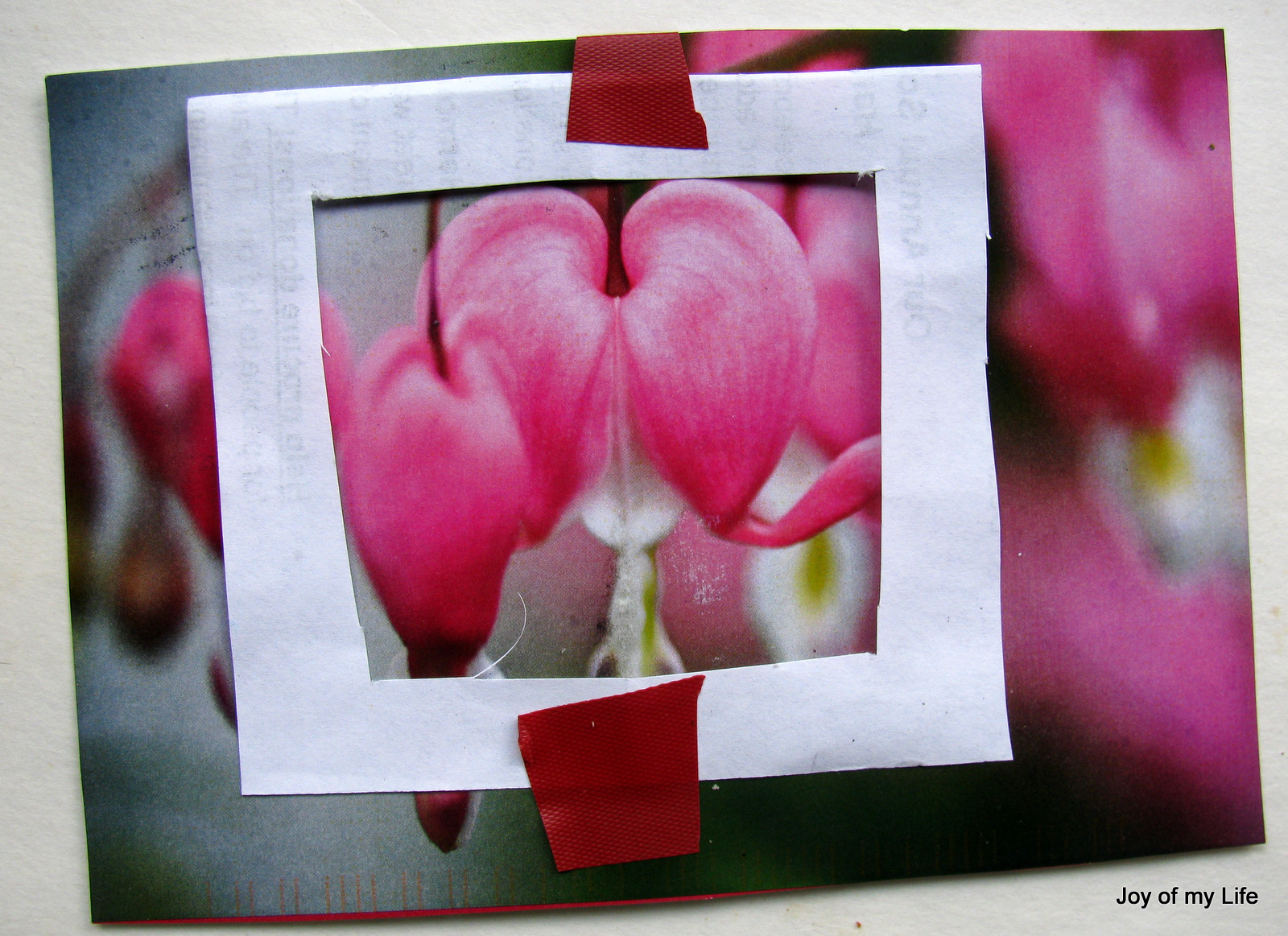
I found an old photograph of the Bleeding Hearts in our garden. I created a small frame to focus on just the details of one flower.


And we sat down side by side. Studied the shapes, light, colors within the small frame. Then, Ana tried her hand at representing what she saw using shapes and color pencils.


[Disclaimer: I am not an artist. I don't even pretend to be one. I am fascinated by artists and creative souls in general. And, I do a lot of art exploration projects with my kids in the hope of educating not just my kids, but myself as well.]

[image sources: goodreads.com, author Jen Bryant's website, author Rachel Rodriguez website, amazon.com, wikipedia]

Labels: , , , , , , , ,

‹Older