Saturday, July 29, 2017

In The Beginning: A Nearly Complete History of Almost Everything


In the Beginning: A Nearly Complete History of Almost Everything 

illustrated by Brian Delf
written by Richard Platt
published in 1995
published by Dorling Kindersley


Being a big fan of Bill Bryson's A Short History of Nearly Everything, I wanted something like that for the kids that will give them a peek into the fantastic diversity that is their world, and possibly an insight into how it got to be that way. A book that is visual and concise, that will draw the young reader without the loud distractions that seem to be a required feature of today's "fact books" -- too many boxes and fonts and insets all screaming for attention with equally bright and eye-popping pictures that vie for attention and thus become counter-productive in engaging a kid who can absorb information even without the gimmicky presentation.

So, when I came across a sole used copy of In the Beginning: A Nearly Complete History of Almost Everything at Powell's Books, I dashed to the checkout counter, paid for it, tucked it into my tote bag, and then released my breath that I didn't even know I was holding. This book had the right balance and the right format that would engage the younger child for hours (and me, of course)

Yes, it was published over a dozen years ago, but, the nice thing about the content of the major part of this book is that it is history, drawing from established facts. Plus it is a DK Book. It might be nice to add an illustration or two in a page or two to bring it up to date but on the scale of time discussed in the book, the last 12 years don't add much more than a trickle to the information therein.


Big Bang, Origins of Life and so on start off the book, but, what is instructive is the illustrated presentation showing the progress of each theme through centuries, themes like: Clothing, Homes, Buildings, Writing, Weapons, Transportation, Communication...


This is a book that cannot be read in a hurry, in one sitting. So, I was glad I picked it up at the beginning of summer break. Now that we are in the second half of summer break, I am glad that the book has been pored over at leisure on  many a peaceful night (and afternoon) by the younger child, who is very much into information-gathering.

The older child picked and chose the pages she was drawn towards - like the Clothing, Two-Wheeled Transportation, and Medicine.

[image source: photos of personal copy of the book]

Labels: , , , , , ,

Friday, March 17, 2017

Aboard a Paper Plane and Other Poems

Aboard a Paper Plane... and other poems
by Joe & Allison Kelly
illustrations by Supakit Chiangthong


When this poetry collection, Aboard a Paper Plane, by Allison & Joe Kelly came my way, I was absolutely delighted to read it! Not just to myself. I read it aloud to my kids, and, randomly quoted some of the lovely lines to the other adult in residence as well.

Shel Silverstein meets Kenn Nesbitt meets Kurt Cyrus.

That's what popped into my head as I read this set of poems. The random everyday quirks with a deeper thought-provoking perspective à la Shel Silverstein, the laugh-out-loud aspect of Kenn Nesbitt's works, as well as the amazing wordplay that Kurt Cyrus brings to his creations, these are what struck me when I read the forty eight poems in this collection.


Some are long and showcase their wordsmithing perfectly while others are crisp and short and made me double up with laughter.

The younger child's favorite was, of course, Bath for the "Ewww..." factor, and Painter, as he had tried that once and found that it was not appreciated.

The older child loved the Secret Club and Pop Quiz, while chuckling at Clover and nodding along with If Only I had a Dollar.

Vegetables - a cautionary tale is at once brilliant and funny, one of my favorites. The wordplay in Broke is superb.


 Before I start listing the joys of each poem here, let me stop and share an informal interview with this talented couple.


1. Tell us about your writing journey - when did you start, what was your motivation for writing? 

J: I started writing children's poetry when I was fifteen - right around the time I met Allison, actually.  I love the variation inherent in a poetry collection, and I love it as both a reader and a writer.  The imagination's zigzag from character to character, situation to situation; not knowing to which world the next page is going to take you, only that it will be a place you're sure to enjoy.  I guess that's why we were drawn to the paper plane.

A: Like most writers, I'm sure, I'm thrilled by the idea of creating something new that wasn't there before: a character, a plot line, a turn of phrase. I've been enthralled with the writing experience since the age of six or so; it's truly been one of the constant joys in my life.

J: And me, right?

A: Yes, Joe.  And you.

2. Do you focus on writing only for children? What are some of your other works?

A: I will write for anyone! I recently started a small business in which I write and publish personal memoirs for people -- usually older folks whose children want to gather their stories and memories in one place before it's too late. I also write material for standardized tests for students ranging in age from kindergarten to high school, and for both native English speakers and English language learners.

J: I'm not quite as versatile as my wife.  It's been largely children's material to date - poetry, rhyming books, middle grade; even tried my hand at YA.  I'm drawn to the imagination bursting from the genre seemingly everywhere you look.  My "day job" is in finance, so I find balance in using the creative side of my brain after a long day or week of analytical thinking.

Aboard a Paper Plane is our first title.  While writing, however, we stumbled upon a few ideas that were too long to be part of the collection.  The game plan now is to turn those into stand-alone rhyming stories.  We've also started planning a second poetry collection.  We don't have any timelines or anything as of yet, but we're certainly having fun putting it all together.


3. What was the inspiration for this particular book? Why a poetry book? How did you settle on the 48 poems included, it's a tall order? Which of these are your top 3 favorites? 

A: A poetry book allowed us to experiment with a lot of tones, themes, characters, and settings.  We were writing the book in our free time (evenings, weekends), so we wanted to make sure the experience was always fresh and exciting.  And as for the inspiration, Joe's the idea generator, so I'll let him take it from here.

J: Thanks, Al!  The inspiration for the book was an odd collection of dozens of little things I've noticed throughout my day-to-day.  Normal things - things you see every day ,but maybe don't put much thought into.  Like a graveyard or a boomerang or a lobster - stuff like that.  If an object or situation catches my eye, I jot it down in the Notes app on my iPhone. It's also energizing to take lofty "life lessons" -- try not to compare with others, be grateful for what you're given, and so on -- and repurpose them in a fun and accessible way through poetry.  In terms of the forty-eight, we were trying to assemble a nice variety of lengths and subjects and styles. There were a handful that didn't fit with Aboard a Paper Plane.  We hope to find a home for them in the next collection!

A: My favorites are probably The Runner, Guardian Angel, and The Tiniest Ant & the Giantest Bear. They're all very different, and I think they give a good idea of our versatility. I think they best showcase our humor, wordsmithing, and wit.

J: I wouldn't say I necessarily have a favorite poem, but I do have a few favorite lines.  Like in the "Octopus Barber", the line about the monkfish.  Or in "Fortune Teller" when the narrator daydreams about body surfing.  Or in "Aboard a Paper Plane" - the part that goes, "You'll cartwheel to the moon and then you'll swim from here to Spain / Or close your eyes and scrunch your face to sprout a lion's mane."  That makes me smile every time.


4. Tell us about your favorite children's author(s)? Favorite children's book(s)?

J: When I was very young, my favorite book was Richard Scarry's "Best Ride Ever". In retrospect, it was a pretty odd story.  Essentially, the plot line revolved around this dog named Dingo.  Dingo Dog had a really, really cool red car.  What Dingo Dog did not have was much respect for traffic laws.  Dingo would drive his car down the sidewalk, through the supermarket - I think at one point he even drove through someone's living room?  At end of the day, the whole book was a pretty airtight case study on why we don't let animals operate machinery.  According to my dad, I would laugh nonstop through the whole story.  Guess I was kind of a weird kid...

A: You were a weird kid?  According to my mom, my favorite book as a little kid was "The Book of Virtues".  It was 1,000 pages and had no pictures.  I would ask my dad to read it to me every night...

J: Okay - you got me there. But since my Dingo Dog-days of childhood, I've accumulated a whole host of both authors and stories I admire.  Just to name a few: Norton Juster's "The Phantom Tollbooth" & Lewis Carroll's "Alice's Adventures in Wonderland" for their wordplay and structure.  Shel Silverstein for his characters and situations.  R.L. Stine's "Goosebumps" for their zany twists.  But my absolute favorite?  I love "Oh, the Places You'll Go".  My grandparents gave me a copy when I graduated high school.  It's been on my desk ever since.

A: I loved the Berenstain Bears series -- the cute stories, the colorful full-page pictures! But most of the formative works I read as a child were when I was a little older, eight or nine or so. I loved "Little Women" most of all, followed closely by "A Wrinkle in Time" and the Babysitter's Club series.


5. How does the collaboration work? Each writes, and also edits the other's?

A: Writing children's poems has always been Joe's passion.  He comes up with the idea, any clever turns of phrase or characters, and writes a first draft.  Then, we both sit down in front of it to comb through line by line and word by word.  I'll suggest changes, shore up the scheme, and do my best to make sure every word counts.  We find that this process makes the best use of both of our skills.

J: That said, there were a few poems in the collection that we wrote pretty much top-to-bottom together.  These were, most notably: The Tiniest Ant & the Giantest Bear, If I Only Had a Dollar, Patient Pat, and The Gadget.  My favorite part about writing is being able to work with Allison.  I love having this as a shared experience.


6. Why eBook? And how was the self-publishing experience? Were you interested in submitting to the traditional publishers?

A: At this point, self-publishing Aboard a Paper Plane as an eBook was our most practical and expedient option.  We've also submitted to some literary agents and traditional publishers.  We're hopeful that our run as an eBook isn't the destination, but rather a step on the journey.


7. How did you "meet and collaborate" with the illustrator? On behalf of the illustrator, will you be able to share how they created the art, and whether they are open for working with other authors interested in self-publishing?

J: We met Supakit on Fiverr (which - by the way - is a great platform for children's book authors to partner with illustrators).  Our experience with him was fantastic - he was professional, easy to work with, and very talented. For each poem, we'd put together a detailed description of what we were looking for in the picture, shoot it over to Supakit, and then let him work his magic.  Unfortunately, we don't know too much about his process.  As of today, Supakit has taken his profile down on Fiverr.  He was a student during most of our collaboration, and we got the sense that he was taking on other time-intensive responsibilities as he got closer to graduating.


8. What do you do when you are not writing? What are your other interests/passions?

J: When I'm not writing or working, I enjoy running on the treadmill while watching a movie or show (currently, season 1 of True Detective), practicing the piano, drinking Guinness, all things personal finance, and spending time with my friends, family, and beautiful wife.

A: I love trying new recipes, learning languages (I'm currently taking a Spanish class!), reading, entertaining, and slowwwly decorating our house. And of course, spending time with my family, friends, and Joe!


Our sincerest gratitude to the Saffron Tree team for featuring us and our debut poetry collection, Aboard a Paper Plane! We truly appreciate all you do to promote children's literature. We hope you enjoy Aboard a Paper Plane; please reach out at jkelly821@gmail.com if you have any questions or comments! Happy reading!


[Disclosure: I received a review copy of this book but the opinions shared here are entirely my own. Review policy for this blog is available.]


Labels: , , , , , , , ,

Saturday, January 28, 2017

Three Little Words

Three Little Words
A Memoir
by Ashley Rhodes-Courter


[Note: Some explicit references to abuse and pedophilia can be disturbing for younger readers. Recommended for 18+]


Ashley Rhodes-Courter is a phenomenon, an inspiration, a powerhouse of progress and change in the child services. This book started out as an essay titled, "Three Little Words", for NYT - an essay about her adoption day, which won a grand prize in June 2003. People expected the three little words to be "I love you", but readers find out that it is actually, "I guess so" - the three words which sealed the deal to make her adoption official.

Ashley's teen mom lost custody of her by age 3, and since then Ashley was shunted from foster home to foster home in the Florida foster care system for the next 9 years. Some of the stay was brief, some longer; some were tolerable, some were outright abusive; yet, she endured, and tried to thrive. Knowing that nobody can take away her education, she excelled in the school system no matter which foster home or which public school she went to. Sometimes she never got to spend a full year in the same school, and that did not make her withdraw into herself. Instead, she found ways to stand out through her achievement - be it essay writing, or public speaking, or acing the tests and being a straight-As student.

The book is a memoir, recounting her experiences upto and including her adoption by the Courters and her successes thereafter, including being invited to the White House as President Clinton's guest, winning an essay to spend time with her favorite author J.K.Rowling even as a teen. Her life has been one painful event after another until she found herself surrounded by so much love and care with the Courters that she was able to give back, and give back generously.

I could not put this book down, and had to finish reading it in one long sitting, one recent weekend. To think that the childcare services are so steeped in bureaucracy and neglect that many children fall through the cracks never to resurface is infuriating.

Being a gifted writer, Ashley's words cut deep without being bitter or resentful. Her honesty and her unique perspective on the traumatic events in her life are not paraded for pity but shared with clear insight into the  breakdown in the system which allowed this to happen, not just to her, but the thousands of other kids with no families.

Her question still remains unanswered probably: Why do states pay a fortune to foster parents rather than helping the biological parents out? If her own mother was given the financial support that the vile Mrs. Moss was given, wouldn't their lives together been a lot less painful? Why are the likes of Mrs. Moss allowed to get away with cruelty time and time again while the biological parents are penalized at the first hint of failure as a parent?

Her other book Three More Words tries to answer all the questions we have from her first book, plus shares her journey as a foster care parent.

[image source: http://rhodes-courter.com/three-little-words/]

Labels: , , , , , ,

Saturday, January 14, 2017

None of the Above

None of the Above
by I.W. Gregorio

[Note: Recommended for 18+ due to physically intimate situations; also included are biological and physiological information regarding reproductive anatomy and disorders of sexual development.]


A practicing surgeon by day and a YA writer by night, Ms. Gregorio is also a founding member of We Need Diverse Books ™ dedicated to advocating changes to the publishing industry in order to help create and promote inclusive literature that honors the lives of all young people.

The book is about Kristin Lattimer, a high school senior voted homecoming queen, who finds out that she is Intersex in a rather painful and unexpected way: Krissy is a female, grows up to be a female, thinks and feels like a female, identifies as a female, is heterosexual, has external female characteristics, and yet, she has internal male reproductive organs, not the female uterus.

And, without her permission, this information is leaked to the school, which spins out of control. Her struggles in school, in life, to come to terms with this and to do what is surgically possible for "normalizing" makes up a good chunk of the book, with the associated drama and complications in relationships and friendships and heartbreaks.

Author Gregorio has done a brilliant job of explaining the medical and biological facts, while very gently yet firmly showing the emotional turmoil that people with AIS (Androgen Insensitivity Syndrome) go through, and the adjustments they have to make in their lives to accommodate this constraint. At times, the kids sound pedagogical with the medical information conveyed to the reader in chunks, but, their interactions and relationships are very much in tune with what is expected from teenagers overall.

It is impossible not to root for Kristin and jump in to defend her against the insensitive bullies. What was heartbreaking for me was when she was removed from the track team because there was an issue of her gender - she cannot compete in the girls' track events as she is not 100% a girl - after training hard and being the best; and, she was put in a position where she couldn't go on using the girls' bathroom.

Through it all, she has a steadfast friend, and there is a sweet budding romance that comes from shared experience and a deeper understanding of oneself.

Why are humans obsessed with highlighting the differences and excluding fellow humans on that count? Is there any hope for a gender neutral society in our future?

[image source: www.amazon.com]

Labels: , , , , ,

Saturday, November 05, 2016

Tangerine

Tangerine
by Edward Bloor


Tangerine is an uplifting multi-threaded story, featuring a young protagonist who has a strong sense of self-worth, that combines rite-of-passage with sibling rivalry, race issues, environmental concerns, football mania, minority communities and more, told brilliantly, without stodgy pontificating or sappy sentimentality.

Seventh grader Paul Fisher moves to Tangerine County, Florida, with his family to start a new school year at Lake Windsor Middle School (LWMS), leaving Houston and his friends behind without too much drama. Overshadowed by his older brother Erik, who is the center of the Erik Fisher Football Dream that his parents have intricately woven and diligently pursued thanks to Erik's phenomenal placekicking, Paul is left to his own devices most of the time, ignored, and underappreciated despite his superb goal-tending abilities for his school soccer team.

Paul wears thick glasses to help him see better. His brother originated this story of Paul staring at the solar eclipse for too long and thus losing his visual acuity. Paul is not sure that story is true, but, he dare not challenge his brother as Erik is quite the mean-spirited bully who hides it well around his parents. His parents don't seem too forthcoming to clarify this vision issue either.

Between the stench of the muck fires that would never go out, and the swarm of mosquitoes that thrive in the swamp created when misguided folks tried to douse the muck fire with gallons of water, life in Tangerine County is not all pleasant. Add to it the very real danger of being hit by lightning, as well as drowning in a sinkhole while sitting in the classroom, life can be positively dangerous.

Indeed, when during football practice, one of the kids of the high school football team is struck by lightning and dies, folks just take it in their stride and don't even suspend practice the next day, carrying on as if nothing can be more important than NFL dreams.

And yes, the sinkhole gobbles up quite a few of the portable classrooms of LWMS, with the kids just barely escaping death. If all this seems highly improbable, think again.

Paul Fisher is furious that his mom demanded a tour of his new school explicitly declaring that he is "legally blind", a tour that was not offered willingly by the Principal at the outset, but was reluctantly given owing to Paul's limitation. She goes so far as to sign him up for IEP as if to emphasize the "visually handicapped" idea, which as it turns out, disqualifies him to play in LWMS's soccer team, despite being the best goalie that a team can hope for.

"I followed slowly, angry at Mom for calling attention to my eyesight. She wanted a tour of the place because she's nosy and wants to see everything for herself. It wasn't because I can't see, because I can. I can see just fine."

Though Paul is visually impaired, he has never considered it a disability. He has sharp insight and perception when it comes to people around him, especially his parents who always seem focused on the wrong things while ignoring the important things staring at them. His thick glasses has never stopped him from being a first-rate goalie for his school team so far. Nor has it stopped him from being deeply observant and profoundly astute for a kid his age.

"But I can see. I can see everything. I can see things that Mom and Dad can't. Or won't."

Or won't. That is the key.

The plot thread of the Tangerine Middle School (TMS) kids and their community where, as Paul puts it, "the minorities are the majority," is superbly developed. As a result of the sinkhole incident, Paul gets an opportunity to change schools, and he voluntarily opts to go to TMS, known as the middle school for troubled youth, while LWMS is for the so-called elite.

Paul makes himself fit in at TMS and works hard to get on the soccer team, even if not as a starter. The citrus farming with its threat of freeze, the bare minimum subsistence, the hardworking Cruz family, the all-too-painful story of Antoine Thomas and his sister, Shandra... There is so much going on in this book that one cannot just put it down and walk away not knowing how it all works out...

Rather than reveal all the lovely details, I think I'll stop here, allowing myself a few more words to gush about this book. While some situations may seem a bit contrived for the dramatic effect, the book is very realistic in terms of relationships, rivalries, priorities, lifestyles -- conditions of life -- in what appears to be an idyllic place that was once the Tangerine capital of the world. Paul is memorable and I can't help but hope that kids in his situation have that level of understanding and maturity to handle what life throws at them. Paul reaches for the light when he could have abandoned levelheadedness and sought the dark. He looks for the positives, not faults, he never complains and he knows what's right even if his own family doesn't acknowledge it.

[image source: EdwardBloor.net]


Labels: , , , , , ,

Sunday, September 18, 2016

Summer Reading: A Baker's Dozen 3rd Grade Chapter Books

There is a reader for every book and a book for every reader. As long as they meet each other I have no complaints.

Now that Summer is over and school has begun in right earnest, I thought I should jot down the books that the then 3rd grader read over summer. Just random picks. I didn't have an agenda. Well, I sort of did, but did not enforce it.

Agreed, I'd rather have my kids read what I consider wonderful and worthy, or what the general writing community and librarians and teachers consider must-reads. But, each kid is different and what speaks to them and appeals to their sensibilities and interests varies widely. So, if they end up not loving a book that I rave about, it's okay.

So far, almost every book by Roald Dahl has been much enjoyed by both the kids. The BFG is a hit, of course, thanks to his whizpopping and his strange grammar. The Witches  made him wonder about the women he sees - seemingly ordinary people - whether they could be secret witches. The Giraffe, the Pelly, and Me was nice too. Matilda was fantastic.

As a non-fiction fan, it is gratifying for me to see the younger one finish fiction chapter books voluntarily. Especially because non-fiction picture books have filled our lives with wonder, right from the kid's infancy.

Here are a few fiction chapter books that the 3rd grader has enjoyed this summer either listening to me read it out loud, or reading them by himself as he lost patience waiting for me.


Dave Pigeon
by Swapna Haddow
illustrations by Sheena Dempsey

A quick read pumped with the kind of silliness that appeals to kids, Dave Pigeon has its laugh-out-loud bits as well as some bits that the jaded adult in me knew was a drag but just put in there to get the kids to giggle.

Two pigeons are scrounging for scraps, and not doing so well, when a Human Lady (with a cat in her basket) comes along with a perfectly stale bread that is a heavenly treat for the said pigeons. Her cat, however, finds its own treat in tormenting the two pigeons, one of which gets its wing hurt. That's our "Dave", so named when the Human Lady takes him home to mend.

The friend pigeon, Skipper, follows along and finds that life can be good with the Human Lady if only the Mean Cat was out of  the way. They both embark on schemes to throw the cat out, but end up with a different problem when the book ends.

So, there is bound to be a part 2 that tells us more about how things progress.

[image source: Author website]


Oggie Cooder (2 book series)
Oggie Cooder, Party Animal

by Sarah Weeks

Veteran author Sarah Weeks manages to create a likable character whose life is realistic enough for kids to take notice and bizarre enough for kids to keep reading. Oggie Cooder is a naturally talented charver. What is charving? It is carving cheese with teeth.

There's the usual super-privileged girls, the boisterous jocks, the dorky smarties; and despite fame trying to change him, Oggie remains true to his sweet nature.

The second book, Party Animal, is all right. There is the requisite diva-ish girl who does not want Oggie to come to her party but invites him anyway, and then imposes these impossible rules for him to follow if he is to come to her party. Not my cup of tea, but all in all, Oggie comes out nice and likable again.

[image source: scholastic]


Tales of a 4th Grade Nothing
(Superfudge, Double Fudge)
Judy Blume

What's not to love about these soon-to-be classic books? Peter Hatcher, his little brother Fudge, and their lovely family are quite a bunch. Virtually every kid I know has read at least one "Fudge book".

Ms. Blume is a master at her craft, spinning seemingly mundane everyday events into wild adventures that turn out to be entertaining, and yet full of heart and tons of humor.

Although Peter is our protagonist, he mostly talks about his brother, Fudge, whose attention-getting antics might be all-too-familiar for parents with high-energy/highly-imaginative kids. Baby sister Tootsie brings new fodder for such antics and the anecdotes flow into a general story with not necessarily a huge conflict/resolution style arc but more of a things-happened-and now-it's-all-right kind of sequence.

Read an Excerpt

[image source: Puffin- Penguin/Randomhouse]


Heck (series)
(Rapacia, Blimpo, Fibble)
by Dale E. Basye
illustrated by Bob Dob


This is a book I did not scan ahead, or read to the child, so I kept getting updates from the reader in installments as and when he read it. It seemed so bizarre that I had to pick it up and do my usual rapid-reading to make sure.

Marlo and Milton get sent to Heck after they are killed. They meet Virgil there, in Heck, which is practically like Hell: there is school there! The threesome try to escape this freakish world.

There are a few more books in the series and the kid has been working his way through them. The rich wordplay and fantasy world building might just be offbeat enough to keep the kid engaged.

Read an Excerpt

[image source: Penguin Random House]


Ukulele Hayley
by Judy Cox

A heart-warming book where kids are not bystanders in their own art enrichment education. Hayley can play the ukulele, it must run in the family since her great-aunt Ruby was famous for it. But, when her school decides to cut funding for the music program, she gathers her fellow music enthusiasts and puts together a show, and in effect appeals to the board to change their mind.

Kids can identify with Hayley and her seeming lack of special talent: while others can sing, dance, juggle and what-not, she seems to be talentless. Until she discovers ukulele, and discovers that with just 3 chords she can learn to play many tunes.

[image source: Holiday House]


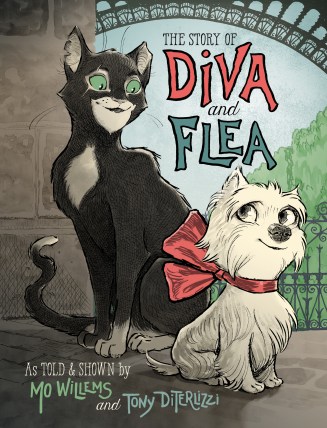
The Story of Diva and Flea
by Mo Willems
illustrations by Tony DiTerlizzi


I must admit that the main reason the resident Elephant and Piggie fan picked up this book is the name-recognition factor: being familiar with the Mo Willems name.

It's a sweet story of friendship between an alley cat, Flea, surviving on pure wits and next-to-nothing-scraps and a pampered little 'fraidy-cat dog, Diva. Their friendship grows gradually, organically. They each help the other out of their comfort zone and find that life isn't so bad on the other side.

Diva shows the joys of regular, reliable, predictable Breck-fest and indoor life to Flea who is used to scavenging for fish bones and food remnants in the dumpsters.

Flea shows the joys of exploring, living free and flâneur-ing, while helping Diva overcome her fear of feet.

[image source: Disney Publishing]


Jelly Bean
Shelter Pet Squad  

by Cynthia Lord

After Rules by Cynthia Lord, I was looking for other books that the younger child might enjoy. Having lost our own pet guinea pig, it seemed like he was ready to read about another guinea pig looking for a home.

Second-grader Suzanna cannot have pets in her apartment, even though she would love to have one. Her parents thought it would be a good idea for her to volunteer at the nearby pet shelter. Suzanna is shy at first, but soon makes good friends at the shelter and takes it upon herself to find a good home for Jelly Bean, a guinea pig that another family dropped off at the shelter as they cannot care for it anymore.


[image source: Scholastic]


No Talking
by Andrew Clements
illustrated by Mark Elliott


It seems like just about every fourth-grader has encountered this book in school as teachers and librarians seem to put it on every reading list they send home. As they should, indeed!

The noisy fifth-graders, notorious for their rambunctious behavior, decide to stop talking in school suddenly, after being inspired by Mahatma Gandhi who had made it a habit to abstain from speech one day a week during his adult life.

It is a riotous read. The complicated rules for "allowed" talking is laid out organically - three-word sentences only at a time - as the teachers and principal try to deal with this civil disobedience. Of course, on the one hand, the teachers are happy with all the peace and quiet, but on the other, it clearly is not working out well overall.

All's well that ends well, of course, as the two camps (girls vs. boys) end up as allies rather than adversaries and learn a thing or two from each other.

[image source: Atheneum/ Simon & Schuster]


Wonder
by R.J. Palacio

Ten year old Auggie starts mainstream school after spending his formative years hiding under a toy helmet. His face is quite deformed and that becomes the focus for anybody who meets him. They are unable to see the humanity in him and his struggles.

Told via eight different narrators with unique voices and perspectives, the book allows us to get to know Auggie for who he is, not what he looks like. And, it captures the circumstances and emotions that lead to misunderstandings, perhaps even to friendships. As Auggie navigates his middle-school life, he learns to be more comfortable with himself, and we learn to choose kindness.

As the Dalai Lama said, and as I quote him at home often when kids start fighting with each other:

"Be kind whenever possible. It is always possible."

Read an Excerpt

[image source: Penguin Random House]


Ruby Lu, Empress of Everything
by Lenore Look
illustrated by Anne Wilsdorf


Ruby Lu ends up being likable, even if not memorable. When her (deaf) cousin, Flying Duck, emigrates from China and starts living with them, things change for the worse at home. At least, that's what Ruby thinks.

At first, Ruby is quite excited about Flying Duck's arrival and takes it upon herself to be the best Smile Buddy. But slowly, things she took comfort in starts to change - more Chinese spoken at home, more Chinese foods at the table, and her best friend Emma doesn't seem like her best friend anymore.

The book easily addresses the challenges of summer school, swimming, emigration and transition to life in a new country as seen through an Asian-American kid whose hopes and fears are quite authentic, convincingly told from a second-grader's point of view.

Browse Inside 

[image source: Simon & Schuster]


Bud, Not Buddy
by Christopher Paul Curtis
(1999)

Ten year old Bud Caldwell is probably known to most 4th and 5th graders in public schools. Orphaned, and abused in foster homes, he flees his quiet town in Depression-era Michigan, setting out on a journey to meet his father. Rather, the man he thinks is his father - bass player for the Dusky Devastators of the Depression, Herman E. Calloway.

Along the way, Bud-not-Buddy has a lot of weird experiences/adventures. Even the most heart-wrenching moments are infused with hope, and Bud's attitude is ever-hopeful and positive. Bud is extremely likable - polite and sensitive, brave and smart.


Read About the Book at Penguin Random House

[image source: multcolib.org]


The Seventh Wish
by Kate Messner


Although it seemed that this book might be a bit beyond his realm of experience, it worked out all right for our nightly read aloud sessions. Much like the fairy tale, "The Fisherman and His Wife", where the fish can grant a wish but the wish always backfires unless worded carefully, our protagonist, Charlie, catches one while ice-fishing.

Charlie's struggles and daily travails was appreciated more by the eleven year old than the eight year old, but still, he was somehow drawn to it and stuck with it till the end, having us read aloud till the book was done. The heroin-addiction for Charlie's sister was a bit much for him, as it bothered him that it can really happen, even if to a character he doesn't care about...


[image source: Author website]


The Hobbit, 
Or There and Back Again
by J.R.R. Tolkien

Since I love the book a lot, I took it upon myself to read it aloud to the kid. It was a blast as expected, reading a chapter at a time.

And, it was even more fun comparing it to the movie(s) to see what parts got dropped out of the movie and speculating why.



[image source: multcolib.org]


Flora & Ulysses
by Kate DiCamillo
illustrated by K.G. Campbell


While this was a fun summer read, I decided to dedicate a separate post to Flora & Ulysses.


Labels: , , , , , , ,

Sunday, August 07, 2016

Flora & Ulysses

Flora & Ulysses
by Kate DiCamillo
illustrations by Keith Gordon Campbell


Ten year old self-proclaimed natural-born cynic, Flora Belle Buckman, is lonely and in a rut with no relief, being quite fed up with the status quo. In the middle of accepting her parents' divorce, it is not at all surprising that precocious Flora lives by the mantra, "Do not hope; instead observe."

And, it is no wonder she turns to her trusted "Illuminated Adventures of the Amazing Incandesto!" and its companion "Terrible Things Can Happen To You!" for advice and lessons on life, even though her mother, Phyllis, categorically rejects these as "the idiotic high jinks of comics."

It all starts when Flora's neighbor Tootie Tickham gets a Ulys­ses Super-Suction Multi-Terrain 2000X vacuum cleaner for her birthday. The said vacuum cleaner on its maiden venture sucks up an unsuspecting squirrel and spits it out sans some fur, seemingly unharmed. However, Flora (and Tootie) know otherwise. As does the unsuspecting squirrel.

"Holy bagumba!" says Flora when the squirrel lifts up the vacuum cleaner effortlessly to get it out of the way. There is no doubt the squirrel has superpowers, he can even fly, even if he is a bit dazed from the experience. "His brain felt larger, roomier. It was as if several doors in the dark room of his self (doors he hadn’t even known existed) had suddenly been flung wide. Everything was shot through with meaning, purpose, light."

Flora names him Ulysses and takes him home for tending and nursing, and that's when yet another superpower is revealed: the power of words, as typed by the squirrel on her mother's typewriter. Yes, a flying squirrel who can think human thoughts and write human words and who has immense physical strength for a rodent of his stature. Is he a superhero or not?

Flora and Ulysses have quite a wild adventure together, not straying far from home, of course. Add to this mix the enigmatic and cerebral William Spiver, Tootie Tickham's nephew, who is temporarily blind and has been banished from his mother's home, we have a comical and entertaining story that unfolds in the most unpredictable manner.

The conflict occurs when Flora's mom decides to do away with Ulysses and squirrelnaps him in the middle of the night. Flora is no shrinking violet, and she decides to get Ulysses back even if she has to ransom her mom's favorite lamp. Yes, lamp. Which in itself is another superbly crafted character.

Books for kids that offer so much for adults as Kate DiCamillo's books do are hard to come by. While this book is not profound and heavy, it is packed with depth and meaning that kids can peel away depending on their level of maturity and experience in life. I went back and re-read many of the sentences admiring what a master Ms. DiCamillo is at her craft. The words are lyrical, magnificent, and perfect in many places, plus quite funny.

And the illustrations meld seamlessly with the text to enhance the storytelling. Very rarely do novels with illustrated panels in them manage to blend in unobtrusively and add to the reading experience; the most ridiculous moments that may not easily be captured in words get a free-pass, with pictures indeed being worth a thousand words.

Flora's dad is very much in the picture, of course, and Flora is very much attached to her dad. But, his weekend visits are just not enough. Flora is at odds with her mother throughout the book, going so far as to naming her mom as the arch-nemesis for her superhero Ulysses.

The adventure culminates in a satisfactory ending, where Ulysses is unharmed and is actually cherished for his heroism.


Read an excerpt here


[image source: kgcampbell.com/books/]


Labels: , , , ,

Friday, July 15, 2016

Save Me A Seat

Save Me A Seat 

by Sarah Weeks & Gita Varadarajan


Joe Sylvester and Ravi Suryanarayanan. Two kids starting fifth grade at Albert Einstein Elementary. Two kids from completely different backgrounds, cultures, corners of the world. Two kids who just want to fit in. Two kids who are unlikely to become friends.

Written alternately from Joe's and Ravi's perspectives, by two authors, the book unfolds the first week of school where Ravi is a brand new kid, not just to this school, but to America. His family has just moved to New Jersey from Bangalore, India. His paternal grandparents came along as well. His mom is a homemaker while Ravi's dad works full time.

While Joe has been in this school since KG, he has always felt an outsider thanks to his APD (Auditory Processing Disorder) which makes every single noise in his environment equally stimulating and distracting and so is unable to focus as needed while tuning out the unwanted sounds. His mom takes any work she can to supplement the family's income, while his dad is on the road a lot with his trucking job.

Dillon Samreen is a typical spoilt, rich ABCD - American-Born Confused Desi* - another name for U.S.-born kids of Indian immigrants, who craves attention and seems quite popular, thanks to his clothing and antics. [*Desi = Indian]

It's a regular school story, centered around the lunch time in cafeteria. Each section of the book is named the day of the week staring from Monday and ending in Friday. And that's not all, each day of the week is further qualified by the cafeteria lunch served in Albert Einstein Elementary. "Monday: Chicken Fingers." "Tuesday: Hamburgers." and so on. And, sure enough, Dillon is the villain-of-sorts with his bullying and insensitivity and selfishness.

Rather than elaborating on every moment of each day of school life through the week, the book focuses on hand-picked incidents that strike an emotional cord, tailored specifically to elicit poignant responses in readers, both young and older. The clever device of picking up the same incident from Joe's perspective where Ravi left off the narration previously (and vice versa) is done seamlessly and brilliantly. So that, without exchanging much dialog with each other, somehow Ravi and Joe are easily connected, destined to end up together as friends.

Bridging the cultural diversity, the book offers fairly authentic perspectives into Ravi's and Joe's lives without espousing a favored position. Touching upon subtle disability (ADP), we see a bright kid, Joe, from a working-class family, struggling to make friends and share what he can offer. Being from a very different culture, we see Ravi's food and demeanor as authentic to his upbringing so far, with a sense of eagerness to please and to excel even while limited by a hard-to-follow accent.

With two authors bringing their own unique perspectives to the characters, the book is innovative and brilliant. Veteran Sarah Weeks tugs at our heartstrings with effortless ease, while Gita Varadarajan brings rich sensory information about Indian culture through credible characterization of Ravi's family and their interactions.

Being an American of south Indian origin, there were quite a few aspects that resonated with me and, of course, quite a few that grated my nerves. Which is not a bad thing for a book like this, for an adult reader like myself.

One thing that irked me was that Ravi's grandmother says, "Be proud of who you are and remember where you come from. If you are not careful, you'll turn into one of them. Your grandfather didn't slave in the tea plantations so that his only grandson would become some rude, overweight, beef-eating cowboy."

While I do not advocate ever forgetting one's roots wherever that may be, the words, "don't turn into one of them" rather rubbed me the wrong way. As if Americans are all uncouth and unworthy somehow, at least according to grandma, by being overweight cowboys. I perfectly understand the spirit in which it is written, but, even the resident eleven year old was irked by it, being an American with south Indian heritage.

On the other hand, Joe's dad says, "Immigrants. They're visitors in this country; who do they think they are, pushing us around?" when referring to Dillon, an American kid of Indian origin. But, Joe points out that Dillon was born in America and that Dillon's dad is a reputable doctor.

There's nothing wrong with blending in and absorbing the host culture without losing one's own beliefs and identity, picking the best of both worlds. At the same time, are guests wrong to expect the host culture to be open-minded in welcoming them? And then again, is it truly a host-guest situation or a host-parasite relationship that creates this fear and mistrust? Rather than always trying to find fault and be derisive about cultural practices and affiliations different from one's own, is it possible for us to accept and appreciate aspects of various cultures without trying to prove why one is somehow inherently better than the other?

Also, towards the end when grandpa helps Ravi gather a few leeches for his Personal Reflection project, I cringed initially thinking why would grandpa equate Indians to leeches - blood-sucking parasites that drain the hosts and move on?  But then, grandpa states, "These leeches are a reminder of who we are, and where we've come from, Ravi, and of all the hardships we've endured to get here."

Rising from a humble tea plantation guard who protected the workers from these nasty leeches, grandpa is proud that his son worked hard to gain recognition for his intellectual abilities and was sent to U.S to contribute his knowledge and expertise for the better world, so that his grandson can live the American Dream, such as it may be. But, their fairly upper middle-class background was not convincing enough to justify this speech about leeches. However, when I realized that it is drawn from author's own personal experience, it came together quite all right.

Ravi's family moved from Bangalore in South India, and Ravi calls his parents 'Amma' and 'Appa' which are south Indian (particularly, Tamil) terms for 'mom' and 'dad'; however, he also calls his grand-parents 'Perimma' and 'Perippa' which is rather unconventional as those terms also refer to Aunt and Uncle - either mom's older sister and her husband, or dad's older brother and his wife. Not that it affects the story, as families can choose to call grandparents in whatever traditional fashion they adopt, but as a Tamil-speaking reader, it was rather an interesting point for me.

I hope this book is chosen as a must-read for fifth graders in school. It is a fairly quick read. Plenty to discuss. The resident 11 year old, who is exposed to south Indian culture, found it an entertaining read. Even if it was written with Ronaldo from Brasil or Ridwaan from Somalia, instead of Ravi from India, the story would have rung true, and that's the diversity in books that children need to be exposed to. Back of the book has Joe's glossary and Ravi's glossary, plus recipes of Joe's and Ravi's favorite foods.

Having finished this book one weekend evening, after tucking kids in bed, I knew I wanted both the kids to read it. So, I took charge and read this book out loud to them. Slowly, in installments, till my throat went hoarse, I read it aloud to the captive duo every chance I got.

Both kids immediately took to Joe, wondering why Joe does not seek an adult intervention when Dillon screams in Joe's ear on purpose. That is cruel and unacceptable. Their argument: If Joe is not confrontational, it is fine, but, he should not condone that behavior by keeping quiet about it and trying to find a subtler way to get back. How will Dillon learn that what he does will not be tolerated if he does not get any consequence for such an unacceptable act of torment? How can it be tattling when asking an adult for help after being unable to deal with such behavior? Joe tried the appropriate method of using his words and making it clear he doesn't like it, but if Dillon still continues his bad behavior, then why can't Joe seek help from adults? Surely that's not tattling, is it? Why keep it from your parents and teachers and thereby protect Dillon?

And both kids found Ravi to be quite sweet and easy to befriend if he was in their classroom. Being familiar with some of the foods Ravi brings to school, the kids were furious when Dillon called Ravi  "Curryhead" and told him that his food stank and that he stank. The 8 year old was horrified that Dillon would get away with such an insensitive and inappropriate comment. Or that Dillon's cronies would laugh when hearing such hurtful words.

Clearly, the authors knew what they were doing! I wish I could gather all the neighborhood kids and read this book out loud to them. Between Chloe in India, It Ain't So Awful Falafel, and Save Me a Seat, I think there's plenty for kids to think about beyond their own small world.... along with books like Percy Jackson and Divergent and Books of Ember, of course.

[image source: Scholastic]

Labels: , , , , ,

Saturday, July 09, 2016

Unusual Chickens for the Exceptional Poultry Farmer

Unusual Chickens for the Exceptional Poultry Farmer
by Kelly Jones
Illustrated by Katie Kath


Seattle-based author Kelly Jones' debut book is a riot!

Sophie Brown's dad has inherited great-uncle Jim's farm, out in Gravenstein, CA. Twelve year old Sophie, a city girl from L.A., is not thrilled about moving to the farm lock, stock, and barrel. However, being well-mannered and well-adjusted, she is co-operative and understanding of the situation and makes her best effort to adapt to her new life.

Her dad is currently unemployed, while her mom juggles her writing commitments to earn enough to make both ends meet. Meanwhile, Sophie is left to her devices to figure out life in the farm.

Quite by accident, Sophie comes across a flyer from Redwood Farm Supply Company catalog listing unusual chickens. Sophie takes an interest and starts corresponding.

Meanwhile, quite naturally, Sophie stumbles upon Henrietta, a chicken of exceptional abilities. From then on, the story moves forward quite intriguingly, in installments, which the readers glean from the letters Sophie writes to her abuelita, great-uncle Jim, and Agnes of the Redwood Farm Supply Company.

Yes, indeed, the story is told in the form of letters!

Not all books can carry off such a specialized form of storytelling. Not all stories lend themselves well to this format either. After reading it twice in full - once on my own, and once aloud to the younger child, and a few more times in parts to share with the older child, it is clear that the book is a fantastic work that appeals to me as much, if not more than the kids, even if it is middle grade fiction.

Among the many things that appealed to me, one is the subtle but clever reference to how brown-skinned Sophie and her Latina mom are automatically assumed to be migrant farm workers, legal or otherwise, and how they both take it in their stride even though both are US-born citizens, very much American. Her dad being white makes no difference to some people's prejudices.

Another aspect I found quite clever is that only so much can be revealed through the letters, which are mostly one-sided because Sophie's beloved abuelita and great-uncle Jim are dead and have no way of writing back. Plus, Agnes, who initially writes back, sends a bizarre note with lots of xs and extra characters clearly pointing to a faulty typewriter, or an inept typist.

Of course, others include the brief but encyclopedic informational pages about the different types of chickens, the To-do Lists, and the adorable illustrations that make the book a fine read.

Slowly, but, surely, Sophie discovers over half a dozen of these unusual chickens that had belonged to great-uncle Jim, each with their own superpowers, for want of a better word.  And now they belong to her family. But, her parents don't have time for this, so it's up to Sophie to learn to take care of them, and possibly find a way to feed them without adding to the family's strained finances.

Henrietta, a Bantam White,  can move objects - telekinesis style. Chameleon can turn invisible, and Roadrunner/Black Streak can go super fast. Another one, a Buff Orpington, can produce chicks who can turn living things to stone with a blunt look. Plus three Speckled Sussex chickens who can see ghosts.

Their powers are not a secret, and all the folks in the area seem to be fine with it. Well, not all. There is one chicken thief who wants these unusual chickens all to herself, even if they are not hers. Right there is the conflict and rising action. Sophie must protect her chickens and expose the poultry thief. How she does it is quite heart-warming and believable. Along the way, Sophie finds unexpected friendship and inner strength that helps her overcome the problem.

Sophie says: "One thing my parents agree on is this: if people are doing something unfair, it’s part of our job to remind them what’s fair, even if sometimes it still doesn’t turn out the way we want it to." And that's a fair lesson every kid must learn sooner or later.

Katie Kath's pen and ink drawings are a treat, bringing to mind Quentin Blake's masterful art for Roald Dahl's books. The pictures complement the story well and capture the goofiness of the chickens, unusual or otherwise.

Fantasy stories can invest in elaborate world-building to explain every little detail so it's all completely tied in a bow and satisfactory; or, they can leave some things open, bordering on reality, not indulging in world-building but using the realistic experiences to stretch the fantasy a little further than what kids are used to. The latter applies to this book, which makes no attempt to explain how or why there are these unusual chickens and what was a Farm Supply Company doing selling these to anybody willy-nilly.

At the end of the story, both the kids wanted to have chickens at home, even if they are all not like Henrietta.

All in all, a superbly satisfying read. And, I liked the part where Sophie tries to make migas for her parents. Sweet. I haven't had authentic migas but I looked up the recipe ideas for it and tried it in my own way.

Look Inside the book at Random House

[image source: Penguin Random House]

Labels: , , ,

Wednesday, April 27, 2016

Chloe in India

Chloe in India
by Kate Darnton
published by Delacorte Books for Young Readers (January 12, 2016)

I was so busy I didn't hear Mom come up behind me. I heard her voice before I saw her, and this is what that voice said:
"Chloe, Chloe! Oh no, Chloe!"
I froze in front of the bathroom mirror. In my left hand, I was holding a clump of blond hair away from my head. Well, hair that used to be blond. Now it was After Midnight Black.
In my right hand, I was holding an After Midnight Black permanent marker.

With an opening like that, this book hooked me in right away, as it did the resident ten year old.

Eleven year old Chloe did not want to leave her cool, tree-lined Boston home behind and get dumped in horrendously hot Delhi, but she had to go where her parents decided to transplant the family because, as her journalist mom puts it, "that's where the stories are."

It is bad enough that she is unable to fit in and adapt to this new situation, but it doesn't help one bit that her older sister, Anna, seemed to hit the road running, rolling with aplomb at these huge changes. Her perfect older sister Anna who could do no wrong.

Chloe is enrolled in an Indian school, Premium Academy, where she is the only American (besides her sister, of course), and the only blond-haired girl (besides the German girl, but she doesn't count.)

Chloe tries to make the best of fifth grade by trying to befriend the prettiest and richest girl in class, Anvi Saxena, all the while having a nagging sense that something about Anvi's attitude is off and unacceptable to her own ethics. Meanwhile, quite unwittingly, Chloe befriends Lakshmi in her dark black hair and ill-fitting hand-me-down uniform, an underdog, underprivileged girl, of EWS (Economically Weaker Section), who is there to fill a quota in admissions records.

The wholesome but strained friendship blossoming between Chloe and Lakshmi is developed almost poetically. The economic divide, the class-based society, the entitlement of the rich, the squalor of the poor (things that are present in many countries in the world), and the struggles of day-to-day existence are all laid out with honest candor that mitigates the stereotyping. It is what it is, and while we all can squirm and wiggle in discomfort at the inequality, the fact remains that there are social injustices we live with and feel powerless to do anything about.

The utter poverty of Lakshmi and the decadent wealth of Anvi are all-true realities in today's India, even more so due to outsourcing and globalization that has bred a flock of nouveau riche who are not sure what to do with all the new-found wealth.

Setting that aside, I want to talk about the positives of this book, which lies in the way Ms. Darnton provides a peek into the culture as seen from Chloe's perspective. The book is semi-autobiographical, in that, Ms. Darnton who hails from Boston actually lived with her family in New Delhi for five years.

Although the story and the settings are all fictional, the bona fide (fictional) characters in the book come alive in Ms. Darnton's narration, from the fussing and efficient Nepali cook/nanny Dechen, dedicated and trustworthy driver/chauffeur Vijay, to the inimitable and wise class teacher Ms.Puri and the quintessential dance instructor Mr.Bhatnagar, not to mention the kids Dhruv, Lakshmi, Meher, Anvi and Prisha, each with their own personality and baggage.

The conflict in the story for Chloe arises from the dance performance she has to participate in on school Annual Day celebrations. As a child growing up and living those very Annual Day celebrations, I loved how Ms. Darnton, via Chloe, explains the significance to non-Indian readers. It is a big deal to put on a dance and musical show to celebrate school's "birthday" so-to-speak, and it can be very stressful for someone like Chloe who does not like to dance or perform in public. There are invited guests of honor and keynote speaker who form a big part of such a celebration, which warrants a proper show with plenty of rehearsals and pitch-perfect performance.

The nuances and idiosyncrasies that are particular to India come across as genuine yet perplexing realities that Chloe faces as she tries to adapt to her new place and culture. While typecasting is unavoidable in such a story setting, the book compensates by revealing so much heart and warmth that is the essence of India, with not much heavy-handed moralizing from high ground.

Will this book encourage a tween reader to visit India and know more about it and possibly befriend an Indian? Perhaps not. There is too much "reality" and "truth" to it that borders on the negative side and too little magic and beauty that is India that is left out of the story.

The resident ten year old got every single emotion that Chloe felt through this story, she understood where Chloe is coming from, and loved the friendship between Chloe and Lakshmi. But, having visited India and having enjoyed parts of it (definitely not the heat, but most certainly the warmth and generosity of the people she encountered), it did come across as a bit one-sided to read the book as an American with Indian heritage.

I did enjoy the vivid descriptions and exchanges that rang so true that it is easy to forget Ms. Darnton is not a native Indian.

An exchange in class between Dhruv, the typical trouble-making class clown, and Chloe:

"Ma'am!" Dhruv yelled. "Chhole is fidgeting!"
I gritted my teeth. "I am not a chickpea," I hissed. "My name's not Cho-lay. It's Chloe. Klo-ee."
"Now she is talking!" Dhruv yelled. "How can I draw her if she is always talking?"
Mrs. Singh glanced up from her desk at the other end of the room. She put one skinny finger to her thin lips. "Shhh!" she hissed.

Back of the book has a "Questions for Readers" section that talks about a few of the situations in the book that warrant discussion and can turn into useful teaching moments.

A couple of exchanges between Lakshmi and Chloe:

"You look fine," I said. I was trying to sound reassuring, but Lakshmi scowled.
"No fancy kurta," she said. "No dupatta." She shook her head and pointed up toward the apartment. "I can no go your house."
"Are you kidding?" I said. "Look at me!" I pointed at the soy sauce stain on my Red Sox T-shirt. "Seriously," I said. "My parents do not care. Like, not at all. Actually, I know for a fact that they'd love to meet you...
...
Lakshmi looked unconvinced, but before she could protest further, I grabbed hold of her hand and started pulling her up the stairs.

------------------------

"Outside the hospital, one didi sits there. She is -- what you say?-- phool walla?"
"She's a fool?"
"No, no." Lakshmi let out a laugh. "She not fool. She phool wallah. She sell flower, jasmine flower."

I liked the fact that both Chloe and Lakshmi are new to fifth grade at Premium Academy, and both feel they are misfits (the title of the book as released by Young Zubaan), and they are both from opposite ends of the world culturally and economically. But, why should that stop them from getting to know each other and becoming friends?

Look Inside the Book


[image source:  Penguin Randomhouse]

Labels: , , , , ,

Thursday, March 17, 2016

The Babysitters Club Graphic Novels

The Babysitters Club (Graphic Novels)
by Raina Telgemeier

The Babysitters Club Graphic Novels Raina Telgemeier


Based on Ann M. Martin's novels in The Baby-Sitter's Club (BSC) series, these graphic novel adaptations by Raina Telgemeier are absolutely delightful, staying true to the original.

The resident ten year old enjoyed reading the challenges and perks of baby-sitting and the dynamics of friendship between Kristy and her friends in the BSC.

Four books have been adapted so far for the graphic novel presentation, with no more on the horizon at this time. Kristy's Great Idea starts it all, where the girls get together to form the club. In the Truth about Stacey, we watch Stacey go through some tough times, but manages fine thanks to her friends at the BSC. In Mary Anne Saves the Day, we see how Mary Anne rises to the occasion and handles her problems and keeps the BSC tight-knit again.Claudia and Mean Janine opens a window into Claudia and her sister's personalities and relationship.

The illustrations do a fantastic job of setting up the personality of each character with clear and big facial expressions that complement the text, adding a lot of movement and energy, making it crisp and heart-warming at the same time.

[image source: GoRaina.com]

Labels: , , , ,

Wednesday, January 27, 2016

Sy Montgomery's Brilliant Animal Books for Children

Sy Montgomery's Brilliant Animal Books for Children


Quite casually, a few months ago, the seven-year-old and I were researching flightless birds of the world, trying to get past the well-known large birds like ostrich and emu and penguin and cassowary and kiwi. That's when we came across Kakapo, a nocturnal ground-dwelling parrot endemic to New Zealand.

Naturally, we wanted to learn more and so when I came across Kakapo Rescue: Saving the World’s Strangest Parrot by Sy Montogomery and Nic Bishop, at the library, I brought it home, hoping to read it with the younger child in installments whenever he is ready.

I was not ready for the wild enthusiasm he showed for this book! I can see why the book was so well-received, though. Sy Montgomery's books have the right balance of information, real-life drama, engaging storytelling, and intrinsic beauty.

Fewer than 90, yes nine-zero-ninety, of these gorgeous, friendly birds remain in the wild on the remote Codfish Island off New Zealand's south coast. Sy and Nic journeyed there to record the work done, mostly by volunteers, to prevent these sweet birds from going extinct.

The photographs by Nic Bishop, along with an easy-flowing, clear, heartwarming account of her journey of discovery makes this book a huge favorite with me.

The shared experience of reading this to the kiddo and learning about the plight of these birds that were indiscriminately killed when humans took over and settled in its habitat made us so aware of the large impact we have on our environment simply by going somewhere and being there where we were never before.

We ended up reading this book every single night and finished it within a week, coming out of it as if we had traveled to the place ourselves and seen and interacted with the individual birds ourselves. We felt the pain when one of eggs was destroyed, or didn't get fertilized. We couldn't help rooting for these naive and cuddly birds.

[Read an excerpt here]

We were hooked! I borrowed every other book by Sy Montgomery that was available at our library.

In Quest for the Tree Kangaroo, we learnt about this odd-looking creature that resembles a stuffed toy that is determined to stand-out as incongruous: "Impossibly soft, with a rounded face, button eyes, pink nose, upright ears and long, thick, furry tail, the 25-pound animal hops like a kangaroo, carries babies in a pouch like a koala, and climbs trees like a monkey."

In Saving the Ghost of the Mountain, Nic and Sy are on an expedition among Snow Leopards of Mongolia. "Prowling along ridges, slinking below skyline, the snow leopard is as invisible, yet as powerful, as the wind, and as elusive as a ghost." Collaborating with Snow Leopard Trust scientist Tom McCarthy and his team in the Altai Mountains of the Gobi Desert, Sy and Nic try to learn about and save an animal they can’t see—before it becomes a ghost for real.

Among the "Scientists" series of books, the kid loved Octopus Scientists -- no surprise there as Octopus is an all-time favorite for him. From its ability to totally camouflage and blend into its surroundings, its ink, its beak, to its tendency (mama octopus) to starve and die after its eggs hatch, everything about them is curious and intriguing. Sy and Keith Ellenbogan take us along for a wild underwater ride in this book.

One of my personal favorites is The Man-eating Tigers of the Sundarbans by Sy Montgomery. It is poetic and heart-wrenching and fearsome and hopeful all at the same time.

Currently, we are reading Encantado: The Pink Dolphins of the Amazon. One fine day, the kid brought it home from school, checked out from his school library. I sat back knowing my work is done for now.

Next on our list: Snowball the Dancing Cockatoo. Our library does not have it, so, I'll be looking for a used copy to bring home sometime soon.

[image source: Sy Montgomery's website]


Labels: , , , , , , , , ,

Sunday, January 10, 2016

3 Awesome Animal Picture Books

Egg: Nature's Perfect Package 
by Steve Jenkins & Robin Page
published by HMH Books for Young Readers, March  2015


Trademark cut-paper collage on stark white background with crisp, precise nuggets of information make Jenkins's books perfect for animal-non-fiction-loving young readers.

The book is all about eggs as the title suggests: little eggs, big eggs,, where to lay eggs, how many to lay at a time, egg consumers, egg protection, egg packaging, egg carrying, incubation, and getting out of the egg... all are laid out with plenty of animals showcasing their techniques and ideology.

Everything needed to create a new living creature: The Egg.

[image source: HMH Catalog]


How to Swallow a Pig
Step by Step Advice from the Animal Kingdom
by Steve Jenkins & Robin Page
published by  HMH Books for Young Readers, September 2015


A recent top favorite book for the seven year old, he rattles off fascinating facts about animals from this book that surely caught my interest and attention.

Like how a Capuchin monkey smears itself with millipede after rolling the said millipede in its mouth to get it to release its toxins. Why does it do that? Well, that's nature's own insect-repellent right there.

Or, like how smart a crow is that it chooses a stop light and plants its hard-to-crack nut on the road and waits for a car to go by and crush the nut open.

Or, as the title suggests, swallow a whole pig after squeezing it to death as a python does.

The tongue-in-cheek format of the book and the clever presentation is sure to fascinate the curious-minded child, and maybe incite them to imitate these creatures.

[image source: HMH Catalog]


Unusual Creatures
A Mostly Accurate Account of Some of Earth's Strangest Animals
by Michael Hearst
Artwork, Diagrams, and Other Visuals by
Arjen Noordeman, Christie Wright, and Jelmer Noordeman

published by Chronicle Books,  July 2014


"Unusual Creatures is a rich and fantastic book of charming imaginary animals who... what? They're real? I'll be under the bed." -- Lemony Snicket.

That quote on the cover had me chuckling right away.

The book starts out by explaining the biological classification in a kid-friendly way, with the mnemonic:

Kids Place Candles On Foot Gravy Sausage
↠ Kingdom ➢ Phylum ➢ Class ➢ Order ➢ Family ➢ Genus ➢ Species.


I was hooked right on that page, and so was the kiddo.

The book is laid out alphabetically, starting with Axolotl. "Mama, did you know an axolotl can regenerate its body parts, even its heart? We had an axolotl in our classroom last year, remember? They are so cool!" And we learn that the name axolotl comes from the Aztec language, most common translation being "water dog".

Each double-page spread focuses on one animal. The informational text and related diagrams, with K-P-C-O-F-G-S laid out next to the animal's common and scientific name, plus a full page illustration of the animal with a scale to show its size makes it easy to digest the information in small chunks and marvel at nature's creativity.

Turn to any page at random, and you are sure to find a fascinating and rather unusual creature like Barking Spider, or Giraffe-necked Weevil, or Hammerhead Bat, or Long-eared Jerboa, or Magnapinna Squid, or Sea Pig, along with some unique but slightly well-known creatures like Echidna, Honey Badger, Platypus, and Slow Loris.

A must-have for our bookshelf, along with every one of Steve Jenkins's books.

Watch video clippings of featured creatures at unusualcreatures.com

[image source: Chronicle Books]


Labels: , , , , , ,

‹Older