Friday, March 17, 2017

Aboard a Paper Plane and Other Poems

Aboard a Paper Plane... and other poems
by Joe & Allison Kelly
illustrations by Supakit Chiangthong


When this poetry collection, Aboard a Paper Plane, by Allison & Joe Kelly came my way, I was absolutely delighted to read it! Not just to myself. I read it aloud to my kids, and, randomly quoted some of the lovely lines to the other adult in residence as well.

Shel Silverstein meets Kenn Nesbitt meets Kurt Cyrus.

That's what popped into my head as I read this set of poems. The random everyday quirks with a deeper thought-provoking perspective à la Shel Silverstein, the laugh-out-loud aspect of Kenn Nesbitt's works, as well as the amazing wordplay that Kurt Cyrus brings to his creations, these are what struck me when I read the forty eight poems in this collection.


Some are long and showcase their wordsmithing perfectly while others are crisp and short and made me double up with laughter.

The younger child's favorite was, of course, Bath for the "Ewww..." factor, and Painter, as he had tried that once and found that it was not appreciated.

The older child loved the Secret Club and Pop Quiz, while chuckling at Clover and nodding along with If Only I had a Dollar.

Vegetables - a cautionary tale is at once brilliant and funny, one of my favorites. The wordplay in Broke is superb.


 Before I start listing the joys of each poem here, let me stop and share an informal interview with this talented couple.


1. Tell us about your writing journey - when did you start, what was your motivation for writing? 

J: I started writing children's poetry when I was fifteen - right around the time I met Allison, actually.  I love the variation inherent in a poetry collection, and I love it as both a reader and a writer.  The imagination's zigzag from character to character, situation to situation; not knowing to which world the next page is going to take you, only that it will be a place you're sure to enjoy.  I guess that's why we were drawn to the paper plane.

A: Like most writers, I'm sure, I'm thrilled by the idea of creating something new that wasn't there before: a character, a plot line, a turn of phrase. I've been enthralled with the writing experience since the age of six or so; it's truly been one of the constant joys in my life.

J: And me, right?

A: Yes, Joe.  And you.

2. Do you focus on writing only for children? What are some of your other works?

A: I will write for anyone! I recently started a small business in which I write and publish personal memoirs for people -- usually older folks whose children want to gather their stories and memories in one place before it's too late. I also write material for standardized tests for students ranging in age from kindergarten to high school, and for both native English speakers and English language learners.

J: I'm not quite as versatile as my wife.  It's been largely children's material to date - poetry, rhyming books, middle grade; even tried my hand at YA.  I'm drawn to the imagination bursting from the genre seemingly everywhere you look.  My "day job" is in finance, so I find balance in using the creative side of my brain after a long day or week of analytical thinking.

Aboard a Paper Plane is our first title.  While writing, however, we stumbled upon a few ideas that were too long to be part of the collection.  The game plan now is to turn those into stand-alone rhyming stories.  We've also started planning a second poetry collection.  We don't have any timelines or anything as of yet, but we're certainly having fun putting it all together.


3. What was the inspiration for this particular book? Why a poetry book? How did you settle on the 48 poems included, it's a tall order? Which of these are your top 3 favorites? 

A: A poetry book allowed us to experiment with a lot of tones, themes, characters, and settings.  We were writing the book in our free time (evenings, weekends), so we wanted to make sure the experience was always fresh and exciting.  And as for the inspiration, Joe's the idea generator, so I'll let him take it from here.

J: Thanks, Al!  The inspiration for the book was an odd collection of dozens of little things I've noticed throughout my day-to-day.  Normal things - things you see every day ,but maybe don't put much thought into.  Like a graveyard or a boomerang or a lobster - stuff like that.  If an object or situation catches my eye, I jot it down in the Notes app on my iPhone. It's also energizing to take lofty "life lessons" -- try not to compare with others, be grateful for what you're given, and so on -- and repurpose them in a fun and accessible way through poetry.  In terms of the forty-eight, we were trying to assemble a nice variety of lengths and subjects and styles. There were a handful that didn't fit with Aboard a Paper Plane.  We hope to find a home for them in the next collection!

A: My favorites are probably The Runner, Guardian Angel, and The Tiniest Ant & the Giantest Bear. They're all very different, and I think they give a good idea of our versatility. I think they best showcase our humor, wordsmithing, and wit.

J: I wouldn't say I necessarily have a favorite poem, but I do have a few favorite lines.  Like in the "Octopus Barber", the line about the monkfish.  Or in "Fortune Teller" when the narrator daydreams about body surfing.  Or in "Aboard a Paper Plane" - the part that goes, "You'll cartwheel to the moon and then you'll swim from here to Spain / Or close your eyes and scrunch your face to sprout a lion's mane."  That makes me smile every time.


4. Tell us about your favorite children's author(s)? Favorite children's book(s)?

J: When I was very young, my favorite book was Richard Scarry's "Best Ride Ever". In retrospect, it was a pretty odd story.  Essentially, the plot line revolved around this dog named Dingo.  Dingo Dog had a really, really cool red car.  What Dingo Dog did not have was much respect for traffic laws.  Dingo would drive his car down the sidewalk, through the supermarket - I think at one point he even drove through someone's living room?  At end of the day, the whole book was a pretty airtight case study on why we don't let animals operate machinery.  According to my dad, I would laugh nonstop through the whole story.  Guess I was kind of a weird kid...

A: You were a weird kid?  According to my mom, my favorite book as a little kid was "The Book of Virtues".  It was 1,000 pages and had no pictures.  I would ask my dad to read it to me every night...

J: Okay - you got me there. But since my Dingo Dog-days of childhood, I've accumulated a whole host of both authors and stories I admire.  Just to name a few: Norton Juster's "The Phantom Tollbooth" & Lewis Carroll's "Alice's Adventures in Wonderland" for their wordplay and structure.  Shel Silverstein for his characters and situations.  R.L. Stine's "Goosebumps" for their zany twists.  But my absolute favorite?  I love "Oh, the Places You'll Go".  My grandparents gave me a copy when I graduated high school.  It's been on my desk ever since.

A: I loved the Berenstain Bears series -- the cute stories, the colorful full-page pictures! But most of the formative works I read as a child were when I was a little older, eight or nine or so. I loved "Little Women" most of all, followed closely by "A Wrinkle in Time" and the Babysitter's Club series.


5. How does the collaboration work? Each writes, and also edits the other's?

A: Writing children's poems has always been Joe's passion.  He comes up with the idea, any clever turns of phrase or characters, and writes a first draft.  Then, we both sit down in front of it to comb through line by line and word by word.  I'll suggest changes, shore up the scheme, and do my best to make sure every word counts.  We find that this process makes the best use of both of our skills.

J: That said, there were a few poems in the collection that we wrote pretty much top-to-bottom together.  These were, most notably: The Tiniest Ant & the Giantest Bear, If I Only Had a Dollar, Patient Pat, and The Gadget.  My favorite part about writing is being able to work with Allison.  I love having this as a shared experience.


6. Why eBook? And how was the self-publishing experience? Were you interested in submitting to the traditional publishers?

A: At this point, self-publishing Aboard a Paper Plane as an eBook was our most practical and expedient option.  We've also submitted to some literary agents and traditional publishers.  We're hopeful that our run as an eBook isn't the destination, but rather a step on the journey.


7. How did you "meet and collaborate" with the illustrator? On behalf of the illustrator, will you be able to share how they created the art, and whether they are open for working with other authors interested in self-publishing?

J: We met Supakit on Fiverr (which - by the way - is a great platform for children's book authors to partner with illustrators).  Our experience with him was fantastic - he was professional, easy to work with, and very talented. For each poem, we'd put together a detailed description of what we were looking for in the picture, shoot it over to Supakit, and then let him work his magic.  Unfortunately, we don't know too much about his process.  As of today, Supakit has taken his profile down on Fiverr.  He was a student during most of our collaboration, and we got the sense that he was taking on other time-intensive responsibilities as he got closer to graduating.


8. What do you do when you are not writing? What are your other interests/passions?

J: When I'm not writing or working, I enjoy running on the treadmill while watching a movie or show (currently, season 1 of True Detective), practicing the piano, drinking Guinness, all things personal finance, and spending time with my friends, family, and beautiful wife.

A: I love trying new recipes, learning languages (I'm currently taking a Spanish class!), reading, entertaining, and slowwwly decorating our house. And of course, spending time with my family, friends, and Joe!


Our sincerest gratitude to the Saffron Tree team for featuring us and our debut poetry collection, Aboard a Paper Plane! We truly appreciate all you do to promote children's literature. We hope you enjoy Aboard a Paper Plane; please reach out at jkelly821@gmail.com if you have any questions or comments! Happy reading!


[Disclosure: I received a review copy of this book but the opinions shared here are entirely my own. Review policy for this blog is available.]


Labels: , , , , , , , ,

Sunday, October 16, 2016

Finnigan the Circus Cat

Finnigan the Circus Cat
by Mary T. Wagner

Publisher: Waterhorse Press; First edition (May 27, 2016)
Publication Date: May 27, 2016


An warm tale about a simple life that can have its own adventures, this book can be fun for cat-loving kids.

Cousins Max and Leroy, two circus mice, live a well-settled life at the old Farnsworth Circus Museum. They have comfortable place to rest, enough food to eat, no bothersome dogs or cats. But when little Lucy Farnsworth and her family move in, along with their dog Boomer, things start to change a bit. To add to the annoyance, Lucy hides a rescue kitten in their barn, which totally aggravates the mice cousins, naturally.

This little kitten, which is not allowed in the house as Lucy's dad is allergic, seems oblivious to the disturbance he must have caused in the status quo at first. But, Max and Leroy take him under their wing and show him the best spots for hiding, the best hidden route to the stream on a hot day, all the nooks and crannies in the circus wagon...

Things can't be this idyllic for long, and sure enough Hector and Godfrey show up which is not a good sign for Leroy and Max. When Leroy almost falls into Godfrey's mouth, Finnigan, leaps to his rescue, hangs by his long fluffy tail, and saves him from certain death.

The pencil illustrations in the book were done by the author herself. The story flows smoothly and predictably with engaging dialog and not a lot of fast-paced adventure or rising action or conflict. This might be the first in a series where we follow Finnegan along with his new adventures.

[Disclosure: I received a review copy of this book but the opinions shared here are entirely mine.]


Labels: , , , , ,

Wednesday, April 20, 2016

Megan's Brood

Megan's Brood, Book One
by Roy Burdine
illustrated by Shawn Mcmanus


One summer, spunky 6th grader Meg moves into a new place with her parents, leaving her friends and familiar environment behind. In the attic bedroom of the new house, she discovers something magical - a cocoon pulsing with light and tiny heartbeats of unknown creatures.

Over summer, the creatures hatch, ten in all, and seem attached to Meg. She enjoys caring for them while she tries to make new friends in the new place - a skateboarding, garage-band musician of a kid called Cutter, and a soft-spoken well-mannered bookworm like herself called Casper.


Being Book One of a proposed series, we get the background and the set up established over the first two-thirds of the book. Around the last chapter or so, things gather momentum when one of Meg's brood, named Thorn for his spiky scales, reveals his true predatory and controlling nature.

When Thorn binds her dad and friend at their camping night right before start of school term, so as to barter for his siblings, things get fiery hot, literally. But, Meg manages to kick Thorn into the flames, save her dad and friend and the rest of her brood. For now.

The handful of black and white illustrations by Shawn McManus (www.shawnmcmanus.net) sprinkled throughout the book are gorgeous and complement the text well.

It would be interesting to find out how Meg handles her brood as they grow and change and whether Thorn will act on getting his revenge.

Epilogue sets us up for more adventure when we learn that Thorn is not destroyed by the flames after all and inside him beats an angry heart.

Roy Burdine has worked as animation director (Dreamwork's Puss in Boots, Ultimate Spider-Man) and can be found at www.RoyBurdine.com

[Disclosure: I received a review copy of this book but the opinions expressed here are entirely mine.]

[image source: photographed from review copy]


Labels: , , , , ,

Tuesday, April 05, 2016

Bartholomew Quill

Bartholomew Quill
A Crow's Quest to Know Who's Who
by Thor Hanson
illustrated by Dana Arnim

published by Sasquatch Books


Bartholomew Quill was a crow long ago,
when all of the world was new.
When the bears and the bees
and the hares and the trees
were all learning to tell which was who.


Thus starts this book by acclaimed biologist Thor Hanson,which takes us on a lyrical journey back in time when our dear protagonist, Bartholomew Quill, the crow, wants to know who he is.

He flies around encountering various animals and compares features to see if he is one of them. At the edge of the ocean, he sees black birds like himself and asks if he is one of them. The bird answers:

I dive and I float in a waterproof coat
My diet is fish and crustacean.
We are both black and sleek, but you lack a bright beak,
so you cannot be my close relation.

And from the lovely illustrations by Dana Arnim, we know this is a puffin, not a crow.

As our Bartholomew encounters other creatures, he quickly realizes he cannot be one of them, until he sees someone very much like himself, only much bigger - the Raven.

Finally, he looks in nature's mirror - the still lake - as he flies over it and realizes he is a crow.

The ability of many species to recognize their own must have evolved somehow, but this story is set when the world was new, so, possibly Bartholomew has not yet developed self-recognition/other-recognition.

One question that cropped up with the resident 7 year old is, at each stage, without introduction or explanation, how does Bartholomew know what that creature is that is different from himself. For example, after encountering the creature that soars and catches fish all day and has sharp eyes and pale head and tail feathers, we simply read that "Bartholomew thanked the bald eagle," which the young readers deduce from the illustrations but may be puzzled as to how Bartholomew arrived at that conclusion.

Back of the book has a "Get More Out of This Book" section that has some interesting suggestions.

Biologist Thor Hanson is renowned for his adult books about nature -- The Impenetrable Forest, The Triumph of Seeds, and Feathers. He won a PNBA Award and The John Burroughs Medal for Feathers, which was also a finalist for the Washington State Book Award. Hanson is a Guggenheim Fellow, a Switzer Environmental Fellow, and sought-after public speaker.

Illustrator Dana Arnim has a Certificate in Art from the Children’s Market from UW Extension and serves as Co-regional Advisor for the Western Washington SCBWI.

[Disclosure: I received a review copy of this book. The opinions shared here are entirely mine.]

Labels: , , , , ,

Friday, November 20, 2015

The Not Very Merry Pout-Pout Fish


The Not Very Merry Pout-Pout Fish
by Deborah Diesen
illustrated by Dan Hanna

published by Farrar, Straus and Giroux (BYR), Sept 2015

Ages 3-6


Ever since we first encountered Mr.Fish with his fish face stuck in a permanent pout, spreading  dreary-wearies all over the place, we've been a big fan.

And, boy was I thrilled when Ms. Diesen stopped by and left me a comment on that post!

The very first book, The Pout-Pout Fish, with its perfect beat and rhythm, is an all-time favorite for read-aloud sessions. After The Pout-Pout Fish and the Big, Big Dark, and The Pout-Pout Fish Goes To School, the duo is back with some holiday spirit in, The Not Very Merry Pout-Pout Fish.

While it might be near-impossible to recreate the magic of the first book for authors in any genre, it is even tougher in picture books. But, Ms. Diesen and Mr. Hanna have worked very hard to capture the beauty of Mr. Fish's endearing nature yet again.

Mr. Fish makes his Gift list and is all set to go shopping for his friends. He wants to get the best and latest gifts with "bling-zing" as nothing less would do. When circumstances arrange themselves to frustrate and disappoint him regarding finding the very gifts "guaranteed to bring delight", Ms. Shimmer comes along and shows him that making gifts for friends "with his very own fins" is just the thing to do to spread the joys of the season.

The seven-year old's favorite is Manta Claus, and his sleigh pulled by sea horses, of course. Cute and clever details like that tucked into every page provide hours of fun for the little ones to discover and giggle over. Although Mr. Fish's shopping dilemma may resonate more with adults than kids, the gentle reminder that hand-made holidays are what it is all about brings a sense of peace and calmness to the young readers.

I am very happy to be part of the Blog Tour for The Very Merry Pout-Pout Fish.

View Inside the Book at US MacMillan

Learn More at  www.poutpoutfish.com


Interview with author, Ms. Diesen:

How did you come up with the original Pout-Pout fish book in 2008?

The story grew out of an actual pout!  One day many, many years ago, when my elder son was a preschooler, he was having a very grouchy afternoon.  Hoping to amuse him, I made an exaggerated pouty face at him.  He smiled and then pouted right back, which got us both laughing.  “We look like fish,” I said.  “Like pout-pout fish!”  As soon as I said that out loud, it became a story idea.  I jotted the idea down and I started writing The Pout-Pout Fish that same day.  Years later, I started sending the story to publishers, and in 2005 it was accepted at Farrar, Straus & Giroux Books for Young Readers.  The book was published in 2008 and began a series of stories, all featuring Mr. Fish, his friends, and their adventures. Since the first book, we’ve seen Mr. Fish go to school, learn to smile, face the dark, discover how to dream and play hide-and-seek.

What do kids (and their parents) love most about the series? 

I think one of the things that makes Mr. Fish an appealing character for many kids and parents is that kids and parents alike can identify with his experiences.  Toddlers sometimes pout; so do adults!  Preschoolers have things they’re scared of; so do adults!  Kindergartners get nervous about starting something new; so do adults!  Mr. Fish’s experiences provide a way for kids and grown-ups to explore those issues together.  In addition, the stories have rhyme, repetition, and wordplay, which are fun in a read-aloud book.  And Dan Hanna’s illustrations!  They’re fantastic.  They truly bring the stories to life.

What is Mr. Fish up to now? Does he have a case of the “dreary wearies” in the latest book, too?

Mr. Fish’s newest adventure is called The Not Very Merry Pout-Pout Fish.  In it, Mr. Fish is in a bit of a holiday panic, searching for perfect gifts for all of his friends.  His shopping trip is unsuccessful, and Mr. Fish is sure that he’s let all of his friends down.  But his friend Miss Shimmer reminds him that the best gifts of all come straight from the heart, and she helps him craft simple and meaningful presents to bring to the holiday party.  His friends are delighted with their presents, and together everyone celebrates peace, joy, and love – what a very merry gift!

What do you hope young readers (ages 3-6) will learn from The Not Very Merry Pout-Pout Fish? Is there a message here for grown-ups as well? 

I hope that Mr. Fish’s latest tale will help children to realize that presents don’t need to be expensive or complicated or splashy.  Simple, heartfelt presents that connect us to one another are the best gifts of all.  A drawing; a craft project; time spent together; even just a smile!  These sorts of gifts are the most cherished and the most enduring.  It’s a lesson we grown-ups have to re-learn periodically as well.

Do you have any tips for parents of toddlers about the joy of giving presents, rather than just receiving them, this holiday season?

Kids love to give presents, and they especially love having an active role in the process of creating the presents.  Try a craft idea or project that’s extremely simple and stress-free, and then let your child have at it with a minimum of help.  The more messy, lopsided, and imperfect the results the better!  Have fun with the process, and as you do you’ll create not just gifts but memories as well.

How do you and the illustrator, Dan Hanna, work together on the books? (Are there any special stories about the illustrations on Not-Very-Merry that you can share?) 

I absolutely adore Dan’s art, and I credit it as the reason for the success of the series.  We work independently of one another during the creation of the books.  I work with our editor on the stories; then, when a story is finished and ready, she passes it along to Dan.  Dan moves through the art creation process, from sketches to finished product, working with our editor and with the art director.  I do see some of the steps along the way, but during the illustration process the author’s most important task is to stay out of the way!  And that’s for the best, because it allows the artist to bring the story to life in the way only an artist can.  Dan brings a thousand times more to the illustrations than I could ever begin to imagine – the characters and their expressions; the settings and their details; and all the funny and quirky extras.  For instance, in The Not Very Merry Pout-Pout Fish, one of the spreads shows a store full of what I describe in the text as shiny trinkets and handy gadgets.  Dan took that description and brought it alive by imagining, drawing, and labeling shelf after shelf in the gift shop with hilarious and unique sea gifts.  His creativity is amazing.  I feel very grateful and happy to get to make books with Dan!

Any future plans for Mr. Fish? What adventures can we expect to see him in next? 

Mr. Fish has a new mini-adventure coming out later this year called Kiss-Kiss, Pout-Pout Fish.  This mini-adventure, like the previous mini-adventures Smile, Pout-Pout Fish and Sweet Dreams, Pout-Pout Fish, is a very short board book with just a few words per page, meant for babies and young toddlers. In spring 2016, there will be a touch-and-feel alphabet book and a sticker book.  Another mini-adventure, called Trick or Treat, Pout-Pout Fish, will arrive later in 2016.  And in 2017, Mr. Fish will be in a new full-length hardcover called The Pout-Pout Fish, Far, Far From Home.  He stays pretty busy these days!  But he’s enjoying all of his adventures. As am I!


Interview with illustrator, Mr. Hanna:


How long have you been illustrating the Pout-Pout Fish books? What inspired your depiction of the main character, Mr. Fish?

I started illustrating the first book in early 2007 and so it's been about 8 or 9 years now.  About 15 years ago I was scuba diving in Fiji.  There was a huge rusting hulk of a shipwreck about 80 feet down.  At the end of a pole extending above the deck was a small metal basket.  Resting in that basket was a pudgy fish about the size of my fist.  I swam up and looked right into his eyes and he looked right back with a deep, gloomy frown.  Years later, when I received the manuscript for The Pout-Pout Fish, that memory bubbled up.  I realized, at that moment, that Mr. Fish was an actual fish, living on the other side of the world, 80 feet down on a shipwreck.

When there’s a new Pout-Pout story to illustrate, how do you collaborate with author Deborah Diesen?

It may seem odd but I don't communicate with Debbie regarding the illustrations.  I work with are the Editor (Janine O'Malley) and Art Director (Roberta Pressel).  When I initially receive a manuscript I'm given complete freedom to break it down into pages and to illustrate it however I think best.  After I complete the first dummy (a mock-up of the book) I send it to Janine and Roberta.  That begins a long series of feedback and changes until we get to a version that we're all happy with.  At that point I begin the final art that will eventually be delivered to make the book.

What has been your favorite Pout-Pout book to illustrate? Why?

The first book!  Nothing can compare to getting your first book published.  Its success paved the way for all the others.  The original book was the first for both Debbie and me and that made it extra special.Usually a publisher will team up a first timer with someone who has experience.  Fortunately, FSG took achance on two rookies.

What medium do you use to make the illustrations? What’s your favorite to work with? Tell us about your creative process.

I use the PPPPP approach: Paper, Pencils, Pens, Paint and Photoshop. My favorite is just pencil and paper.  When I start a new book I like to visit a variety of coffee shops in my area.  I let my caffeinated mind roam, scribbling out ideas and laughing to myself.  If a sketch doesn't make me laugh then it usually doesn't make the cut.

What illustration in The Not Very Merry Pout-Pout Fish did you have the most fun creating?

I especially like the one where Mr. Fish imagines giving Ms. Clam the robot body.  She just looks so happy and empowered. The items in the shop and the gifts Mr. Fish imagines in this story are so detailed and quirky.

How did you come up with them? Did you have a specific inspiration?

For the imagined gifts, I drew on my own experience as a kid where I would dream up magnificent presents for my family and friends.  Eventually, as with Mr. Fish, I would have to confront reality and drastically scale back my plans. The shop items are based on all the goofy stuff you can find on the shelves of some of the more interesting gift shops.

Of all the items that the Pout-Pout fish dreams up (robot, spaceship, submarine etc.), which one would you love to get this Christmas?

The Submarine!  When I was a kid there was an ad in the back of a comic book for a submarine.  The ad went something like this:
"Delux Submarine!  Life Size!  Torpedo Tubes!  Absolutely NO Cardboard Parts!  Only $10!! I saved up the money and sent away for it.   As I waited for it to be delivered my dreams were filled with visions of underwater adventure.  Eventually it arrived and sank my dreams into the abyss.  It was just a cardboard box with torpedo tubes made from toilet roll tubes.  It was even more depressing than the SeaMonkeys and X-Ray Glasses.

What do you think was your most valuable childhood experience?

Being bored.  I firmly believe that having enough free time to sit around and be bored is very important for the development of a healthy imagination. What kinds of things inspire you to work?I'm primarily motivated by death.  When I contemplate my eventual demise it scares me into action.  Although what really gets me going — is death and a cup of coffee.

What do you want the students to get out of your school visits?

That being a writer or illustrator is like being a wizard.  Your magic wand is a pencil.  Your potions are words and scribbles.  And the spells you cast will be the stories you write and the pictures you draw.  So pick up a pencil and make some magic happen!

Do you enjoy researching or do you prefer working totally from your imagination?

Initially I let my imagination run wild.  Then I knock it out with a tranquilizer dart while I do some research.  Finally, my groggy imagination re-awakes, snarls angrily and then runs wild again.  I've found that this approach works best for me.

Do you have any advice for aspiring picture book illustrators?

Buy one thousand parrots and place them in a room with a looped recording saying something like: "Dan Hanna can sure draw fish!" Then release the parrots, using a helicopter, over each of the major publishing houses. When the editors leave for lunch they'll hear the parrots in the trees screeching "Aaaaccck, Dan Hanna can sure draw fish!" Now I know this scheme seems rather elaborate, but it worked for me.

How did it feel to have your first book (and author Deborah Diesen's first book) become so successful?

It feels like a hot air balloon ride.  But not like one of those rides where the basket catches on fire or the balloon hits a power line or something.

What do you think will be the ultimate fate of your work?

Five billion years from now, when our sun has blown up and the Earth is a smoldering chunk of charcoal, humanity will hopefully have escaped to another planet.  Perhaps, packed away in one of the zillions of moving boxes will be an old, dusty copy of "The Pout-Pout Fish".  Maybe then, some remnant of my wandering soul will smile as a genetically enhanced child stumbles across it and cracks open its ancient spine.

www.BlueBellyLizard.com
www.DanHanna.com


[Disclosure: I received a review copy of the book, but the opinions expressed here are entirely my own.]

Labels: , , , ,

Saturday, October 24, 2015

Black Cowboys

Black Cowboys
text by Kyla Ryman
photographs by Andrea Robbins and Max Becher


Photo books can be tricky, especially photo board books meant for the very young. To correlate the text with the image, and remove any ambiguity so the young mind can make the appropriate connections is not an easy job. Typically, photographs focus on one thing at a time and the text artfully highlights that same thing, drawing the reader's attention to that particular aspect without distractions. Not all books manage to do it well, sadly.

Black Cowboys is a photo board book that digs into American history to bring an almost-forgotten culture. The book has engaging photos of black cowboys and cowgirls doing what cowboys and cowgirls do. About a third of cowboys in the Wild West were black but are not featured prominently in books, movies, and television even though the culture is still thriving today.

The first page shows a photo of two black cowboys in the foreground wearing identical red shirts and cowboy hats and jeans. Background includes another cowboy and cowgirl on a wagon, plus another non-black cowboy in the very back of the wagon. The caption reads "Circle 44 Riding Club, Bruno's Arena, Houston, Texas." The accompanying text on a stark white background simply states, "These cowboys are wearing red shirts."

We go on to see cowboys laughing, cowgirls wearing black shirts, a cowboy on a bull and a cowboy off a bull so on. The photo accompanying the text, "This cowboy is off the bull" was a bit fierce as it shows an irate bull almost stomping down a fallen cowboy. All part of the Rodeo game, as we adults know. And it perhaps serves as an entry point for discussion with the children about rodeo culture. But, as a board book for toddlers, the book has very little to offer.

Although sturdy board books are traditionally for the very young, Black Cowboys can appeal to older children as a way to explore the culture and promote further thought and discussion.

[View inside pages at Home Grown Books]

[Disclosure: I received a review copy of the book but the opinions expressed here are my own]


Labels: , , , ,

Wednesday, June 03, 2015

Where Do Our Baby Teeth Go?

Where Do Our Baby Teeth Go?
Tooth Stories from Around the World
by Vilasinee Bunnag
illustrated by Yasmin Doctor


With the first-grader losing teeth left and right, back-to-back, teeth have been in the limelight for the last few months.

He does not want to leave the baby teeth under the pillow for the tooth fairy as is the tradition around these parts. He did write a note to that effect, in polite words, to the tooth fairy, so (s)he won't be disappointed.

He intends to collect all his baby teeth in a jar and keep them for future research.

Which got us thinking about this tradition of leaving the fallen baby tooth for the tooth fairy. And made us wonder what other such traditions are there related to baby teeth.

What do kids in other parts of the world do when their baby teeth fall out?

Just to answer such a question, this book presents tooth stories from around the world as the subtitle states.

The book starts out by asking 'Have you lost a tooth yet?' And explains a few facts about the 20 baby teeth, including the term "Diphyodont". Then, we embark on a journey around the world to learn about different traditions surrounding baby teeth. A map of the world shows the places we are visiting.

Starting in New York City, where of course the Tooth Fairy has the honors, we move to Mexico where Señor Raton scurries it away. In Brazil, Saint John takes care of it, while in South Korea kids get to throw it up in the air where a magpie catches it and brings a new strong tooth. We learn close to a dozen such traditions in different countries.


And since it's all about each child's own tooth story, the book ends with an invitation: "What's your tooth story?" and offers a Baby Teeth Diagram showing the placement of the mighty twenty.

The illustrations are bright and colorful. Two things that thrilled the resident seven year old: flag of each country tucked away in the illustrations, and peppering of words from other languages. He was chirping the Zulu greeting of "sawubona"  and  the Swedish "Välkommen till Sverige".

Little nuances kept him poring over the pages longer than usual. Like the drums on Nigeria page with their names "djembe" and "shekere", as well as factoids like "Dentists were working on smiles in Egypt as early as 3000 BC" and "China is a land of inventions. Fireworks and bristle toothbrush were invented there over 500 years ago."

The only thing I would've preferred to be different is the font and color of the text - especially white text on a darker background, and the all caps font.

All in all, a fun read.

[Disclosure: I received a review copy of this book from Mighty Twenty's PR. The opinions shared here are my own. The images shared here are from the review copy sent to me.]


Labels: , , ,

Friday, March 13, 2015

Juna's Jar

Juna's Jar

by Jane Bahk
illustrated by Felicia Hoshino


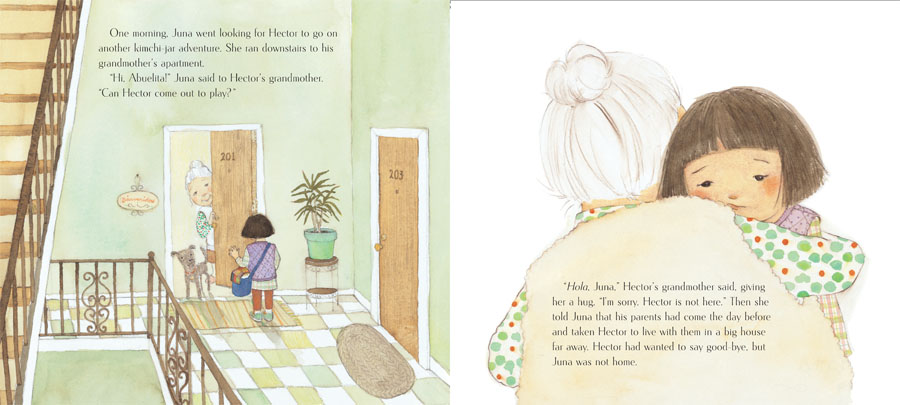
Little Juna loves adventuring with her friend Hector. Armed with an empty kimchi jar, the two friends would explore their neighborhood collecting bugs and rocks, much like any kid their age.

One day, Hector moves away, abruptly, without a chance to say goodbye. How Juna deals with it forms the rest of the book, told in a whimsical, fantasy-style presentation that comes across as Juna's reality.

From Lee & Low Books website


Seeing Juna's sadness and her empty kimchi jar, her brother gets her a fish to cheer her up. Juna watches it swim in circles in her jar. And then, in the same breath, we are whisked away with:

Juna watched the fish swim in circles in her jar.
That night when everyone was asleep, Juna put on a diving mask and fins and dove into the water.
Juna’s fish took her everywhere. They swam with sea turtles, played with dolphins, and discovered a giant clam.
“Can you help me find my friend Hector?” Juna asked her fish.

Kids may not quite catch the subtlety woven in via Juna's nightly adventures. At some level, kids may understand it is Juna's imagination, but they might also be confused by the magical realism woven in, mistakenly assuming that Juna actually gets to go underwater and search for Hector, or that she is dreaming about it all.

Leveraging the power of threes, Juna gets a fish first, then a bean plant, and then a cricket. Each time, she is out on a nightly adventure with these, and at the end of her adventure the things outgrow the jar (or, Juna outgrows them), predictably, as Juna eventually makes peace with Hector's absence.

In the end, she takes her empty jar to the park, not knowing what to put in it, when she comes across another girl looking for a jar to put her inchworm in.

The dreamy watercolors in greens and yellows add a freshness and capture the mood well.

Asian American (and Hispanic, partly) elements are woven in subtly in this book, which brings a familiarity to Asian American kids; at the same time does not isolate the cultural identity of Asians thereby excluding kids of various heritages besides Asian to enjoy this story. If we replace Juna and Hector with a non-Asian Ana and non-Hispanic Victor, and replace the kimchi jar with a typical Mason® jar, the story will still hold together, and we won't know anything about their cultures or their lives, other than the universality of friendship and imagination.

The fact that kids' books still are not diverse enough and come across as predominantly white makes books like these all the more needed. Kids will pick up books with which they can identify better.

Being of mixed heritage, the resident nine and seven year olds have been exposed to just about every multicultural book I can get my hands on, right from their toddlerhood. To be honest, however, they were quite ambiguous about this book, reluctant to finish the first read, let alone ask for repeat reads. The seven year old was confounded by the lack of logic and the monotonous repetition of the pattern of Juna's nightly forays with no surprises or satisfying resolution of Juna's friendship with Hector.

And that is okay - some stories/situations do not have a tied-up-in-a-neat-bow type of resolution. The book is about how Juna fills the lacuna left by Hector's disappearance, leveraging her power of imagination.

However, the kid was trying to convince himself that it is her dream, and in her dream she sees Hector; but then that leaves the issue of the fish outgrowing the jar the very next day. If the time frame had been left ambiguous, it might have been easier to extrapolate that over time Juna makes peace with the situation and moves on.

Winner of Lee & Low's New Voices award, Juna's Jar presents a young Asian American protagonist who cares about nature, values friendship, and is not easily devastated by life's setbacks - she uses her imagination to come to terms with reality.

[image source: Lee & Low books]

[Disclosure: The review copy was kindly sent by the publisher, Lee & Low, but the decision to share this review and the opinions expressed here are entirely my own.]

Labels: , , , , ,

Thursday, February 19, 2015

Patua Pinocchio

Patua Pinocchio  
Patua Pinocchio book review Saffron Tree
by Carlo Collodi
illustrated by Swarna Chitrakar
publisher: Tara Books


By now, The Adventures of Pinocchio by Carlo Collodi has become a household tale that manages to amuse and captivate the young readers. The story has been translated into many languages, endearing the wooden marionette to readers the around the world. His yearning to become a human boy and his adventures along the way is both absurd and heart-tugging.

Well known for their stylized books that showcase indigenous art forms and local artists, Tara Books has taken this classic story, abridged from Carol Della Chiesa's translations from the Italian original, and paired it with Swarna Chitrakar's Patua Scroll Painting of Bengal to present a uniquely amalgamated book that opens with this short and crisp introduction:

How it happened that
Mastro Cherry, the carpenter
Found a piece of wood
That wept and laughed
Like a child!
He gives it to his friend
Geppetto, who fashions a
Marionette and calls it
Pinocchio.


An engaging telling in just about 180 pages, the story pops out and grabs the reader via starkly stylized original illustrations.

Patua Pinocchio book review Saffron Tree
Image Source: Tara Books


For readers used to the Westernized image of Pinocchio in rompers and a hat, it can be a jolt to see this new take on the puppet who wanted it all.

In loincloth and delicate jewelry, with dark-hued (wood-like?) complexion, Patua Pinocchio certainly challenges the readers to take the leap and test if the story is truly universal in its appeal.

The bold lines and rich earthen colors in plain white background adds a deceptive simplicity to the presentation while showcasing the strengths of this traditional art form practiced by the community of Chitrakars centered around Naya in West Bengal.

One of the perks for Indian readers is the parallel between Pinocchio's antics and that of Lord Krishna as a young mischievous cowherd. The idea that children are innately bestowed with godliness that they lose gradually as they grow up is pulled into this tale to present a vibrant interpretation of an ageless story.

The ideas for exploring Patua Pinicchio at Tara Books' site alludes to the fact that a fable that is considered a classic is open to multiple interpretations, one of which is presented in this book.

"Re-Drawing A Classic" section at the back explains how this book emerged from a workshop with artists from the Patua tradition of painting.

[Read an excerpt at DNA]

[Look Inside the book at Tara]

[Disclosure: This book was sent to me by the publisher. The decision to review it, and share my opinions here, is entirely my own.]


Labels: , , , , , , , ,

Sunday, August 24, 2014

Plant a Pocket of Prairie

Plant a Pocket of Prairie
by Phyllis Root
illustrated by Betsy Bowen


I was chuckling heartily along with my daughter when I read the first book I came across written by Phyllis Root, "Looking for a Moose", when my daughter was just about two-ish.

And now, Plant a Pocket of Prairie gave me another way to connect with my now nine year old daughter and inspire her to preserve what's left of our natural environment.

What is a prairie? Most of us know it as the open grasslands of the Mississippi river valley where flora and fauna of all sorts thrive and form a tight eco-system that has been sustaining itself for years. Not many of us may know that it has been dwindling steadily over the past few years.

Once prairie stretched thousands of miles... starts the book, describing the lush meadows that was home to prairie chickens and five-lined skinks among other animals and plants; and then, moving on to state that it is Almost gone now to farm and town and city, even before we knew all the things a prairie could do.

As I read the first two or three pages of the book to my kids, I noticed their squirms and wriggles of initial resistance for the subject matter. By the fourth page, they sat up and exclaimed, "I get it! We are adding on more plants and more animals are coming too!"

The book has a gentle message about bringing the prairie to life even in urban and suburban areas via careful planting and tending. Start planting "in your backyard / or boulevard / or boxes on a balcony" the book suggests in a practical way, because even small pockets of native plants can replicate the wider, larger habitat.
Plant foxglove beardtongue
A ruby-throated hummingbird
 might hover and sip and thrum.
While exotic names like foxglove beardtongue, Joe Pye weed,  and hairy mountain mint certainly kept us smiling, this is not a gardening book per se. It is rather a fanciful flight into what might be if we took a small step towards restoring the environment for the creatures whose territories we have usurped over time. From the small critters, all the way to bison will be back if they have a place to come back to.

The woodblock illustrations are beautiful, giving a back-to-nature sort of unspoiled feel as if we were in a meadow.

Back of the book has a map showing the extent of native prairie from 1847-1908, as well as the tiny blotches of its much-diminished spread as of 1987-2011. How to Plant a Pocket of Prairie section suggests various ways to explore and understand the prairie. Sometimes called "upside down forests" due to the deep roots of many prairie plants, there is more biomass underground than above ground in prairies. There is also a section devoted to the animals and plants of the prairie with brief notes about each.

While it is heartening to read the verses suggesting that planting purple coneflowers will bring Dakota skippers and swallowtails, it doesn't happen overnight. We have a few white butterflies gracing our garden (thankfully we don't have any cabbage family plants in the garden this year) and the kids know first-hand the joy it brings to them.

And, when the kids stop at our purple coneflowers in our small yard hoping to catch a glimpse of a butterfly or a bee, I am glad this book has in some small way inspired them to carry the message forward.

[Disclosure: I received a review copy of this book. But the opinions expressed here and the decision to share it here are my own.]

[image source: University of Minnesota Press]

Labels: , , , , ,

Thursday, May 15, 2014

Summoning the Phoenix

Summoning the Phoenix: Poems and Prose About Chinese Musical Instruments 
By Emily Jiang
Illustrated by April Chu


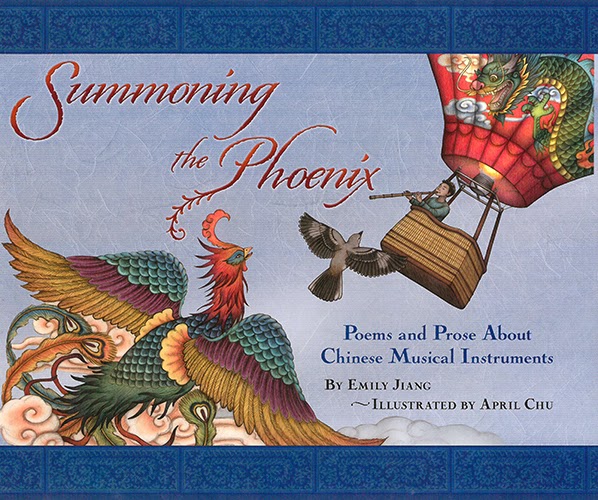
Twelve children assemble, one by one, with their musical instruments, to perform on stage. Thirteen poems capture the mood via upbeat free verses that let us peek into each of the performer's preparations and rehearsals, set in imagined and real landscape.

The illustrations are breathtaking, with nuances tucked in that speak to the talent of Ms.Chu. The title page shows a concert hall lobby full of expectant audience looking through the program sheets and clustering in small groups, waiting for the doors to open. That sets the stage.

From Ehru to Paigu, the poems show the children talking about their instrument in a loving way, with notes on the side to help us learn about these ancient musical instruments, including the percussion instruments at the end.

Ruan (roo-an) is the younger child's favorite, dubbed Chinese banjo by the kid; whereas Xiao (shao) is easily the older child's favorite thanks to the legend about its magical powers of summoning the phoenix. The illustrations for the Xiao poem is magical.

The poem for Guzheng (goo-zeng), a large stringed instrument, evokes an idyllic natural setting of mountains and waterfalls; and the illustration for it is out of this world.

While the instruments are all traditionally Chinese, the modern-day children playing these instruments are depicted with varying ethnicities and ages, adding to the multicultural richness of the reading experience.

Reading Emily Jiang's Favorite Bit of the book gives that much-coveted backstage pass access to the coming together of two brilliant minds, albeit independently, to create this thing of beauty.

This post written for Saffron Tree's Children's Book Week celebration.


[Disclosure: Although I received this book as a free review copy, the decision to share it and the views expressed here are entirely my own.]

[image source: Lee & Low Books]

Labels: , , , , , ,

Sunday, January 12, 2014

The Flute

The Flute
by Rachna Gilmore
illustrations by Pulak Biswas


"Long ago and far away," we enter a village that has a gushing river, on the banks of which our baby girl, Chandra, is born. For a brief childhood spell, she basks in the music of her mother's flute, growing up without a care in the world.

Then her world is turned upside down all of a sudden. A flood sweeps away both her parents, who push her up to safety, handing her the flute, before they pass away. Reluctantly taken in by her aunt and uncle who treat her harshly with nary a kind word, piling brutal workload on her to "earn her keep," Chandra carries on, deriving solace from playing her mother's flute when she can manage it, away from her disapproving uncle and aunt.

But then, much like the twists and turns of fate in fairy tales, her uncle and aunt pluck the flute from her in a fit of anger and toss it into the river. But, Chandra carries on with the chores, bearing the abuses with quiet resignation, through the bitter winter and the searing summer, starving, yet surviving.

And then, one day, as she sits by the river bank, hunger gnawing, she hears a hopeful, almost cheerful music, just like her mother used to make. And out of the river appears a plantain leaf laden with simple yet sumptuous meal. Day after day, she is fed by the mysterious provider. Until her uncle and aunt find out and accuse her of unimaginable things.

Finally, when the monsoon arrives after a long parched summer, it was a relief at first. But then, it rains and rains causing the river to rise. In an abominable act of cruelty, her aunt and uncle push Chandra down as they go higher up to safety, letting her get washed away in the flood.

Read More at Saffron Tree

Labels: , , ,

Tuesday, January 07, 2014

The Adventures of Odysseus

The Adventures of Odysseus
Retold By: Daniel Morden, Hugh Lupton
Illustrated By: Christina Balit


Mythology is a fascinating subject. While I've been partial to Indian, Norse, Scottish, Welsh, and Greek mythologies, possibly because they are well documented and easy to access, I do enjoy glimpses of African, Australian and SE Asian mythologies.

For a while, the older child was obsessed with Greek and Norse mythologies. That's when we read The Adventures of Odysseus, a Barefoot Book. And like all of their books, this is a winner.

barefoot books odysseus

Having encountered Christina Balit in Atlantis for the first time, both the child and I were thrilled to see her illustrations for this book. This is a chapter book for older readers, possibly 8+, with quite mature presentation. The text flows well but is not exactly kid-friendly, and the story itself obviously has traumatic aspects.

The Prologue sets up the background for the adventure. The island of Ithaca is missing their king, Odysseus, for nine years now, when the book starts. And continues for 14 chapters, ending with the Epilogue. We enjoyed the book in small doses, as I read aloud to the 8 yo, one chapter at a time, often less.

The art work is amazing, to say the least. In fact, Zoo In The Sky and Once Upon A Starry Night grace our bookshelves simply because we can't get enough of Ms.Balit's illustrations.

[image source: barefoot books]

Disclosure: While we  received a review copy of the book, the decision to share the book here is my own.

Labels: , , , , , ,

Wednesday, November 13, 2013

Book: Totally Awesome Rubber Band Jewelry


When I saw my daughter sorting through our assorted rubber band collection in the kitchen one evening, carefully picking out the smallest ones of uniform size, I knew she had a crafty plan. And then, when she intently sat intertwining them together by hand with practised ease that night, as I read to her in bed, I knew something was in the making. And finally, when she used a brightly colored small paper clip to join the ends of this long linked rubber bands and handed it to me with a "For you, Mama!" I beamed as I tried on my new bracelet.

Rainbow Loom™, Cra-Z-Loom™, FunLoom™ fever has been running high for a while among kids all over the country. My daughter and her school friends have been exchanging handmade rubber band bracelets over the last couple of months, no loom in sight. Of late, a bunch of brightly colored rubber bands seems to be turning up as a fantastic goody-bag filler for kids' birthday party favors.

When I received a review copy of Totally Awesome Rubber Band Jewelry, I had to check it out for myself and share it here.


The book features instructions and ideas and tips and tricks to keep an enthusiast occupied for hours. From simple basic pattern to more intricate ones like starburst, fishtail, and zipper patterns, the book shows pictures with step-by-step instructions, as well as a finished product. Almost all instructions involve using the loom and the hook that is part of the kit. My favorites were ear-rings, flower-charms, and hippie belts.

As always, this book can be a stepping stone or an inspiration for creating one's own patterns and products. No single book can provide all possible things one can create with this material. Only a handful of items are clearly shown for making from start to finish, the rest being more for understanding the patterns and extrapolating and experimenting for fun.


Labels: ,

Friday, August 16, 2013

How Far Do You Love Me

How Far Do You Love Me
by Lulu Delacre


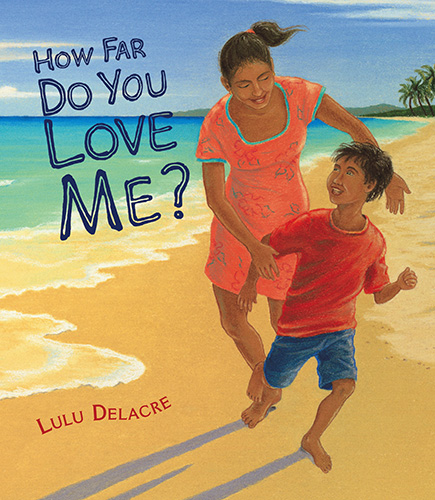
Stemming from a game the author used to play with her daughters, the book takes us on a journey around the world answering the question, "How far do you love me?"

From glaciers of Antarctica to the Grand Canyon, Kangaroo Reef Australia to the Machu Picchu, the lavender fields of Provence to Mekong river in Vietnam, Ladakh in India to Sinai Peninsula we are treated to breath-taking visuals of the beauty of the world around us, and even beyond our planet, while answering the question in the title.

Books by author-illustrators have that perfect connection between visuals and text. The double-page spread of soft pastels of the grand places on earth combined with simple text makes this a wonderful bedtime read. 

Each spread shows an adult and child, presumably parent/child, in the various places, affirming the reader that children all over the world are loved and cared for.

Read More at Saffron Tree

Labels: , , ,

Tuesday, January 01, 2013

Book Review Policy for this blog

Children's (and Adult) Books Review Policy for this blog


It is no secret that I love books, especially children's picture books.

What started as a simple way of keeping track of the books that my kids enjoyed has now become a channel for me to champion for the books that inspire and influence me, not just as a parent, but as a writer as well. In that sense, my book posts are not "reviews" per se, but more of a cheer-leading effort to spread the word about some gems out there that I happen to come across.

I typically write only about books that resonated with me. If a book did not engage me in any positive way, I do not write about it. After all, with limited time at my disposal, I'd rather write about something inspiring than something negative.

I am open to receiving review copies of books for sharing here on my blog.

The themes I lean towards in picture books include (but not restricted to):
  • cultural diversity 
  • wildlife and nonfiction books about animals of all sorts
  • environment, eco-consciousness
  • poetry
  • biographies
  • folktales and traditional literature

The themes I lean towards in middle grade books include (but not restricted to): 

  • realistic fiction
  • adventure / fantasy
  • humor
  • graphic novels
  •  The themes I lean towards in adult books include (but not restricted to): 

  • fiction murder mysteries: crime / detective / thriller
  • nonfiction: memoirs / popular science / writing craft 

    While I would love to offer a review post for every review copy receive, it is not always the case. I do want to affirm that if a book affected us in any positive way, I'd be happy to write about it here.  


    I accept digital and print ARCs and review copies of picture books, chapter books, middle grade, and YA. 

    Please contact me for details.

    I do not participate in advertising or product endorsement or commercial ventures. I write simply because it gives me great pleasure to share a book that was well-received by us at home, in the hope that readers of this blog might find it useful as well.


    Labels: , ,

    Monday, May 02, 2011

    The Greedy Sparrow: An Armenian Tale

    greedy sparrow armenian folktale lucine kasbarian maria zaikinaThe Greedy Sparrow: An Armenian Tale

    retold by Lucine Kasbarian
    illustrated by Maria Zaikina


    Ages 4-8

    Marshall Cavendish Children, April 2011

    Folktales and fables from around the world have striking similarities in that they convey universal truth and wisdom, typically via animal protagonists, generously laced with humor. And yet, they differ in the presentation, drawing from cultural traditions of the people orally handing down these tales.

    One of the Armenian folktales passed down through generations in the author's family orally is The Greedy Sparrow. The book dedication reads, To my forbears, great-grandmother, and father, all of whom preserved the sparrow fable through the ages. The great-grandmother mentioned is a celebrated storyteller from the Old Country.

    I was delighted to get in touch with author/journalist Lucine Kasbarian a few weeks ago. As her website notes, the author is passionate about her ethnic Armenian heritage and enthusiastically shares it with the world.

    The Greedy Sparrow is the first time English retelling of this tale in the children's picture book format. It starts with Once there was and was not a sparrow, which suggests that the tale may be real or imagined, we may never know.

    A sparrow gets a thorn in his foot. He flies around and finds a kindly baker who removes the thorn and tosses it into her oven. The wily sparrow, instead of thanking her and moving on, comes back a while later and demands that he get his thorn back. Needless to say, the baker cannot give it back. Either you give me my thorn or you give me some bread demands the sparrow. And the baker has no choice but to give some bread.

    The sparrow is not content. He goes about tricking and bartering item after item, including a new bride in the bargain, until he meets a minstrel with a lute. When the confounded minstrel has no choice but to hand over his lute, the sparrow seems contented. He starts singing the story, In place of a thorn, I got a bread. In place of a bread, I got a sheep... and so on till, ...I got a lute. And now I am a minstrel!

    In all the gloating, he loses footing and ends up with a broken lute and a thorn in his foot. Back at Square One.

    Trickery is not rewarded, especially when it takes advantage of the good nature of people who willingly help others. That message got cleverly (and clearly) conveyed to my six year old who pored over the illustrations with fascination, while reading the simple narration. She particularly like the speech bubbles, with red text reserved for the sparrow, which automatically made her change her voice and accent as she read aloud the sparrow's part in the narration.

    Illustrator Maria Zaikina was approached to illustrate The Greedy Sparrow when the author and publisher viewed her Armenian folk animations on YouTube: http://www.youtube.com/watch?v=QJ5NAXT9pLs

    The bold, vibrant folk-style illustrations complemented the story well, transporting us to a time and place that evokes nothing but simple unadulterated joy, and possibly nostalgia for a bygone era.

    Ms.Zaikina's illustrations reminded me of my childhood favorite Ladushki, Ladushki - Russian Folk Rhymes and Tales For Little Ones illustrated by Yuri Vasnetsov and retold in English by Irina Zheleznova, a book vibrant with color and imagination, which to this day stirs warm memories when I share it with my children.

    References to places in Armenia, the map and activities on author's website and the traditional attire shown in the illustrations gave us a jump start to explore the geography and culture further.

    Here is an interview with the author, conducted by Tom Vartabedian, at Asbarez.com.

    [Disclosure: I received a copy of this book from the author.]

    [image source: Lucine Kasbarian's website]

    [This post written for Saffron Tree]

    Labels: , , , , , ,

    ‹Older