Sunday, June 26, 2016

It Ain't So Awful, Falafel

It Ain't So Awful, Falafel

by Firoozeh Dumas

Publisher: Clarion Books (May 3, 2016)

I have been trying to stick this book under the noses of whoever will tolerate such liberties, urging them to read it, just so they can derive the immense satisfaction that I did from a book so superbly written that it makes me hope that world peace is easily achievable if only all books were like this.

Of course, I do that a lot with every well-written book, be it Middle Grade, YA, or Adult, fiction or non-fiction, that has come my way.

Yes, this is a Middle Grade fiction, not a heavy literary tome by a Pulitzer winner.

I first got introduced to Firoozeh Dumas's writing through her memoir-of-sorts, Funny in Farsi. Being an Iranian American who lived through the Iran Hostage Crisis as a youngster, Firoozeh is both wise and pragmatic, always ready to state what she feels is right with just the right touch of humor that takes away the edge and makes you ponder on the realities of the situation. Her writing is honest and brilliant -- she spins poignant moments into funny yarns that are moving, heart-warming, vivid, and masterly, all at the same time.

Zomorod Yousoufzadeh is looking forward to starting middle school right after this summer break. Although born in Iran, she has been in the US for a few years now because her father's job brought them to America and has kept them here. The story starts with her family moving from Compton, CA to Newport Beach, CA.

As we enter the story, Zomorod starts calling herself Cindy, after the littlest Brady Bunch kid that everyone loves. Why?

“It’s not like I’m trying to pretend that I’m not Iranian. I just want people to ask questions about me when we meet, not about where I’m from.”

Obviously, "Zomorod" is not an easy name to pronounce, and is way too weird-sounding, plus she simply wants to fit in and belong here. "Hi, I'm Cindy" shifts the focus from her nationality to herself as an individual, compared to "Hi, I'm Zomorod."

Cindy's dad, an engineer, was sent to the US to collaborate on building oil refineries. He has studied in the US before and speaks English just fine (but for the accent) and is looking forward to doing the best he can in both his professional and personal life, and loves to speak eloquently about Iran and oil refineries with whoever is (un)lucky enough to start a conversation with him. 

Her mother on the other hand speaks barely any English (except hello and thank you) and feels isolated as a result, but still refuses to learn English and prefers having Zomorod as her translator. What's Cindy to do? Except to tell us readers that she loves her parents very much but that she'd rather keep them hidden till she feels that they are no longer embarrassing to her. Typical tween!

The book hinges on Cindy/Zomorod. She  carries the book on her young shoulders with panache. She relies on her inherent sense of humor to tackle life's weird encounters when nothing else would work. With a steadfast fellow bookworm, Carolyn, for a friend, Cindy manages to balance her parents' expectations with her own need to belong, while navigating the student life at Lincoln Junior High, and discovering Girl Scouts, Halloween, and Taco Nights at Carolyn's.

Pivoting around the Iran Hostage Crisis, Firoozeh shows us the dark side of our own weaknesses and fears that prevents us from standing up for what we know is right -- how our perception gets easily clouded by collective hysteria. With her sharp insight into human nature and her firm belief that people around the world are not that much different from each other, Firoozeh, through Zomorod's dad, assures us that, "...people like that are not truly horrible; they just need a geography class, a passport, and a few foreign friends."

The little nuggets about hospitality culture and the universal language of food can easily be applied to Indians just as well as it applies to the Iranians in this story. In fact, some of the characters in the book could just as well be from India, they'd slide right into their roles just as easily. Which attests to the fact that human beings everywhere are not all that different from each other once we take away the language and the food and the geographical borders -- humans seek the same thing: a sense of community, safety, security, and to live their lives as best as they can.

This splendid story mingles family, politics, and immigrant experience, with friendship, self-identity, and coming-of-age angst while addressing paranoia, xenophobia, and intolerance with wry wit and gentle humor.

I can easily see this book becoming required reading for all fifth graders so they can peek into the cultural nuances from an immigrant child's perspective, even if the story is set in the 1970s and 80s. When the resident 11 year old avid reader started chortling at every other page, saying, "Mama, listen to this:..." and proceeded to read passages from the book back to me, I knew I could ask for nothing more from a book.

Speaking from personal experience, I see Zomorod's self-identity as dual, such is the nature of immigrant children -- they manage to extract the best of both worlds and come out a better version of themselves in the end, holding on to what centers them from their own heritage while being open to new experiences and putting out new roots that will anchor them in their current domicile.

[image source: HMH Books]

Labels: , , , , ,

Sunday, March 27, 2016

Sona and the Wedding Game

Sona and the Wedding Game,
My Dadima Wears a Sari,
Monsoon Afternoon
by Kashmira Sheth
illustrated by Yoshiko Jaeggi
Tiger in my Soup
by Kashmira Sheth
illustrated by Jeffrey Ebbeler


Being a big fan of stories with strong multicultural backdrop, when I came upon a handful of picture books by Kashmira Sheth, I ended up reading them back to back to my kids. Illustrations by Yoshiko Jaeggi effortlessly capture the magic of Indian culture.

Sona and the Wedding Game was a favorite as it gave a glimpse into an Indian wedding tradition practised in certain communities, (not all over India) -- the bride's sister must steal the groom's shoe at the wedding. There are several traditions, some more solemn, some more fun, practised by different communities across India, adapted to their own local customs. Sona is unfamiliar with this tradition and doesn't know how to go about it, but what are annoying cousins for, right?

Monsoon Afternoon captures the joys of monsoon season and the intergenerational bonding in a subdued way, while not being cliched.

My Dadima Wears a Sari is quintessentially Indian in that it talks about the beautiful attire that is just 6 yards of fabric, the sari. It can become an umbrella, it can become a pouch for collecting seashells, it can bandage up an injured knee... Having grown up with sari all around me, I have a deep love for the traditional sari, which I must admit, I don't wear often. Again, an intergenerational bond is established in the book via traditional clothing - viz., Dadima's wedding sari, the one she brought with her when she came to America, and she shows her granddaughters how to wear it.

Full of imagination and lovely illustrations, Tiger in my Soup is about a boy wanting his older sister to read to him. She refuses of course, busy with her own book and earphones. But when she serves him a can of soup for lunch, the steam rises and assumes the shape of a... Tiger. Jumping out of the soup, the tiger prowls about, wild and unpredictable, so naturally the boy defends himself with kitchen utensils, while the soup sits there getting cold. The sister finally caves in and warms up the soup in the microwave, and reads the book to him. Satisfied, the boy (and the tiger) settle down for imaginary wanderings.

[image source: Yoshiko Jaeggi, Kashmira Sheth websites]

Labels: , , , , ,

Wednesday, December 30, 2015

7 Inspiring Picture Books

True life stories can be quite inspiring for the young. And stories set in parts of the world where life is so very different from theirs can be both educational and moving.

While many of these books are a few years old, the message remains relevant and meaningful for kids growing up in today's increasingly global world.


Four Feet, Two Sandals
by Karen Lynn Williams & Khadra Mohammed
illustrated by Doug Chayka

Relief workers bring in used clothing and shoes to a refugee camp. Everyone scrambles to get what they need. Ten-year-old Lina is thrilled to find a perfect sandal. However, she is a bit upset when she finds another girl holding the other matching sandal.

Soon Lina befriends the other girl, Feroza, and they decide to take turns to use the pair of sandals.

Warm colors and double page spreads bring the terrain closer to the readers, while the words portray the hope and courage and strength of the refugees around the world who live in constant uncertainty and fear.

Teacher's Guide

[image source: Author Karen Lynn Williams website]


Razia's Ray of Hope
One Gir's Dream of an Education
by Elizabeth Suneby
illustrated by Suana Verelst

Razia Jan, born in Afghanistan, moved to the US when she was a young woman. She worked as a tailor and raised her kid in a small town in MA. When Razia felt the need to connect people from her new home in America with people in Afghanistan, especially after Sept 11, 2001, she looked for ways to make a difference.

She finally left US and went back to Afghanistan where she felt she can make a difference by educating the girls there who are usually sidelined and subjugated. She started the Zabuli Center for Girls in the middle of seven villages that never had a girls' school before.

Gorgeous illustrations transport the reader to the culture and country, while the carefully chosen words explain the complicated nature of relationships and priorities for families in that part of the world. Glossary introduces us to Dari words.

[image source: Author Elizabeth Suneby website]


Malala Yousafzai
Warrior with Words
by Karen Leggett Abouraya
illustrated by L.C.Wheatley

Winner of Nobel Peace prize 2014, Malala is not an unknown figure today. Her belief that every child has a right to education has inspired many children and adults around the world including governments and policy-makers.

To think that a simple act of going to school can be dangerous in some parts of the world was rather unbelievable for my kids when we read this story. And that she would be shot in the head while riding a bus with other kids was even scarier.

The book is a kid-friendly story of her life so far and how she started the Malala Fund to give girls hope for a better life through education. Malala's courage and determination shines through the story.

[image source: amazon.com]


Emmanuel's Dream
The True Story of Emmanuel Ofosu Yeboah
by Laurie Ann Thompson
illustrated by Sean Qualls


In Ghana, West Africa, a baby boy was born:
Two bright eyes blinked in the light,
two tiny fists opened and closed,
but only one strong leg kicked.

Born with only one strong leg, Emmanuel Ofosu Yeboah did not let his disability define him. He cycled an incredible 400 miles across Ghana to spread his message: disability does not mean inability.

After his mom died, Emmanuel came up with a plan. He wrote to the Challenged Athletes Foundation in San Diego, CA, who sent him bike, plus helmet, shorts, socks, and gloves! He went door to door for further support and hired a taxi to follow him with water; he got a camera and had his friends make the video.

Through bustling Accra, over rolling hills, through rain forests and across wide muddy rivers he pedaled on for 10 days, wearing the colors of his country and a shirt printed with the words "The Pozo" or "the disabled person."

He didn't stop there, though. His continued efforts and activism inspired the Ghanian Parliament to pass the Persons with Disability Act which ensures equal rights for all the citizens, disabled or not.

[image source: Author Laurie Thompson website]


One Plastic Bag
Isatou Ceesay and the Recycling Women of the Gambia
by Miranda Paul
illustrated by Elizabeth Zunon

In Njau, Gambia, people simply started trashing the plastic bags, dropping them where they please and going about their way, not paying any heed to the environmental impact of their action. Bags accumulated in ugly heaps, catching water and breeding mosquitoes, strangling gardens and suffocating livestock.

Isatou Cessay could not sit by and watch this. She decided to do something about it. She collected these discarded plastic bags, recycled them into beautiful utilitarian purses. Soon other women joined in and she showed them how to make purses, which they then sold for a fair dalasi. Soon, she had made enough money to buy a goat for their family.

One day the rubbish will be gone and my home will be beautiful, thinks Isatou...

[image source: Author Miranda Paul website]


One Hen
How One Small Loan made a Big Difference
by Katie Smith Milway
illustrated by Eugenie Fernandes

When kids ask how can one little thing make any difference, this is the story that can inspire them about how a small help can make a huge difference in someone's life.

Set in Ghana, the story is about how Kojo, a microentrepreneur, takes the small loan of one hen and ends up building a poultry farm. Based on a real person, Kwabena Darko, who changed his community and is helping others do the same, this is a story as much about perseverance and determination as it is about generosity and resourcefulness.

Beatrice's Goat by Page McBrier and Lori Lohstoeter is a similar story where Beatrice receives a goat, Mugisa, as a present, much like Heifer  Project International has been doing. Milk from the goat helps the poor family of six hope for a better life. And eventually, it even allows Beatrice to go to school as she dreamed.

OneHen.org, a non-profit empowers children to become social entrepreneurs to make a difference in the world.

[image source: One Hen Inc.,]


The Red Bicycle
The Extraordinary Story of One Ordinary Bicycle
by Jude Isabella
illustrated by Simone Shin

Bicycle can be the best mode of transportation in many parts of the world where unpaved roads and rough terrain discourage motorized transportation between remote villages. Bringing crops and goods to market is made easier with just pedal power.

When Leo in North America outgrows his bike, he wants it to be something more than just a pile of metal tossed in a junkyard. When he talks to his bike shop owner, he learns of an organization that collects used but good bicycles, fixes them up and sends them across the world to those who cannot afford one or have access to one but certainly need one for local transportation.

Thus begins the journey of "Big Red", Leo's bicylce, which ends up with Alisetta in Burkina Faso where she puts it to good use hauling goods to the market and watching over her family's sorghum field. When Big Red's spokes break and Alisetta knows not what to do with it, along comes Boukary who can fix anything. Can he squeeze yet another use out of Big Red? Of course!

Boukary attaches a trailer to the bicycle and it becomes a makeshift ambulance with a stretcher and belt for keeping patients safe when transporting them to the nearest clinic. Haridata loads the medical bags, water, blanket on La Grand Rouge as she calls the bike, and rides ready in case she runs into someone needing medical aid.

Back of the book has information section titled, What You Can Do To Help.

[image source: Author Jude Isabella website]


Labels: , , , , , , ,

Friday, March 13, 2015

Juna's Jar

Juna's Jar

by Jane Bahk
illustrated by Felicia Hoshino


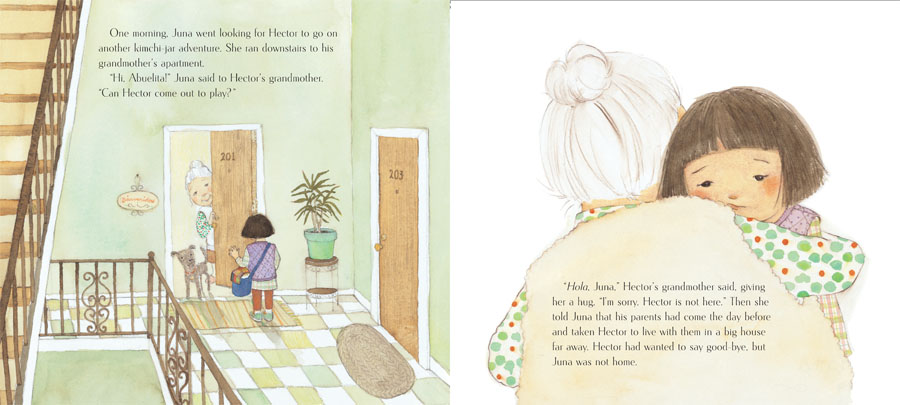
Little Juna loves adventuring with her friend Hector. Armed with an empty kimchi jar, the two friends would explore their neighborhood collecting bugs and rocks, much like any kid their age.

One day, Hector moves away, abruptly, without a chance to say goodbye. How Juna deals with it forms the rest of the book, told in a whimsical, fantasy-style presentation that comes across as Juna's reality.

From Lee & Low Books website


Seeing Juna's sadness and her empty kimchi jar, her brother gets her a fish to cheer her up. Juna watches it swim in circles in her jar. And then, in the same breath, we are whisked away with:

Juna watched the fish swim in circles in her jar.
That night when everyone was asleep, Juna put on a diving mask and fins and dove into the water.
Juna’s fish took her everywhere. They swam with sea turtles, played with dolphins, and discovered a giant clam.
“Can you help me find my friend Hector?” Juna asked her fish.

Kids may not quite catch the subtlety woven in via Juna's nightly adventures. At some level, kids may understand it is Juna's imagination, but they might also be confused by the magical realism woven in, mistakenly assuming that Juna actually gets to go underwater and search for Hector, or that she is dreaming about it all.

Leveraging the power of threes, Juna gets a fish first, then a bean plant, and then a cricket. Each time, she is out on a nightly adventure with these, and at the end of her adventure the things outgrow the jar (or, Juna outgrows them), predictably, as Juna eventually makes peace with Hector's absence.

In the end, she takes her empty jar to the park, not knowing what to put in it, when she comes across another girl looking for a jar to put her inchworm in.

The dreamy watercolors in greens and yellows add a freshness and capture the mood well.

Asian American (and Hispanic, partly) elements are woven in subtly in this book, which brings a familiarity to Asian American kids; at the same time does not isolate the cultural identity of Asians thereby excluding kids of various heritages besides Asian to enjoy this story. If we replace Juna and Hector with a non-Asian Ana and non-Hispanic Victor, and replace the kimchi jar with a typical Mason® jar, the story will still hold together, and we won't know anything about their cultures or their lives, other than the universality of friendship and imagination.

The fact that kids' books still are not diverse enough and come across as predominantly white makes books like these all the more needed. Kids will pick up books with which they can identify better.

Being of mixed heritage, the resident nine and seven year olds have been exposed to just about every multicultural book I can get my hands on, right from their toddlerhood. To be honest, however, they were quite ambiguous about this book, reluctant to finish the first read, let alone ask for repeat reads. The seven year old was confounded by the lack of logic and the monotonous repetition of the pattern of Juna's nightly forays with no surprises or satisfying resolution of Juna's friendship with Hector.

And that is okay - some stories/situations do not have a tied-up-in-a-neat-bow type of resolution. The book is about how Juna fills the lacuna left by Hector's disappearance, leveraging her power of imagination.

However, the kid was trying to convince himself that it is her dream, and in her dream she sees Hector; but then that leaves the issue of the fish outgrowing the jar the very next day. If the time frame had been left ambiguous, it might have been easier to extrapolate that over time Juna makes peace with the situation and moves on.

Winner of Lee & Low's New Voices award, Juna's Jar presents a young Asian American protagonist who cares about nature, values friendship, and is not easily devastated by life's setbacks - she uses her imagination to come to terms with reality.

[image source: Lee & Low books]

[Disclosure: The review copy was kindly sent by the publisher, Lee & Low, but the decision to share this review and the opinions expressed here are entirely my own.]

Labels: , , , , ,

Sunday, June 01, 2014

My Mom is a Foreigner, But not to Me

My Mom is a Foreigner, But not to Me
by Julianne Moore
illustrated by Meilo So


Some books are quite off-beat thanks to their uncommon subject. They speak to a potentially small group. Not just speak, but rouse this small audience. And, therein lies the appeal of such odd books. But, if not executed well, they tend to be muddled, not to mention patronizing and disagreeable.

The parts about Mom looking different; Mom reverting to a different language at times-- especially quoting sayings from another language and giving unfamiliar nicknames to the kids; Mom making them follow unusual customs that are from another land; Mom feeding them a wildly different array of foods on certain occasions; these easily resonated with my kids; while some other parts left them quite confused about this book.

The text is simple, like a 6/7 year old talking, so it works without offering anything overtly profound or deep, yet is kid-relatable. With under 500 words, the book presents the likes of mommies who came here with just a suitcase and have managed to unpack and throw away the suitcase only to drop anchor and grow roots. Talk about mixed messages!

Having said that, I must admit there were a few aspects of the book that could have been different to be more appealing and less jarring.

1. The inconsistencies for one: Is the book for this generation? In which case, moms coming on boat is rather odd unless one is talking about specific immigrants, legal or otherwise, from nearby foreign islands. Incidentally, "foreign" is itself not easily understood by kids, nor is it a word frequently used by kids to describe their parent of a different heritage/ethnicity. For a permanent-resident/citizen of a country, regardless of their ancestry, it is rather inappropriate to be addressed as "foreigner", especially when the person has chosen to assimilate into the new country and embrace its culture wholeheartedly, while holding on to the memories of their own origins and ancestry.

2. The illustrations for another: Is the book talking mainly about mixed heritage kids? Bi-cultural kids who are reluctantly accepting the self-professed less-preferred side of themselves, whichever that might be? The pictures were all over the place and did not clearly show a mom and a child looking very much alike thanks to their genes, and accepting who they were while celebrating their own origins.

3. And, varying fonts were used extensively: perhaps to suggest different languages/heritages but that wasn't easy to discern while reading aloud, or reading to oneself for an eight year old. For example,

We eat funny kinds of food sometimes
I love it.
It tastes gross.
My Grandma made it, she taught my mom.
I put it on my toast!

4. Trying to encircle all manners of mixed heritage families, the book leaves kids (and adults like me) befuddled. Is it about adopted kids of varying ethnicity? Is it about a first or second generation American kid, whose mom is a quirky mix of mainstream-American with hints of her childhood cultural identity? Is it about a new immigrant mom who does not speak English? For instance,

Sometimes it's hard work
teaching my mom stuff
But she's learning more each day
She'll be done when I'm grown up.

There are some things I don't tell her
because she already knows
Like how she would take care of me
From my head down to my toes.

These statements sound so presumptuous and condescending at the same time. How old is this kid whose voice we read here? What kind of "stuff" is the kid teaching the mom - language or propriety?

5. A lot of "weird" and "funny" and "strange" are thrown around in the book, which I found distasteful in the context in which it was used; plus, the term "foreigner" itself was slightly offensive. Is this to appeal to an Americanized child who has a Tradition-loving parent? The book starts out by talking about a mom who came here as a child, in which case, wouldn't she be quite well acclimatized by the time her child is born?

In trying to be all-encompassing, the book ends up being neither here nor there. And, for kids like mine who do not think their mom as any less than any other mom they encounter, this book seems to suggest otherwise, even if well-intentioned.

Despite my list of execution-related peeves, the concept is a good one. We ought to embrace the various ethnicity and heritage and look past the differences to see what ties us together, especially in this increasingly global village where each generation is actively blurring the geographical boundaries. No matter how they look or where they came from, Moms love their kids unconditionally. That message is universal.

[image source: multcolib.org]

Labels: , , ,

Thursday, May 15, 2014

Summoning the Phoenix

Summoning the Phoenix: Poems and Prose About Chinese Musical Instruments 
By Emily Jiang
Illustrated by April Chu


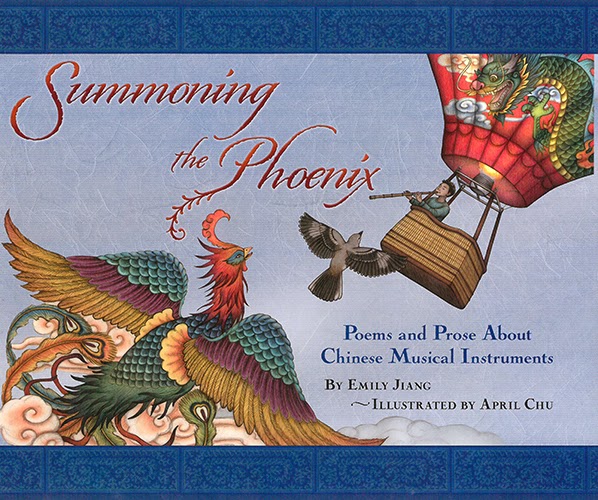
Twelve children assemble, one by one, with their musical instruments, to perform on stage. Thirteen poems capture the mood via upbeat free verses that let us peek into each of the performer's preparations and rehearsals, set in imagined and real landscape.

The illustrations are breathtaking, with nuances tucked in that speak to the talent of Ms.Chu. The title page shows a concert hall lobby full of expectant audience looking through the program sheets and clustering in small groups, waiting for the doors to open. That sets the stage.

From Ehru to Paigu, the poems show the children talking about their instrument in a loving way, with notes on the side to help us learn about these ancient musical instruments, including the percussion instruments at the end.

Ruan (roo-an) is the younger child's favorite, dubbed Chinese banjo by the kid; whereas Xiao (shao) is easily the older child's favorite thanks to the legend about its magical powers of summoning the phoenix. The illustrations for the Xiao poem is magical.

The poem for Guzheng (goo-zeng), a large stringed instrument, evokes an idyllic natural setting of mountains and waterfalls; and the illustration for it is out of this world.

While the instruments are all traditionally Chinese, the modern-day children playing these instruments are depicted with varying ethnicities and ages, adding to the multicultural richness of the reading experience.

Reading Emily Jiang's Favorite Bit of the book gives that much-coveted backstage pass access to the coming together of two brilliant minds, albeit independently, to create this thing of beauty.

This post written for Saffron Tree's Children's Book Week celebration.


[Disclosure: Although I received this book as a free review copy, the decision to share it and the views expressed here are entirely my own.]

[image source: Lee & Low Books]

Labels: , , , , , ,

Monday, May 30, 2011

The Cazuela That the Farm Maiden Stirred

The Cazuela That the Farm Maiden Stirred
by Samantha R. Vamos,
illustrated by Rafael Lopez

Ages 4-8

Published by Charlesbridge (Feb 2011)


Sometimes, there is an inexplicable cosmic coincidence that brings things together in our lives, be it as profound as meeting our spouses, or as simple as finding a beautifully illustrated children's book.

I was at the post office a while back and noticed the new set of stamps released recently. Now, going to the P.O. has become a rarity in today's life. And, while there, browsing and finding stamps I want to buy is a luxury. I used to collect stamps and appropriated my dad's ancient collection when I was young, but, between college and moving across continents, all that is lost. I must admit I have a weakness for stamps still, and manage to get most of the commemorative ones for hoarding collecting...

So, it does seem like a mysterious concatenation of circumstances that made me notice the Latin Music Legends set of stamps. While all the names of the legends there were familiar, I was struck by the fact that we had just read about Celia Cruz - book + CD from the library, called Celia Cruz, Queen of Salsa by Veronica Chambers.

But, most of all, Rafael Lopez, the designer of the stamps entered our little world and made it beautiful and bright.

And, that is how we came upon The Cazuela that the Farm Maiden Stirred, and got introduced to Samantha Vamos.

The bilingual book presents a cumulative story, much like This is the House that Jack Built, where we not only follow the progressive unfolding of events, but also learn a bit of Spanish. Each page introduces a new item in English, but on successive pages that item is referred to by the Spanish word, and it gets quite challenging (and fun) to keep up.

We start with the innocuous,
This is the pot that the farm maiden stirred.

Next, we read,
This is the butter that went into the cazuela that the farm maiden stirred..

Then,
This is the goat that churned the cream to make the mantequilla that went into the cazuela that the farm maiden stirred.

There is an underlying reason for everything that happens in this lively sequence: the making of Arroz con Leche, Rice Pudding.

The text flows easily, blending the two languages. The author shares, "As I incorporated Spanish words, the text flowed differently – the words sounded more intimate and tender. The English text with Spanish words woven in resonated because the bilingual manner of speaking reminded me of the way I had heard languages (in addition to English, my father fluently speaks four languages) expressed as a child."

Growing up with 3 different languages, besides English, and studying in English-medium school, I could identify with the author's note about having "bilingual on the brain" as shared in this article. To this day, I constantly "mix" Tamil, Hindi, Malayalam words into my thoughts and internal conversations as I primarily think in English.

The illustrations are breath-taking, vibrant and rather funny. From stark white background on the first 2 or 3 pages as we focus on the cazuela, mantaquilla and cabra, the images get rusty orange and colorful as the day progresses. The cabra with his toque, the gallina with her apron, the burro with his boots all add to the charm.

As artist Rafael Lopez shares in the post Stirring the Pot of Color, "For me color is an expression of my identity, my heritage and I believe it is the most direct route to the emotions of children and families who will turn the pages of my books". It is his bold colors, arresting images and textures that catch the eye, holding us ransom.

Little touches like the smiling sol looking in through the doorway, the gallina laying the eggs while grating the limon as the campesino tends to her... well, just about every single page is incredibly gorgeous, and complements the text well.

Back of the book has Arroz con Leche recipe and Glossary of Spanish Words.

[image source: author Samantha Vamos website]

Labels: , , , , ,

Thursday, May 12, 2011

Grandfather's Journey


Grandfather's Journey
by Allen Say

Caldecott Medal Book

Ages: 4-8

Houghton Mifflin Books for Children (October 25, 1993)


Allen Say reveals the intense and poignant feelings of longing an immigrant heart brooks with its consuming affinity for the birthplace as well as the adopted homeland.

Chronicling his grandfather's journey from Japan to America at the turn of the century, with breathtaking watercolor illustrations, Allen Say shares a beautiful dilemma in an elegant, compact, and moving way.

Clothed in Western attire, a young Japanese man boards a steamship and sails across the Pacific. When he embarks in America, he continues his journey to explore the new land, learning as much as he can, experiencing the awe-inspiring majesty with the thirst of an explorer. Of all the places he visited, he liked California the best and so settles there. For a while. Soon, the immigrant soul longs for the birthplace.

So he returns to Japan. He gets married, brings his new bride to San Francisco Bay that he calls home. They have a baby girl. But, the dormant longing for the childhood friends and places resurface. He grows restless till he can take it no longer. Then, he packs his family and heads back to his homeland. Once there, surrounded by his old friends and familiar childhood places, his heart seems to fill up with joy.

The baby girl is all grown up now and is married to the man she fell in love with, and soon, the author Allen Say is born. The author grows up with stories of California from his grandfather's journey. A war intervenes when grandfather plans a trip back to California, and somehow circumstances arrange themselves so that grandfather could never make that one last trip to the second home he loved so much.

When the author finally makes his journey to California as an adult, he understands his grandfather's emotions as he undergoes similar emotions himself.

The watercolor illustrations are photoreal, to borrow the only word that comes close to describing them. The faces rarely betray any emotion, mostly appearing sombre and tranquil. Each page has a large portrait with only a crisp sentence or two with carefully controlled words.

Significant events like marriage, new baby are presented incidentally, keeping the focus on this overarching ache for being in two places at once.

Being an immigrant myself, and of the view that geographical boundaries need not be divisive thus fostering exclusivity, I completely identified with, "The funny thing is, the moment I am in one country, I am homesick for the other". Home is where the heart is. And for some of us, the heart refuses to be contained within one arbitrary man-made geographical unit of land.

Tea with Milk is another book by this author that struck a distinct chord in me. Multicultural themes naturally have a special appeal for us at home. Raising bi-cultural children as an immigrant mother, it has been a struggle for me to balance the exposure to the culture I grew up with. While When in Rome be a Roman has been my philosophy, I also feel I owe it to my children to educate them on my side of their origin... but, that train of thought has to wait for another day to gain voice here in my little corner.

We had borrowed the copy that comes with an audio CD of the story. It was quite an experience to read the book a few times first, poring over the images, and then turning out the lights at bed time and listening to the subtly powerful words.

I doubt if my six year old got as much out of it as I did. It seems to me that many of the books that win the Caldecott medal seem to appeal more to the adult mind than the child.

[image source: Houghton Mifflin Books]

Labels: , , , , , ,

Saturday, October 30, 2010

A Calendar of Festivals

A Calendar of Festivals
retold by Cherry Gilchrist
illustrated by Helen Cann

Ages 9-12

Barefoot Books

Many communities around the world set aside special day(s) each year to commemorate a certain unique aspect of their cultural proclivity. Celebrated as a festival, these events not only stand to mark the cycle of our calendar, but also provide an opportunity to gather together with family and friends and rejoice, share a meal, and express our wonder and gratitude for life itself.

A Calendar of Festivals presents eight such festivals celebrated around the world, at different times of the year, starting with Purim in March to Russian New Year in December.

A one-page introduction of each festival presents the history, significance, and the traditional manner of celebration still observed today. The story behind the festival then unfolds, with bright and colorful illustrations.

For instance, the introduction to the Indian festival of Holi begins with, "Imagine being allowed to squirt all your friends with different colored paints!" Not having experienced this first-hand, my five-year old daughter found it exciting that children and adults are encouraged (and cheered) to indulge this way once a year, every year.

Celtic New Year fell on November 1st, known as Samhain. The day before was believed to be the time to scare away the ghosts and demons (symbolically our own fears and negativity perhaps?) by lighting bonfires. The book traces how this ancient Celtic festival came to be known as Halloween today.

From Vesak (enlightenment of the Buddha) to the Japanese festival of Tanabata, from the ancient Roman midwinter celebration now observed as Christmas to a relatively modern festival of Kwanzaa created by Dr.Maulana Karenga, the book manages to inform and entertain the young readers.

The book does touch upon the underlying deistic beliefs for each festival, drawing from mythology, folklore and biblical references. While the book doesn't intend to be a comprehensive list of popular festivals, or an exclusive subset of lesser-known festivals, there is a conspicuous absence of representation from certain cultures that would have made this book wholesome and well-rounded.

[image source: amazon.com]
[this post written especially for Saffron Tree's CROCUS 2010]

Labels: , , ,

Wednesday, October 06, 2010

One Green Apple


One Green Apple
by Eve Bunting
illustrated by Ted Lewin

Starting with the gentle themes as in Hurry Hurry, Flower Garden, through knotty feelings that make growing up difficult as in Little Bear's Little Boat, all the way up to complex layers of emotions addressed in books like Terrible Things (An Allegory of Holocaust), Train To Somewhere, Eve Bunting has become a much-admired and respected author in our house.

One Green Apple is about little girl Farah, uprooted from her country by circumstances beyond her control and re-planted in a new country, gingerly taking her first step in her path to confident integration as an immigrant.

The story narrates a short episode in Farah's life: her second day in the new school, going on a field trip to a local apple orchard with her class. Her apprehensions about seating during the ride (boys didn't sit next to girls in her country), or the dupatta she wears over her head as is the custom in her country/culture seem very real and understandable.

Some are friendly. But some look at me coldly and smile cruel smiles. I hear my country mentioned, not fondly.

However, Anna, who is sitting next to Farah during the ride, uses the universal ice-breaker: a smile and her own name by way of introduction. Pointing to herself in response, "Farah" she declares with a beautiful smile.

The teacher proceeds to instruct the children to pick one and only one apple to be taken into the shed for slicing, juicing and sharing, taking extra care to use exaggerated expression for Farah's sake.

Ms.Bunting conveys Farah's discomfort at this via her private thoughts, "I understand. It's not that I am stupid. It is just that I am lost in this new place"

While the other kids are busy picking out the reddest sweetest apple, Farah chooses one green apple from a lonely short tree.

When they all toss in their apples into the machine in the shed, the teacher is surprised at Farah's choice of one green apple, but lets it go. Farah lends a hand as the children work together to extract the juice from the machine.

I think I taste my special apple, Farah says to herself as she sips the fresh cider.

While some things are unfamiliar, Farah notes that the crunching noise of the dogs eating the fallen apples, the tickle of hay with its smell of dry sunshine, the loud belch that instigates laughter are the same as at home. Laughs, sneezes, belches and lots of things.

It is the words that sound strange. But soon I will know their words. I will blend with the others the way my green apple blended with the cider.

Ted Lewin's illustrations drench each page with the light and warmth of the sun, projecting hope and cheer. The penultimate page zooming in on Farah's face which sports a genuine smile hinting at self-assurance is priceless.

Neither preachy nor heart-wrenching, the narration flows gently revealing what it might feel like to be a Muslim immigrant attending school in the U.S.

The obvious questions Ana asked were, "Why did her family have to move?", "Why couldn't she learn English in her country?". While immigration is not easy for a five-year-old to understand, fortunately I did have a point of reference to talk about it: Ana has expressed interest in going to France, living there, and learning ballet. (Possibly triggered by some of the non-fiction book we read on ballet recently). When I reminded her that her ballet teacher will be speaking in French and so will most of her friends and she will need to learn the new language, Farah's predicament started making sense. The feeling of displacement and the comfort in feeling welcome in a new place were emotions she could relate to.

[Cross-posted at Saffron Tree]

Labels: , , ,

Monday, June 07, 2010

Blue Corn Grinding

Ana's School had a fantastic program last week, just for parents. Children worked hard and were quite thrilled to share their presentation with us. The three classes came up with a production each, in their own unique way.

One of the classes, with slightly older kids, managed to learn about Brainstorming, Storyboard, Characters, Costume-making and related aspects hands-on, which culminated in an original story being acted out for us in full splendor. Their teacher did a fantastic job, and it was clear the kids took pride and ownership in their presentation. It was a simple story set on the beach, with turtle, crab, whale, palm trees...

Another class taught us about The Water Cycle bringing to life the Rivers, Clouds, Sun and other entities, in their charming way. I was awe-struck at the children's enthusiasm and energy, which clearly reflected their teacher's.

Ana's class told us the tradition of Blue Corn Grinding by the Hopi Indian via a beautiful song with dramatic interludes. The farmers plant the blue corn, the sun blazes down, everything is dry; then come the rain showers making the corn plants grow green and tall; and finally the little ears of corn with their tassels waving above are ready to be harvested; the corn is then ground in a traditional mano and matate.

Much like the Ammikkal and Kuzhavi I grew up with, a matate (muh-taa-tay, as best as I can gather) is a large, usually flat, stone on which the corn/grains is placed. A mano is a smaller stone or rock which is rolled over the matate to break down the grains into a powder.

The Blue Corn Grinding Song evokes such wonderful feelings, it is hard to describe. And I admire her teacher for helping the students learn about the tradition, appreciate the song, and play the parts they felt comfortable with, to tell us the story.

The audio clip is not of the best quality. What with joy-filled parents murmuring their awe and restless little siblings calling out their names, the kids on stage probably felt overwhelmed. But here is a short clip anyway:


Ana was one of the 3 corn plants. Her role was to just lay down in prostrate position till swallows bring the rain clouds (played by Ana's spunky little friends), "Swallow tells glad news, bringing dark rain clouds"; then, slowly stand up tall as the plant grows when the song says "Green and tall the corn grows, green and tall the corn stands". Ana was in her own world, waving and dancing, pretending being a corn plant. And, her costume was terribly simple, as the idea was to hint at, rather than create a true likeness of a corn plant.

(Cropped and isolated Blue Corn Plant Ana)

As always, I was very impressed with Ana's teacher. She is a talented musician, a Montessori student taught by her Montessori mom, always enthusiastic about sharing the Montessori materials in her class with us. The Blue Corn Grinding Song is rare and precious and am so thrilled she brought it to us so beautifully that day with her children - especially since it has a special place in her heart as it was taught to her when she was little by her mother.


Labels: , , ,

‹Older