Fifteen Picture Books To Have Fun with Words
Native English speakers take it in their stride. The quirkiness of the language with as many exceptions to the rule as there are rules is nothing to worry about. It all falls in place, beautifully! So what's to fret about, right?
A non-English-speaker who is eager to master the Queen's language might find it completely confounding. What with idioms, phrases, homographs, homonyms, not to mention the hodge-podge of foreign words adopted liberally, learning English can be both challenging and fun.
Just for the fun of it, since we like reading themed books back to back from the library, we recently checked out some picture books that turned out to be a delight.
I. Rhyming Epithets:
A Huge Hog Is A Big Pig
 A Rhyming Word Game
by Francis McCall & Patricia Keeler
One of the favorite word games we play at home goes by a few popular names, one of which is Stinky Pinky. It is a game of answering the clue with a rhyming epithet - an adjective and a rhyming noun. For example, happy father is a glad dad; a clever cat is a witty kitty; an uncommon rabbit is a rare hare.
This book has 15 such Stinky Pinky clues with colorful photographs featuring children and the object in question.
I always wonder about the repeat-read value of such books - once we have read it, we know the answers and there is no incentive to read it again.
[ A version of this game available online]
II. Idioms & Phrases:

Raining Cats and Dogs
A Collection of Irresistible Idioms and Illustrations
by Will Moses
We've all heard of phrases which don't mean much when taken at face value, and may in fact be confusing and irrelevant to the situation. Idioms are a wonderful construct and discovering them as a youngster was a fun activity for me that I am now happy to pass on to my kids.
Monkey Business by Wallace Edwards was the kids' first introduction to idioms; the inimitable illustrations plus a little spot-the-ape type activity tucked into the pictures kept the kids engaged.
With folkart style illustrations that are literal and funny, Raining Cats & Dogs states the idiom, explains the meaning, and gives an example usage. For example, the illustration for "Feeling Blue" shows a man with a sad face with blue skin, and his pets are all blue as well; "Make a Beeline" shows a lovely country road with a line being drawn by a buzzing bee and a sign saying 'Buzz's Painting Company."
 In a Pickle: And Other Funny Idioms
by Marvin Terban
illustrated by Giulio Maestro
Much like Raining Cats & Dogs above, this book has silly illustrations to help remember the meaning of the idioms. The explanation is a bit more elaborate here.
III. Palindromes:

Go Hang a Salami! I'm a Lasagna Hog!
Palindromania!
by Jon Agee
A master at wordplay, Jon Agee specializes in the silly, funny, and clever use of the language, with delightfully amusing pictures to boot.
What's not to like about palindromes? The illustrations are quirky and playful in both these books. Some phrases may not be easy for the very young to understand, but, 8+ year olds might appreciate the humor and cleverness of it all.
IV. Oxymorons:

Who Ordered the Jumbo Shrimp?
by Jon Agee
The only picture book I found at my library that introduces this weird feature of our English language helped the kids think about such expressions they might have come across and not realized. "Pretty Ugly" is one that jumped to their minds right away. All in all, a fun book that amuses the adult reader as much as it amuses the kids.
V. Tongue Twisters:

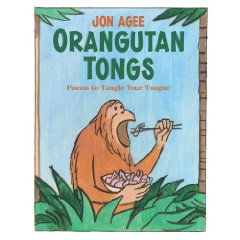
Orangutan Tongs
by Jon Agee
Shared here already, the book is quite fun to try out the tongue twisters.
 Oh Say Can you Say
Fox in Socks
by Theodore Seuss Geisel
Two classic books that take wordplay to the ultimate degree and deliver immense satisfaction and joy to read aloud to kids. Nothing more to say about these, except, if one has not read these by now, one must please do so immediately!
VI. Crazy Collective Nouns

A Shiver of Sharks:
A Compilation of Aquatic Collective Nouns
by PatrickGeorge
Collective nouns are bizarre sometimes, and it takes a while to get used to some of the zanier ones. This book collects aquatic animals. The stylized design of the illustrations makes the book a treat to behold. Also by PatrickGeorge are A Filth of Starlings, A Drove of Bullocks, A Crackle of Crickets
 Have You Ever Seen a Smack of Jellyfish?:
An Alphabet Book
by Sarah Asper-Smith
Alphabetically organized books are always engaging for young kids. This books presents collective nouns of various animals - the animals arranged alphabetically. From Army of Ants to a Zeal of Zebras, we learn the collective noun, with full page illustration that is child-friendly.
 A Zeal of Zebras:
An Alphabet of Collective Nouns
by Woop Studios
Much like the book above, this book goes one step further and presents the collective nouns in alphabetical order rather than the creatures arranged in alphabetical order as the book above does.
So we start with an Aurora of Polar Bears, a Bale of Turtles, and work our way up to a Zeal of Zebras. Of course, it is inevitable to not end with Zeal of Zebras as there aren't many 'Z' animals.
The illustrations are gorgeous, quite stunning.
VII. Homonyms & Homophones

The King Who Rained
by Fred Gwynne
Words that are spelled differently but sound the same and have different meanings can be confusing.
Although over a quarter century old, the book still has its appeal to this day. Fairy tails, king who rained... you get the idea.
The pictures show the literal image, making it completely giggle-worthy for the kids.
The Dove Dove: Funny Homograph Riddles
 by Marvin Terban
illustrated by Tom Huffman
Two words spelled the same way, but pronounced differently and have different meanings are quite a challenge for new readers.
The riddle format is presented as a sentence with boldface for the homographs. Example, Living animals dwell here. The answer is Live/live - Live animals, live here. Another example, The bird of peace plunged into the water. The dove dove into the water.
A bit challenging for the seven year old, but the nine year old had fun with most of the riddles in this book.
VIII. Similes
Crazy Like a Fox: A Simile Story
by Loreen Leedy

Rather than isolated listing of similes, incredibly talented writer, Loreen Leedy, presents an adventurous tale of Rufus fox who scares Babette the sheep by roaring like a lion; she then gets mad as a hornet... and so the story goes, with one simile after another adding spice to the story.
The figure of speech is explained, and kids are encouraged to come up with their own similes.
A non-English-speaker who is eager to master the Queen's language might find it completely confounding. What with idioms, phrases, homographs, homonyms, not to mention the hodge-podge of foreign words adopted liberally, learning English can be both challenging and fun.
Just for the fun of it, since we like reading themed books back to back from the library, we recently checked out some picture books that turned out to be a delight.
I. Rhyming Epithets:
A Huge Hog Is A Big Pig
A Rhyming Word Gameby Francis McCall & Patricia Keeler
One of the favorite word games we play at home goes by a few popular names, one of which is Stinky Pinky. It is a game of answering the clue with a rhyming epithet - an adjective and a rhyming noun. For example, happy father is a glad dad; a clever cat is a witty kitty; an uncommon rabbit is a rare hare.
This book has 15 such Stinky Pinky clues with colorful photographs featuring children and the object in question.
I always wonder about the repeat-read value of such books - once we have read it, we know the answers and there is no incentive to read it again.
[ A version of this game available online]
II. Idioms & Phrases:
Raining Cats and Dogs
A Collection of Irresistible Idioms and Illustrations
by Will Moses
We've all heard of phrases which don't mean much when taken at face value, and may in fact be confusing and irrelevant to the situation. Idioms are a wonderful construct and discovering them as a youngster was a fun activity for me that I am now happy to pass on to my kids.
Monkey Business by Wallace Edwards was the kids' first introduction to idioms; the inimitable illustrations plus a little spot-the-ape type activity tucked into the pictures kept the kids engaged.
With folkart style illustrations that are literal and funny, Raining Cats & Dogs states the idiom, explains the meaning, and gives an example usage. For example, the illustration for "Feeling Blue" shows a man with a sad face with blue skin, and his pets are all blue as well; "Make a Beeline" shows a lovely country road with a line being drawn by a buzzing bee and a sign saying 'Buzz's Painting Company."
In a Pickle: And Other Funny Idioms by Marvin Terban
illustrated by Giulio Maestro
Much like Raining Cats & Dogs above, this book has silly illustrations to help remember the meaning of the idioms. The explanation is a bit more elaborate here.
III. Palindromes:
Go Hang a Salami! I'm a Lasagna Hog!
Palindromania!
by Jon Agee
A master at wordplay, Jon Agee specializes in the silly, funny, and clever use of the language, with delightfully amusing pictures to boot.
What's not to like about palindromes? The illustrations are quirky and playful in both these books. Some phrases may not be easy for the very young to understand, but, 8+ year olds might appreciate the humor and cleverness of it all.
IV. Oxymorons:
Who Ordered the Jumbo Shrimp?
by Jon Agee
The only picture book I found at my library that introduces this weird feature of our English language helped the kids think about such expressions they might have come across and not realized. "Pretty Ugly" is one that jumped to their minds right away. All in all, a fun book that amuses the adult reader as much as it amuses the kids.
V. Tongue Twisters:
Orangutan Tongs
by Jon Agee
Shared here already, the book is quite fun to try out the tongue twisters.
Oh Say Can you SayFox in Socks
by Theodore Seuss Geisel
Two classic books that take wordplay to the ultimate degree and deliver immense satisfaction and joy to read aloud to kids. Nothing more to say about these, except, if one has not read these by now, one must please do so immediately!
VI. Crazy Collective Nouns
A Shiver of Sharks:
A Compilation of Aquatic Collective Nouns
by PatrickGeorge
Collective nouns are bizarre sometimes, and it takes a while to get used to some of the zanier ones. This book collects aquatic animals. The stylized design of the illustrations makes the book a treat to behold. Also by PatrickGeorge are A Filth of Starlings, A Drove of Bullocks, A Crackle of Crickets
Have You Ever Seen a Smack of Jellyfish?:An Alphabet Book
by Sarah Asper-Smith
Alphabetically organized books are always engaging for young kids. This books presents collective nouns of various animals - the animals arranged alphabetically. From Army of Ants to a Zeal of Zebras, we learn the collective noun, with full page illustration that is child-friendly.
A Zeal of Zebras:An Alphabet of Collective Nouns
by Woop Studios
Much like the book above, this book goes one step further and presents the collective nouns in alphabetical order rather than the creatures arranged in alphabetical order as the book above does.
So we start with an Aurora of Polar Bears, a Bale of Turtles, and work our way up to a Zeal of Zebras. Of course, it is inevitable to not end with Zeal of Zebras as there aren't many 'Z' animals.
The illustrations are gorgeous, quite stunning.
VII. Homonyms & Homophones
The King Who Rained
by Fred Gwynne
Words that are spelled differently but sound the same and have different meanings can be confusing.
Although over a quarter century old, the book still has its appeal to this day. Fairy tails, king who rained... you get the idea.
The pictures show the literal image, making it completely giggle-worthy for the kids.
The Dove Dove: Funny Homograph Riddles
by Marvin Terban illustrated by Tom Huffman
Two words spelled the same way, but pronounced differently and have different meanings are quite a challenge for new readers.
The riddle format is presented as a sentence with boldface for the homographs. Example, Living animals dwell here. The answer is Live/live - Live animals, live here. Another example, The bird of peace plunged into the water. The dove dove into the water.
A bit challenging for the seven year old, but the nine year old had fun with most of the riddles in this book.
VIII. Similes
Crazy Like a Fox: A Simile Story
by Loreen Leedy
Rather than isolated listing of similes, incredibly talented writer, Loreen Leedy, presents an adventurous tale of Rufus fox who scares Babette the sheep by roaring like a lion; she then gets mad as a hornet... and so the story goes, with one simile after another adding spice to the story.
The figure of speech is explained, and kids are encouraged to come up with their own similes.
Labels: ages 6-9, ages 9-12, all ages, fiction, picture book, wordplay
posted by Sheela
0 comments